Updated
Accounts payable reconciliation: your books versus the supplier's
Accounts payable reconciliation means comparing what you owe each supplier according to your books with what the supplier says you owe, usually from their statement of account, and explaining every difference. The open items on the creditor account should match the statement once timing is allowed for. What remains is either an error in your books, an error in theirs, or a dispute nobody has raised yet.
Most teams treat this as a month-end chore for a few large suppliers. It is more useful than that: the differences show exactly where the payables process leaks. Missing invoices, payments the supplier cannot apply and credit notes nobody booked are symptoms of the same problems that make the close slow, and the year-end balance confirmation puts them all on one page.
What is supplier statement reconciliation, and when do you need it?
A supplier statement lists every invoice, credit note and payment the supplier has recorded for you, with an open balance on a given date. Your side is the creditor account (Kreditorenkonto) for that supplier in the subledger, with its open items. The reconciliation puts the two lists side by side.
It is a different control from the ones next to it. The three-way match checks a single invoice against order and delivery before payment. Payment reconciliation checks that bank transactions are matched to the right items. The supplier statement is the only check that uses the supplier's own records as evidence, which is why it finds errors the other two cannot see, such as an invoice that never reached you.
You do not need to reconcile every supplier every month. A practical rule is to reconcile monthly for your largest suppliers by volume, for suppliers with frequent partial deliveries or credit notes, and for any account with a debit balance or items older than ninety days. The rest can wait for the year-end. Where payables fit among the other balance sheet accounts is covered in balance sheet reconciliation.
Why do your books and the supplier's disagree?
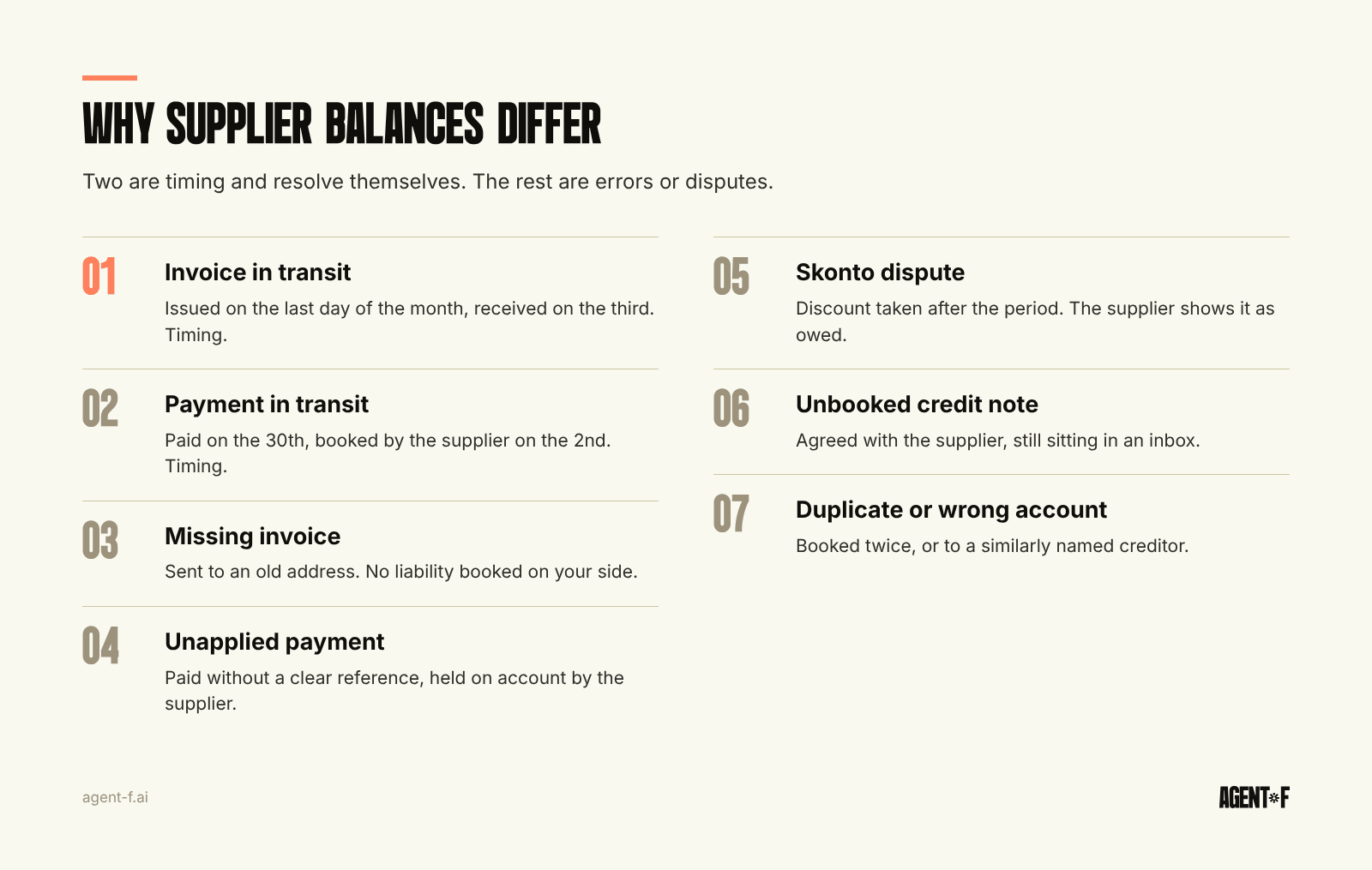
Differences fall into two groups. Timing differences resolve themselves. Errors do not.
Timing differences
- Invoices in transit. The supplier issued the invoice on the last day of the month, and it reached you on the third.
- Payments in transit. You paid on the 30th, and the supplier booked the receipt on the 2nd.
Errors and disputes
- Missing invoices. The supplier sent an invoice that never arrived, often to an old email address or a former employee. You have no liability booked, and they will send a reminder soon.
- Unapplied payments. You paid, but without a clear reference, so the supplier holds the money on account and still shows the invoice as open.
- Skonto disputes. You deducted an early payment discount (Skonto) after the discount period, and the supplier shows the difference as still owed.
- Unbooked credit notes. A credit note for a return or price correction sits in an inbox. We cover the booking rules in credit notes and invoice corrections.
- Duplicates and wrong accounts. An invoice booked twice, or to a sister company's creditor account with a similar name.
How do you reconcile a supplier statement step by step?
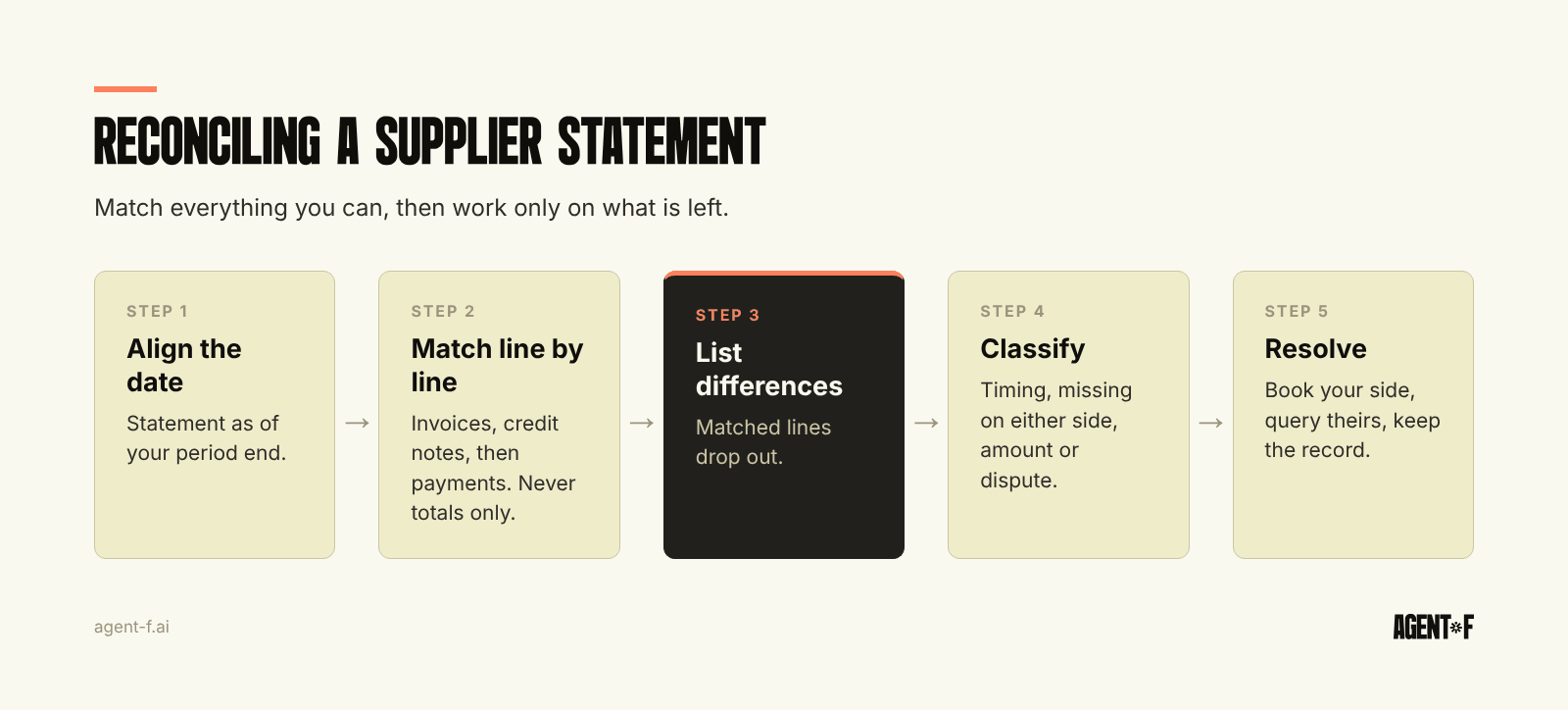
- Align the date. Ask for the statement as of your period end, not the date the supplier happens to send it. Otherwise every recent transaction becomes a false difference.
- Match line by line. Match invoices by invoice number and amount, then credit notes, then payments. Matching on totals alone hides offsetting errors.
- List only the differences. Everything matched drops out. What is left is the working list.
- Classify each difference. Timing, missing on your side, missing on their side, amount difference, or dispute. Note who owns the next step.
- Resolve and document. Book what is missing on your side, send the supplier a short list of what is missing on theirs, and keep the reconciliation with the period's records.
The last step matters more than it seems. A reconciliation that ends with "difference noted" and no owner will show the same difference next month, slightly larger.
What does a year-end balance confirmation (Saldenbestätigung) reveal?
At year-end, every company that keeps books under the German Commercial Code (HGB) must prepare an inventory of its assets and liabilities (§ 240 HGB). For payables this is a book inventory: the open items per creditor, reconciled to the ledger. German law does not require a written confirmation from each supplier, but many companies send balance confirmation requests (Saldenbestätigungen) to selected suppliers, and auditors of audited companies routinely use third-party confirmations as audit evidence.
The responses are a stress test of your payables hygiene. Four patterns appear again and again:
- Invoices you never received. Each one is a liability missing from your balance sheet, and a cost missing from the year. If the service was delivered before year-end, it belongs in the accounts, as an invoice booking or as an accrual.
- Old open items. Invoices open on your side for six months that the supplier shows as paid point to a payment booked against the wrong item.
- Debit balances. A creditor account where the supplier owes you money, from an overpayment or an unused credit note. That is a claim to collect, not a rounding issue.
- Unanswered requests. No response is a result too. It usually means the request went to the wrong contact, the same reason invoices go missing.
If your tax advisor (Steuerberater) prepares the annual accounts, they will ask for the reconciled open items lists, as described in our guide to the year-end close. Monthly reconciliation of the top suppliers makes that request a formality.
Which differences need a booking, and which need a call?
Book a difference only when the evidence is on your side. A missing invoice for goods you received should be booked when the invoice arrives, or accrued at month-end if it has not. Input VAT on it cannot be deducted until you hold a proper invoice, as explained in input VAT deduction. A credit note you agreed to and have in writing can be booked now.
Call, or write, when the evidence is on the supplier's side: an unapplied payment, a disputed Skonto, a price difference. Send the payment date, amount and the invoice number it was meant for. Most of these resolve in one exchange, but only if someone sends it.
Never book a difference just to make the balances agree. A plug entry on a creditor account hides the problem and will surface at the next confirmation or the next audit.
How does Agent F help with accounts payable reconciliation?
In Agent F, supplier invoices, credit notes, payments and bank transactions sit on one data model with the creditor accounts, and payments arrive through the direct bank integration, so the open items per supplier are always current. That is the list you compare a supplier statement against. Real-time aging shows at once which items are older than their payment terms, before the statement arrives.
Reconciliation is AI-assisted. Anomaly detection flags bookings that look unusual, such as a possible duplicate invoice, and every suggestion comes with a confidence score. A person reviews it, decides what to book and what to query with the supplier, and every decision is logged in the immutable audit trail. At year-end, the open items per creditor reach your tax advisor through the DATEV integration.
Keep the supplier statements themselves with the reconciliation record, so the auditor can see what you compared and when. A reconciliation without the evidence behind it is hard to defend later.
To start, request statements as of the last month-end from your five largest suppliers and reconcile them line by line. Count the differences by cause. If missing invoices dominate, fix how invoices reach you. If unapplied payments dominate, fix the payment references. Then decide which suppliers to reconcile every month.
Learn how Agent F works, or see it on your own supplier statements at agent-f.ai/demo.
This article is for general information only and does not constitute tax or legal advice. Parts of it were generated with AI. Please consult your tax advisor or legal counsel before acting on it, and feel free to reach out at team@agent-f.com with any questions or for support.