Updated
Balance sheet reconciliation: which accounts to reconcile at month-end and why
Balance sheet reconciliation means proving, account by account, that every balance in your ledger is backed by something outside it: a bank statement, an open-item list, a payroll run, a tax return or a contract. In a German company on SKR04, bank, clearing, receivables, payables, payroll and VAT accounts need this every month. Provisions, prepayments and fixed assets can follow a quarterly or yearly rhythm.
Most companies reconcile the bank and leave the rest to the tax advisor (Steuerberater) at year-end. The accounts that cause the surprises are rarely the bank accounts. They are the clearing accounts that were meant to return to zero and quietly stopped doing so months ago.
What is balance sheet reconciliation, and why is it more than the bank?
Every balance sheet account makes a claim. Receivables of 412,000 euros claims that customers owe you exactly that. A payroll liability of 38,000 euros claims that this amount of wage tax and social security is due next month. Reconciliation checks the claim against independent evidence and explains every difference.
The bank is the easy case, because the bank statement is external, complete and dated. If you have not automated it yet, start there: we describe a daily routine in automated bank reconciliation. This article covers everything else on the balance sheet, where the evidence is harder to find and where nobody notices a wrong balance until it is large.
In German practice the term is Kontenabstimmung. The principle is the same as in any other country, but two things are particular. First, many companies split the bookkeeping with their tax advisor, so the person who books a transaction is often not the person who would notice it is wrong. Second, the BWA (the monthly management report from your tax advisor) shows profit and loss, not balance sheet accounts. A broken clearing account does not appear in it at all.
Which accounts should you reconcile every month, and which once a year?
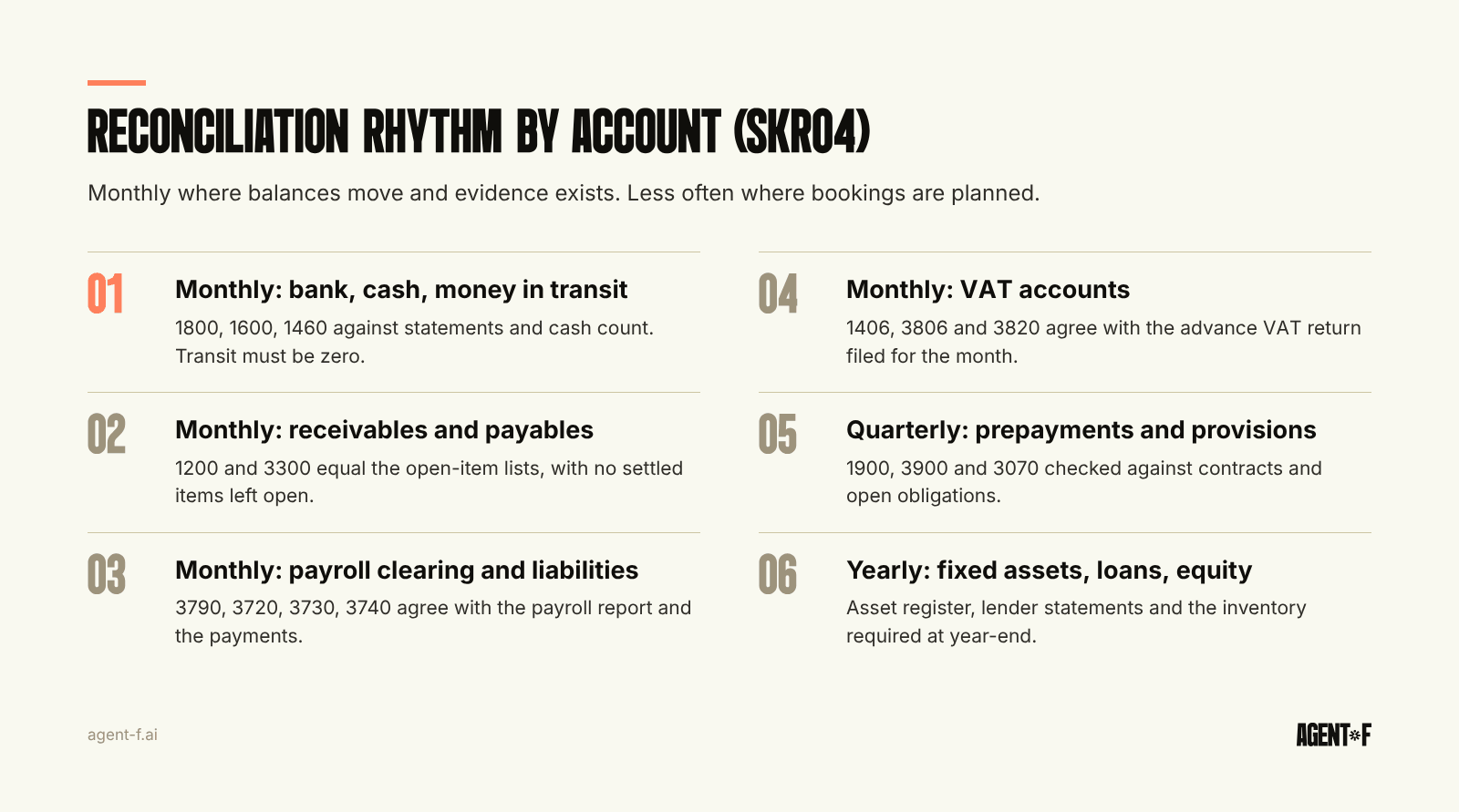
A useful rule: reconcile monthly every account that moves monthly and has external evidence. Reconcile less often the accounts that change through planned bookings. Here is how that looks with SKR04 numbers, the chart of accounts most German GmbHs use.
Monthly, without exception
- Bank (1800 and following) and cash (1600). Balance per ledger equals balance per statement or cash count on the last day.
- Money in transit (Geldtransit, 1460). Transfers between your own accounts. Must be zero, or explained by a transfer that left on the 31st and arrived on the 1st.
- Receivables (1200) and payables (3300). The ledger balance equals the open-item list, and the open-item list contains no item you know is settled. The supplier side gets its own treatment in supplier statement reconciliation.
- Payroll clearing (3790) and payroll liabilities (3720, 3730, 3740). Net wages, wage tax and social security agree with the payroll report and with what was actually paid.
- VAT accounts (1406 input VAT, 3806 output VAT, 3820 advance VAT payments). The balances agree with the advance VAT return (UStVA) filed for the month.
- Payment provider and card clearing accounts. Every payout and every card statement is matched, and the balance is only what is in transit.
Quarterly, or monthly if the amounts are material
- Prepaid expenses (1900) and deferred income (3900), checked against the underlying contracts.
- Accruals and other provisions (3070), checked against the list of open obligations.
- Intercompany balances in a group, which need both sides to agree. See intercompany reconciliation.
Yearly, with the annual accounts
- Fixed assets against the asset register, and loans against the lender's statement.
- Equity and the profit carried forward.
- A full inventory, which § 240 of the German Commercial Code (HGB) requires at each financial year-end anyway.
The yearly group is shorter than most people expect. If the monthly group is done properly, the year-end close becomes a check of a few accounts instead of an archaeology project.
Why do clearing accounts never clear?
A clearing account (Verrechnungskonto) holds an amount on its way from one place to another. It should be empty most of the time. In practice, they are often the accounts with the oldest unexplained balances in the ledger.
Four patterns cause most of it:
- Two people book the two halves. Your team records the payment from the bank, the tax advisor books the payroll entry from the payroll report. If one uses a slightly different amount or date, 3790 keeps a residue nobody owns.
- Fees and rounding. A payment provider pays out 9,741.20 euros for sales of 10,000 euros. If the fees are not booked separately, the difference stays in the clearing account.
- Interim account as a parking lot. Account 3630 (other clearing accounts) is where unclear items go "until we know". Without a monthly review, it becomes the place where they stay.
- Durchlaufende Posten (1370). Amounts collected on behalf of someone else, such as fees passed on to a customer. They must leave as they came, but often only one side is booked.
Every clearing account needs an owner, a target balance of zero and a list of items that explains anything else. A residue older than one month is investigated, not carried.
What counts as a finished reconciliation?
A reconciliation is finished when someone else could check it without asking you. That needs four things:
- The ledger balance on the last day of the month, after all bookings for that month.
- The external balance from the evidence: statement, open-item list, payroll report, UStVA, contract schedule.
- An explanation for every difference, each with a date, an amount and either a booking that fixes it or a reason it is a timing difference that resolves itself.
- A reviewer and a date. The person who prepared it is not the person who signs it off.
Two errors are common here. The first is "fixing" timing differences with a correcting entry, which then has to be reversed next month and creates the next difference. The second is accepting a difference as immaterial without writing down why. Under the GoBD (German digital bookkeeping rules), the reasoning behind a correction should be traceable later, which a cell comment in a spreadsheet on someone's laptop does not achieve.
Put the reconciliations as fixed steps into your month-end close checklist, with the account list above as the scope. If the list feels long, sort it by risk: what would hurt most if it were wrong for six months.
How does Agent F prepare reconciliations so you only review exceptions?
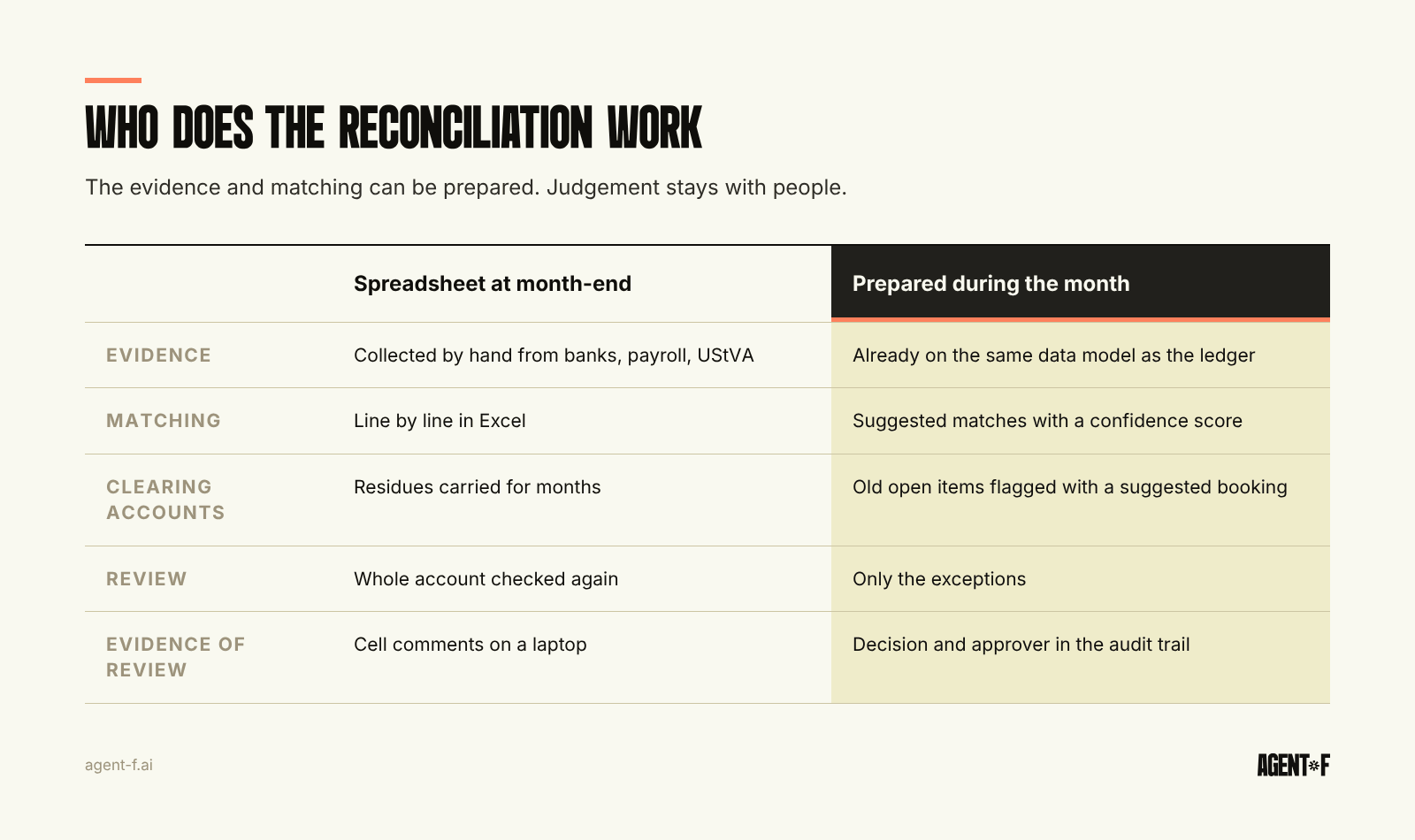
Most of the time in a reconciliation goes into collecting evidence and matching lines. That part can be prepared by the system, so that people spend their time on the lines that need judgement.
In Agent F, bank statements, payment provider payouts, payroll postings and the UStVA figures all sit on the same data model as the ledger. For each account in scope, Agent F compares the ledger balance with its evidence, matches the individual items and lists what remains. Each proposed match comes with a confidence score, so a reviewer can accept the obvious ones in bulk and look closely at the rest.
For clearing accounts, Agent F flags items that have stayed open longer than expected and suggests where they belong, for example a payment provider fee that was never booked, or a payroll payment that differs from the payroll posting by a few cents. Nothing is booked without approval. The suggestion, the decision and the person who made it are kept in the immutable audit trail, which is what your tax advisor and an auditor want to see.
Because the reconciliations run during the month, the close does not start with a stack of accounts. It starts with a short list of exceptions, and the period lock is set once they are cleared. The balances then go to your tax advisor through the DATEV export, already reconciled.
For your next month-end, pick the five clearing accounts with the largest balance and the oldest items, give each one an owner, and write down what the balance should be. Then compare 3790 with last month's payroll and the VAT accounts with the filed UStVA. Those two checks alone usually find the residue the BWA never shows.
Learn how Agent F works, or see it on your own ledger at agent-f.ai/demo.
This article is for general information only and does not constitute tax or legal advice. Parts of it were generated with AI. Please consult your tax advisor or legal counsel before acting on it, and feel free to reach out at team@agent-f.com with any questions or for support.