Updated
Accrued expenses at month-end: booking costs in the month they belong to
An accrued expense is a cost your company has already incurred but not yet received an invoice for. At month-end you book an estimate, so the cost shows up in the month the service was used, and you reverse it when the real invoice arrives. Without accruals, your monthly figures follow the supplier's billing cycle, not your business. In Germany, the year-end version is a provision (Rückstellung) under § 249 HGB.
Most growing companies leave accruals to the tax advisor (Steuerberater) once a year. That makes eleven monthly reports wrong in a predictable way, and the correction lands in December, when nobody can act on it anymore.
What is an accrued expense, and how does German accounting treat it?
The idea is simple: costs belong to the period in which the service was received, whatever the date on the invoice. The German Commercial Code (HGB) states this as the accrual principle in § 252 Abs. 1 Nr. 5, next to the prudence principle in Nr. 4. The background is in accrual vs cash accounting.
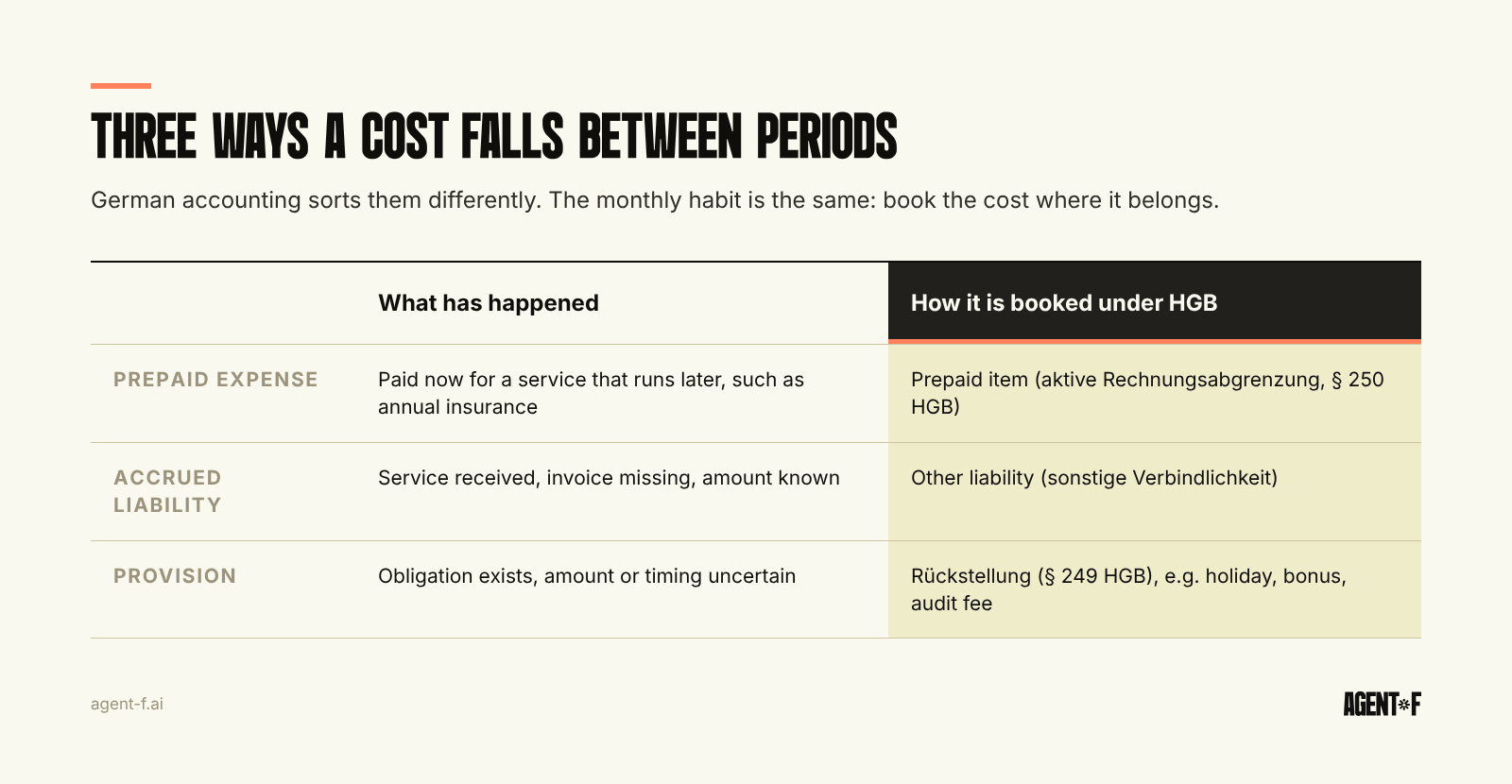
German accounting sorts costs that fall between periods into three buckets, and English terms do not map one to one.
- Prepaid expenses (aktive Rechnungsabgrenzung, § 250 HGB). You paid before the period ends for a service that runs after it, such as annual insurance or a yearly software licence. The unused part sits on the balance sheet.
- Accrued liabilities. The service is received, the invoice is missing, but amount and creditor are known, for example a fixed monthly retainer. In German practice this is often booked as an other liability (sonstige Verbindlichkeit).
- Provisions (Rückstellungen, § 249 HGB). The obligation exists, but its amount or timing is uncertain. Typical cases are unused holiday, bonuses, audit and year-end preparation costs, and pending legal disputes.
For the monthly management view, the distinction matters less than the habit: if a cost belongs to October, it should be in October. For the annual financial statements (Jahresabschluss), the classification matters, and your tax advisor will decide it.
Which costs need an accrual at month-end?
Accrue what is material and predictable, and ignore what is small and noisy. In a typical 30 to 100 person company, the list is short.
- Services billed in arrears: freelancers, agencies, consultants and contract developers who invoice after month-end.
- Consumption-based costs: cloud hosting, energy, logistics and payment fees where the bill follows the month.
- Goods received without an invoice: a delivery is in the warehouse, the supplier invoice is not. An open purchase order with a goods receipt is the clearest accrual signal there is, and the three-way match closes it later.
- People costs: bonuses earned during the year, overtime and holiday entitlement not taken.
- Annual costs you know are coming: the audit, the tax advisor's year-end fee, an annual licence renewal billed at the end of the term.
Agree on a threshold with your tax advisor, for example a fixed amount per item, and apply it every month. Consistency matters more than precision: a cost accrued in some months and not in others creates more noise than one never accrued at all.
How do you estimate an accrual when the invoice has not arrived?
HGB asks for the amount that is necessary "according to reasonable commercial judgement" (§ 253 Abs. 1 HGB). You need a method you can explain to an auditor. Four sources usually cover it:
- The purchase order. If you ordered 40 hours at an agreed rate and the goods receipt or timesheet confirms the work, the amount is known.
- The contract. Retainers, rent-like services and subscriptions have a fixed monthly value.
- History. If the hosting bill was between 11,000 and 12,500 euros for the last six months and consumption was stable, the average is a reasonable estimate.
- The budget owner. For one-off projects, the person who ordered the work knows best how much of it was delivered.
Write down the basis for each estimate. Under the GoBD (German digital bookkeeping rules), a booking needs a supporting document, and for an accrual the document is your calculation. A short note on the entry, with the PO number or the months the average came from, is usually enough. For provisions that run longer than a year, HGB also requires discounting at a published average interest rate, which is a year-end question for your tax advisor rather than a monthly one.
What happens at year-end if you skip monthly accruals?
The costs do not disappear. They arrive in the wrong month, and your tax advisor fixes the year when preparing the financial statements. In practice, that means three things.
First, the monthly BWA (the monthly management report from your tax advisor) is wrong in a pattern. Months with many late invoices look profitable, the following months look expensive, and a budget vs actual comparison shows variances that are timing, not performance. Teams learn to ignore the report, which defeats its purpose.
Second, December carries the catch-up. Provisions for holiday, bonuses, audit fees and missing invoices are booked in one go, often weeks after year-end. The annual result changes after the board has already seen the "final" numbers.
Third, the year-end gets slower and more expensive. Your tax advisor has to reconstruct which invoices from January and February relate to the old year, and someone in your team has to answer the questions. We describe that process in year-end close in Germany.
There is also a tax wrinkle: commercial law requires provisions for expected losses from pending contracts, but tax law prohibits them (§ 5 Abs. 4a EStG), so the commercial and tax balance sheets can differ.
How do you reverse an accrual without counting the cost twice?
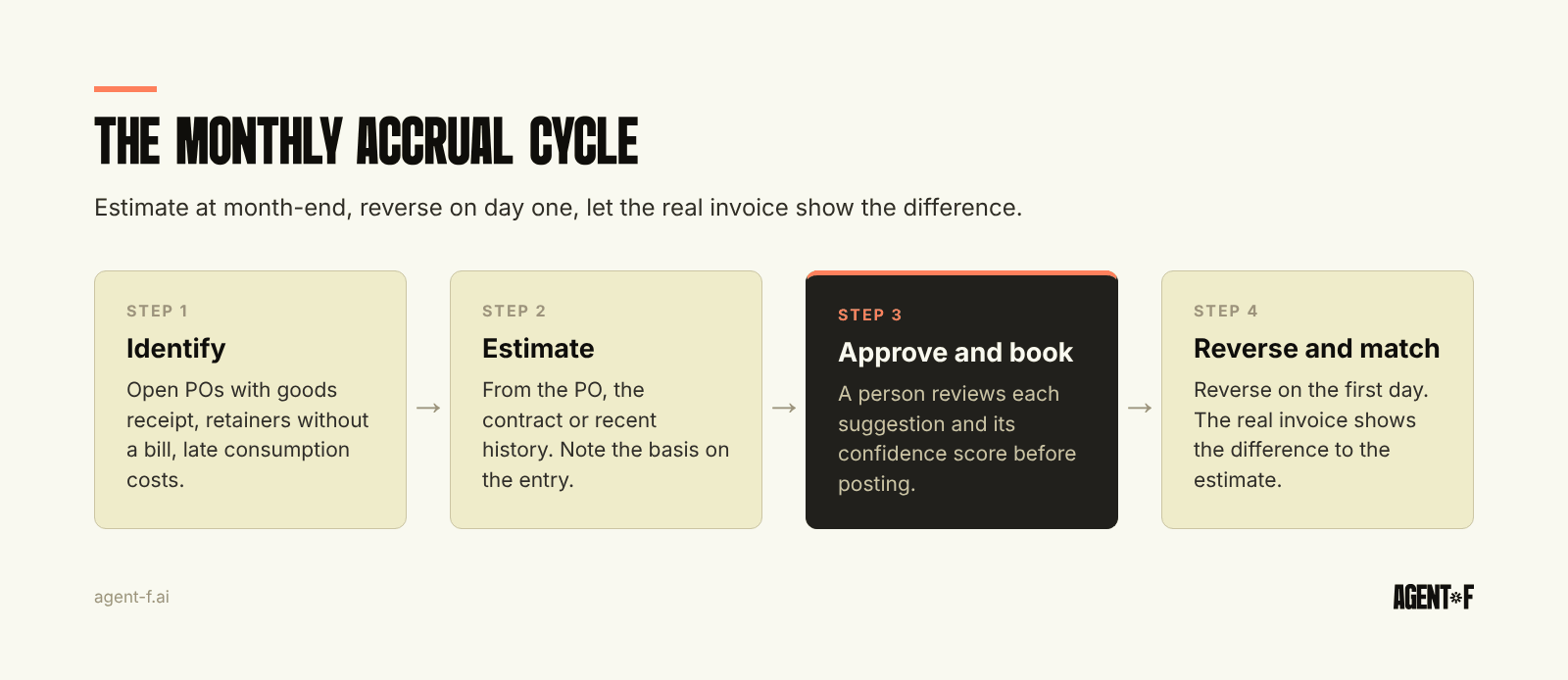
Accruals are adjusting journal entries, and the standard method is to reverse them automatically. You book the accrual on the last day of the month (expense to the cost account, credit to the accrual or provision account) and reverse it on the first day of the next month. When the real invoice arrives, it is booked normally. The net effect in the new month is the difference between estimate and invoice, which is exactly the correction you want to see.
Problems start when this is done by hand. Someone forgets the reversal and the cost appears twice. Someone reverses an accrual for an invoice that arrives two months later, so the cost disappears from both months. Someone books the real invoice against the accrual account directly while the reversal also runs.
Three habits prevent most of this:
- Link every accrual to its source, such as the purchase order, the contract or the supplier, so you can see when the matching invoice arrives.
- Review open accruals older than two months every close. They are either a missing invoice to chase or an estimate to release.
- Keep year-end provisions separate from monthly accruals. A holiday provision is updated, not reversed and rebooked each month.
The month-end close checklist shows where this review fits among the other close steps.
How does Agent F help you book accruals at month-end?
In most companies, accruals are a spreadsheet of suppliers, last month's amounts and who to ask. In Agent F, that data is already in one system. Purchase orders, goods receipts, contracts, recurring costs and supplier history sit on the same data model as the general ledger.
At month-end, Agent F proposes accruals from that data: an open PO with a goods receipt but no invoice, a monthly retainer without this month's bill, a hosting bill that has not arrived yet. Each suggestion shows its basis and a confidence score. A fixed contract amount scores high. An average of a fluctuating cost scores lower and is flagged for a closer look.
A person reviews and approves the entries. Nothing is posted automatically. Approved accruals reverse on the first day of the next month and are matched to the real invoice when it comes in, so the difference is visible instead of buried. Every suggestion, approval and change is recorded in the immutable audit trail, which is what your tax advisor and auditor will ask for. The entries flow into the BWA and the DATEV export without a separate list, and the month-end close process shows how this fits into a close of one to two days.
To start this month, take your last three months of supplier invoices and mark the ones that arrived after the month they relate to. Agree a materiality threshold with your tax advisor. Build a short list of recurring accruals and book them with automatic reversal, and review anything still open after two months. You will see the effect in the next BWA.
Learn how Agent F works, or see it on your own month-end close at agent-f.ai/demo.
This article is for general information only and does not constitute tax or legal advice. Parts of it were generated with AI. Please consult your tax advisor or legal counsel before acting on it, and feel free to reach out at team@agent-f.com with any questions or for support.