Updated
Month-end close process: closing in days when your tax advisor does the books

A month-end close process is the fixed sequence of work that turns a month of transactions into numbers you can rely on: collect and book every document, reconcile bank and open items, post accruals and depreciation, review the result, file the advance VAT return and lock the period. In Germany, most growing companies share this work with a tax advisor (Steuerberater), so the speed of the close depends on how cleanly the two sides hand over.
Most advice on closing faster assumes an in-house team that owns every step. In the Mittelstand, the tax advisor often books, reviews or files, and the close is really a relay. The goal of this guide is a close that finishes in days because each side knows what it prepares, what it receives and when the month is final.
What does the month-end close process actually include?
Our month-end close checklist lists the nine individual tasks. This article looks at the process around them: the order, the owners and the deadlines. Grouped into stages, the close has four parts.
- Capture. Every incoming and outgoing invoice, receipt, card transaction and payroll run for the month is in the system with its document attached.
- Reconcile. Bank accounts, clearing accounts (Geldtransit), payment providers and open receivables and payables agree with external evidence.
- Adjust. Accruals, deferrals, depreciation and prepayment releases put costs and revenue in the month they belong to.
- Review and lock. Someone checks the result against budget and prior month, the advance VAT return (UStVA) is filed and the period is locked so nobody changes it afterwards.
The law does not prescribe a monthly close as such. It is the VAT calendar and the German digital bookkeeping rules (GoBD) that set the pace. The GoBD consider it unproblematic to record non-cash transactions within ten days and to book them periodically by the end of the following month, provided documents cannot get lost in the meantime. A company that wants a BWA (the monthly management report from your tax advisor) it can steer by needs to be much faster than that.
Who does what: your team or your tax advisor?
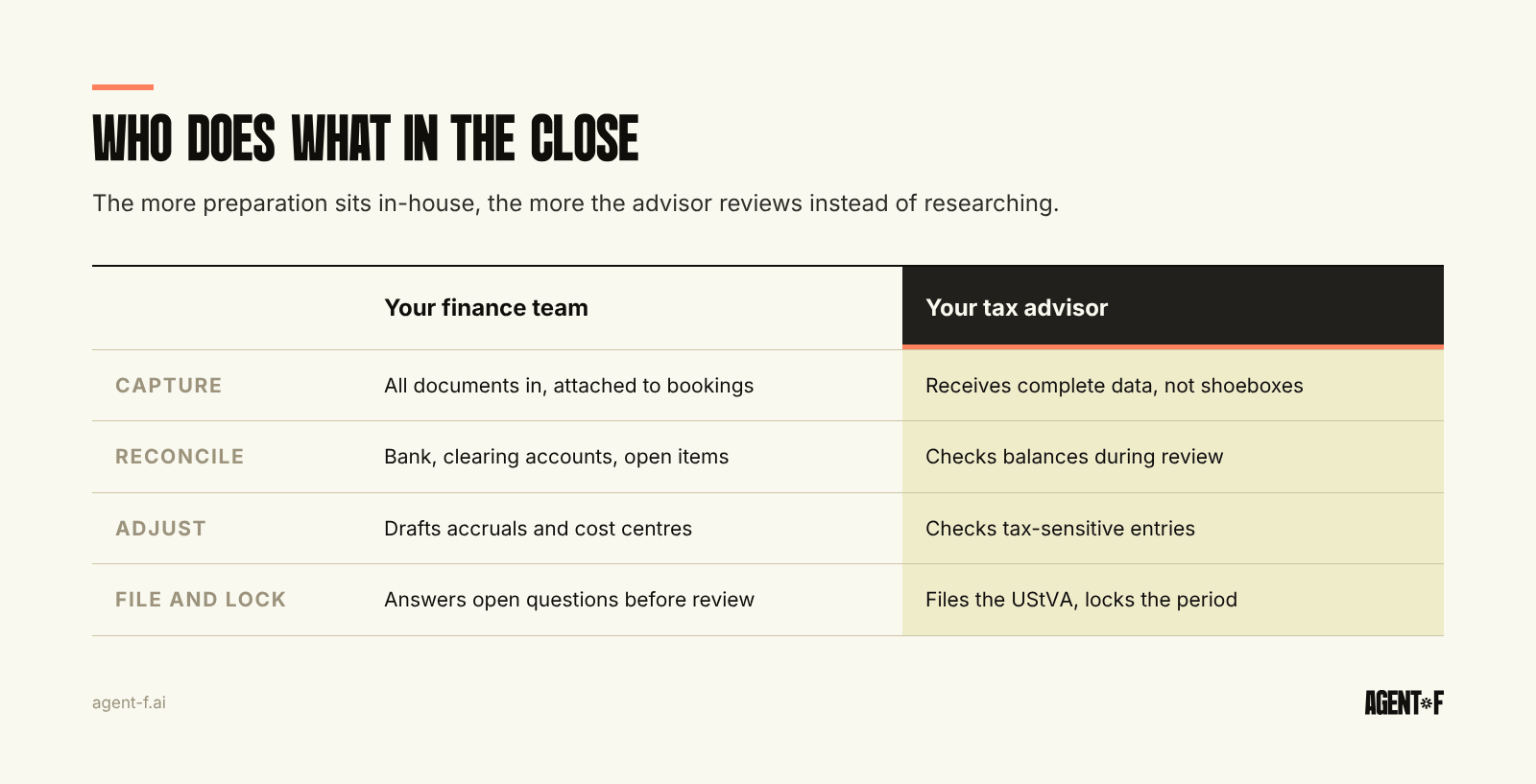
There is no single model. Some companies send all documents to the tax advisor, who books everything. Others keep bookkeeping in-house and use the advisor for review, VAT filings and the annual accounts. Most sit in between, and that is where closes slow down, because nobody wrote down where the line is.
A split that works for many companies with 20 to 100 people looks like this:
- Your finance team owns capture, bank and open-item reconciliation, cost centre allocation and the first draft of accruals. These steps need knowledge of the business: which project an invoice belongs to, whether a service was delivered, which contract is still open.
- Your tax advisor reviews the month, posts or checks tax-sensitive entries, prepares and files the UStVA and later the annual accounts under the German Commercial Code (HGB).
- Shared: the list of open questions. One list, one owner per item, answered before the advisor starts the review, not by email afterwards.
The more of the first group sits in-house, the faster the close, because the advisor reviews instead of researching. We discuss the trade-offs in more detail in working with your tax advisor.
What does a month-end close calendar look like with a tax advisor?
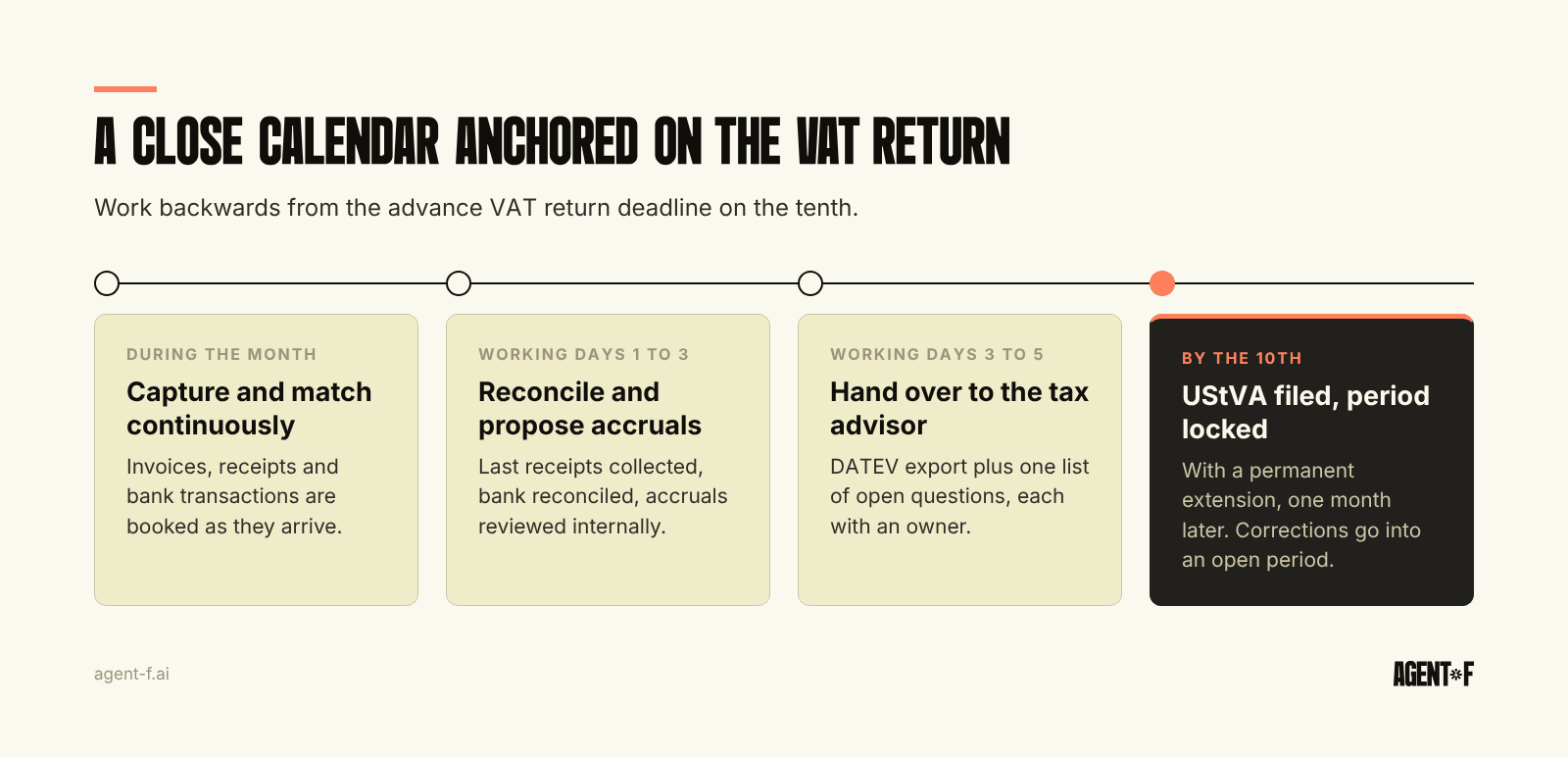
The anchor date is the advance VAT return. Under § 18 UStG it is due on the tenth day after the end of the period. Companies whose VAT for the previous year exceeded 9,000 euros file monthly. With a permanent extension (Dauerfristverlängerung), the deadline moves back by one month. The details are in advance VAT return in Germany.
Working backwards from that date gives a calendar like this:
- During the month: documents are captured and booked as they arrive, bank transactions are matched daily or weekly.
- Working days 1 to 3: the last invoices and card receipts are collected, the bank is fully reconciled, accruals are proposed and reviewed internally.
- Working days 3 to 5: the data goes to the tax advisor, usually as a DATEV export, together with the list of open questions.
- By the tenth (or the tenth of the following month with the extension): the advisor reviews, the UStVA is filed and the month is locked.
A company that books continuously can deliver the BWA in the first week. A company that starts collecting receipts on the first of the month will still be chasing them on the eighth.
Where does the close lose most of its time?
The time goes into waiting and rework, rarely into the booking itself. Four patterns come up repeatedly.
Documents arrive late. Card receipts sit in employees' inboxes, supplier invoices wait in an approval email chain. Every missing document becomes a question for the advisor and a correction later.
Reconciliation starts at month-end. If bank transactions are matched only once a month, the first three days of the close are spent on matching that could have happened during the month.
Accruals are guessed from memory. Without a list of recurring costs and open orders, someone reconstructs from the last month which invoices are still missing. Our article on accruals at month-end covers the method.
The handover goes back and forth. The advisor receives the data, finds unclear items, asks, waits and books again. Each round adds days, and the BWA arrives after the decisions it should have informed.
When is the month really closed?
A month is closed when its numbers can no longer change without a visible correction. Under GoBD, booked entries must not be altered in a way that hides the original. In DATEV-based bookkeeping, this happens through the lock (Festschreibung). Many tax advisors lock a month once the UStVA for it has been filed, so the figures reported to the tax office and the ledger stay identical.
That has two practical consequences. First, everything that belongs to the month should be booked before the VAT return goes out, because corrections after the lock are new entries in a later period. Second, your internal system and the advisor's records need to agree on which periods are locked. If your team keeps posting into October after the advisor has locked it in DATEV, the next export creates differences that someone has to explain. Agreeing what the DATEV export contains, and when, prevents most of these.
How does Agent F help you close in days?
With month-end close automation in Agent F, most of the close moves into the month itself. Supplier invoices, receipts and bank transactions are captured and matched as they come in. For each one the system suggests the account, cost centre and VAT treatment from your own booking history, with a confidence score. A person approves, and the approval is recorded in the immutable audit trail.
At month-end, Agent F proposes accruals from recurring costs and open purchase orders, and runs depreciation and prepayment schedules. Each proposal carries a confidence score and goes onto a close list that your team works through and approves. Items the system is unsure about go to the open-questions list instead of being booked silently.
When the list is done, Agent F prepares the UStVA figures and the DATEV export for your tax advisor from the same data model, so there is no second copy to reconcile. After filing, the period is locked in Agent F as well, and later corrections are posted visibly in an open period. Teams that work this way typically move from a 5 to 10 day close to 1 to 2 days.
To start, write down your current split of tasks with your tax advisor, agree on the date each month when the data is handed over, and move bank matching from month-end to weekly. Then measure how many open questions go to the advisor each month: that number tells you more about your close than its length.
Learn how Agent F works, or see it on your own close at agent-f.ai/demo.
This article is for general information only and does not constitute tax or legal advice. Parts of it were generated with AI. Please consult your tax advisor or legal counsel before acting on it, and feel free to reach out at team@agent-f.com with any questions or for support.