Updated
AI accounting accuracy: what benchmarks and error rates mean for approval
AI accuracy on accounting work depends on the task. Reading fields from an invoice or suggesting an account from booking history is a narrow, checkable task where trained systems do well. Multi-step work such as a reconciliation with judgement calls or a year-end adjustment is where errors cluster. A single accuracy figure hides that difference, and it says nothing about which errors are expensive.
Benchmark headlines are useful as a reminder that AI makes mistakes. They are less useful as a decision tool. The practical question for a finance team is which outputs can be accepted on a sample check, which need one approval, and which need two. That is a control design question, and finance has answered it before, for people.
What do AI accuracy benchmarks actually measure?
Public benchmarks for AI on accounting typically give a set of models a set of tasks, then score the answers against a correct solution. The tasks vary widely: answering accounting exam questions, extracting data from documents, categorising transactions, preparing journal entries or completing a multi-step close task.
Three things are worth checking before reading anything into the result:
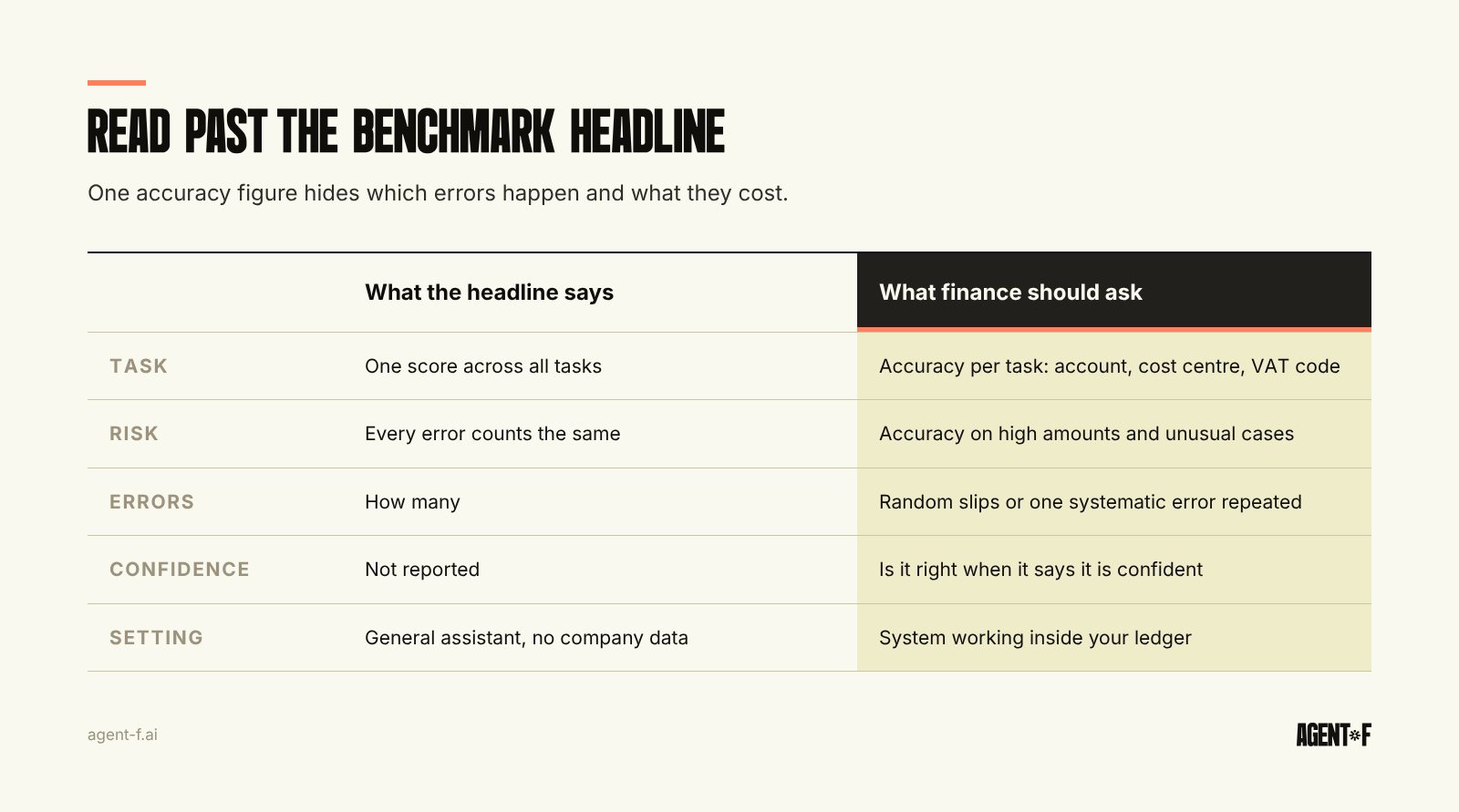
- The task mix. A benchmark weighted towards exam questions measures knowledge. One weighted towards real workflows measures execution. They produce very different scores for the same model.
- The setting. A general assistant answering from a prompt has no access to your chart of accounts, your booking history or your supplier master data. A system working inside the ledger does. Benchmarks usually test the first.
- The scoring. Is a task counted as failed when one figure is wrong, or is partial credit given? Is the explanation checked, or only the final number?
Benchmarks also age quickly. A result from last year describes last year's models. The useful takeaway is rarely the exact percentage. It is the pattern: where models fail, and whether they fail visibly or quietly. We look at the difference between a general assistant and a system in the ledger in ChatGPT or Claude for finance.
Why is an overall accuracy figure not enough for accounting?
Accounting errors do not cost the same. A coffee receipt booked to the wrong expense account changes nothing that matters. A supplier invoice with the wrong VAT code can cost the input VAT deduction. A revenue entry in the wrong period changes the monthly result that goes to the board.
An overall figure also hides the distribution. Ninety-five correct suggestions out of a hundred can mean five random slips, or one systematic error repeated five times. The second is worse, because it will repeat next month as well.
The questions that matter for a finance team are therefore more specific:
- Accuracy by task. How often is the account right, the cost centre right, the VAT code right?
- Accuracy by risk. How does it perform on high amounts, unusual suppliers, new accounts?
- Calibration. When the system says it is confident, is it right? When it is unsure, does it say so?
- Visibility of errors. Does a wrong suggestion look wrong, or does it look exactly like a right one?
Calibration is the one most often missing from headlines, and it is the one that makes approval design possible.
What kinds of errors does AI make on accounting work?
It helps to sort AI errors into four groups, because each needs a different control.
- Extraction errors. A date, amount or VAT ID read incorrectly from a document. These are caught by checking against other data: the order, the bank payment, the supplier record.
- Classification errors. The wrong account, cost centre or tax code. These are the most common in day-to-day bookkeeping and the easiest to learn from, because each correction becomes training data for the next suggestion.
- Reasoning errors. A wrong calculation across several steps, such as an accrual, a depreciation schedule or an FX revaluation. These need a rule-based check, not another AI opinion.
- Fabrication. An explanation or a number that sounds right but has no source in the data. A system that answers from the ledger can show the bookings behind every answer, which makes this kind of error visible. A general assistant often cannot.
The broader question of which accounting tasks AI should take on at all is covered in where AI belongs in accounting.
How do you turn an error rate into an approval design?
Finance teams already use a familiar logic for people: small, routine items get a light check, large or unusual ones get a second pair of eyes. The same logic works for AI, with one addition: the system's own confidence score.
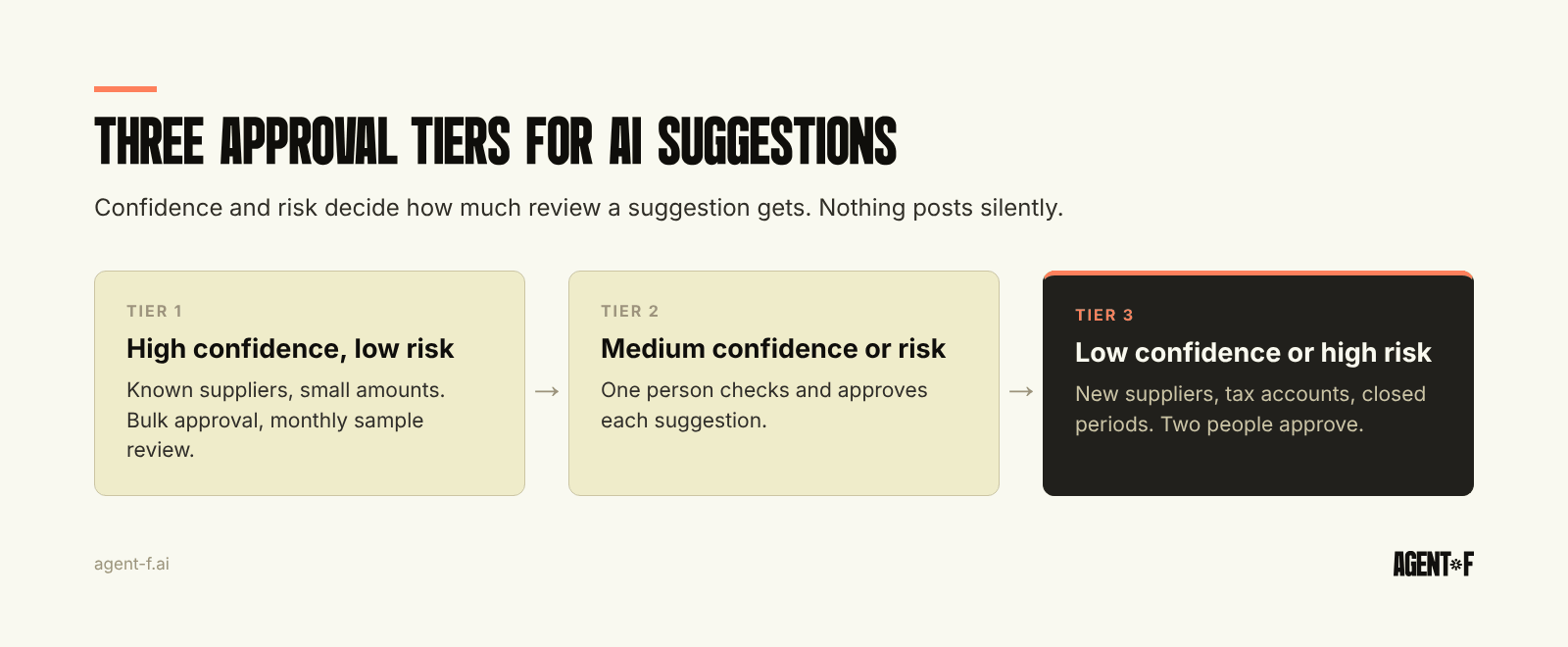
A workable design has three tiers:
- Tier 1: high confidence, low risk. Recurring suppliers, known accounts, amounts below a threshold. The suggestion is prepared for bulk approval, and a sample is reviewed each month.
- Tier 2: medium confidence or medium risk. One person checks and approves each suggestion.
- Tier 3: low confidence or high risk. New suppliers, high amounts, tax-relevant accounts, manual journal entries. Two people, following the same rules as in journal entry approval.
Two numbers then show whether the design works. The override rate per tier tells you how often people change the suggestion. The error rate in the monthly sample of tier 1 tells you whether the threshold is set right. If tier 1 overrides stay rare and the sample is clean, the threshold can move. If not, it moves back.
Some tasks should stay in tier 3 regardless of the score. Period-end adjustments, entries on tax accounts, changes to master data such as a supplier's bank details, and anything that touches a closed period are better reviewed by two people, because a confident error there is expensive and hard to see later. The aim is to spend approval time where it changes the result. A team that reviews every coffee receipt with the same care as a six-figure invoice is usually the team that misses the six-figure error.
What do German bookkeeping rules expect from an AI-assisted process?
German law does not prohibit AI in bookkeeping, and it does not shift responsibility to the software. The company remains responsible for its books. Under § 239 Abs. 2 of the German Commercial Code (HGB), entries must be complete, correct, timely and orderly. Under § 239 Abs. 3 HGB, an entry may not be changed in a way that hides its original content or leaves unclear whether a change was made later.
The GoBD (German digital bookkeeping rules) add a requirement that matters here: companies must keep a process documentation (Verfahrensdokumentation) that describes how their bookkeeping works. For an AI-assisted process, that means describing which tasks the system suggests, which thresholds apply, who approves what, and how corrections are recorded. A tax advisor (Steuerberater) or auditor reading it should be able to follow a booking from document to ledger.
In practice, this rules out one design: AI that posts silently. Every suggestion, approval and correction needs a record, kept unchanged.
How does Agent F handle accuracy and approval?
In Agent F, every AI action is a suggestion with a confidence score, and a person approves it before it is booked. You define the approval workflows for your team, and every suggestion and every approval is kept in an immutable audit trail. The design is described in AI agents for finance and what an AI-native ERP is. Because suggestions learn from corrections, reconciliation accuracy typically reaches 90 percent or more by the third month.
Whatever system you use, three questions are worth asking: can it show its confidence per suggestion, can you set thresholds yourself, and can you see every override afterwards? If the answer to any of them is no, the benchmark score matters less than it seems.
Learn how Agent F works, or see it on your own bookings at agent-f.ai/demo.
This article is for general information only and does not constitute tax or legal advice. Parts of it were generated with AI. Please consult your tax advisor or legal counsel before acting on it, and feel free to reach out at team@agent-f.com with any questions or for support.