Updated
Budgeting process for growing companies: top-down, bottom-up and a budget that matches the books
A budgeting process for a growing company works best in three passes: management sets targets top-down, each cost centre owner drafts a bottom-up budget, and one reconciliation round closes the gap. The result should be built on the same accounts and cost centres as your bookkeeping, so that every month the budget can be compared line by line with the actual figures.
Most budgeting advice is about method: incremental, zero-based, driver-based. For a company of 30 to 150 people, method matters less than structure. A budget that lives in a different structure from the books produces variances nobody trusts, and after a few months nobody looks at it.
What should the budgeting process produce?
A budget is three things at once, and it helps to be clear about all three before the first spreadsheet is opened.
A plan. Expected revenue, costs and headcount for the year, month by month, so that the company knows what it is aiming for and how much cash it needs.
A set of spending limits. Each budget owner knows what they can spend without asking again. This is the part that changes behaviour, and it only works if owners can see where they stand during the year.
A yardstick. Each month, actual figures are compared with the budget. That comparison is where most budgets fail, for reasons we come back to below. Our guide to budget vs actual per cost centre covers the monthly analysis itself.
The numbers behind the plan, such as how to project revenue and costs from last year's actuals, are covered in annual budget planning. This article is about the process around those numbers: who does what, in which order, and in which structure.
Should you budget top-down or bottom-up?
Both, in sequence. Each method on its own has a known weakness.
Top-down budgeting starts with management. The founders or the management board set revenue targets, a cost ceiling and a hiring plan, and finance splits them across departments. It is fast and keeps the budget aligned with the strategy and with what investors expect. Its weakness is that department heads did not build the numbers, so they do not feel bound by them.
Bottom-up budgeting starts with the people who spend the money. Each cost centre owner plans their costs, hires and projects. The numbers are better grounded and owners feel responsible for them. The weakness: the sum of all departmental wishes almost never fits the company's targets, and padding is common, because owners expect to be cut.
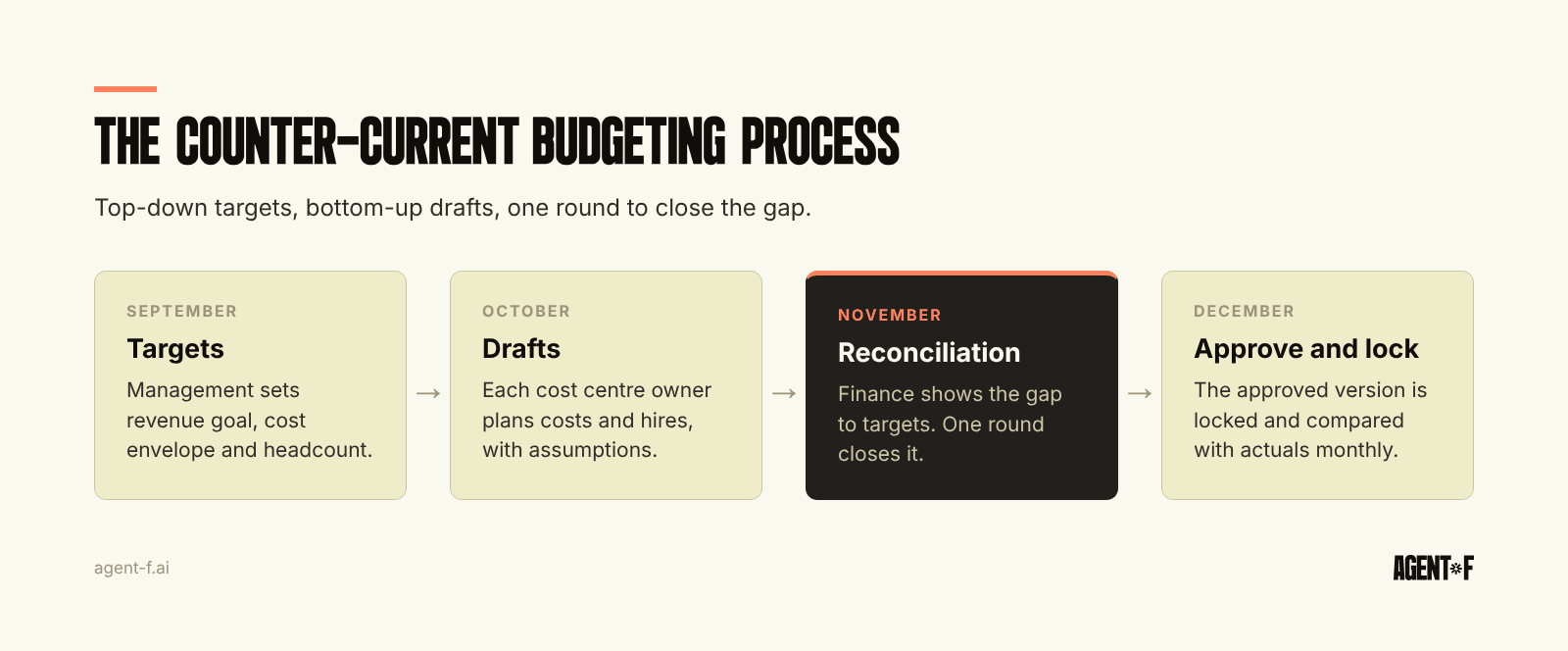
German controlling has a name for the combination: the counter-current method (Gegenstromverfahren). In practice, it runs in four steps:
- Targets: management sets the frame. Revenue goal, total cost envelope, headcount and any fixed priorities.
- Drafts: each owner builds a draft for their cost centre within that frame, with the main assumptions written next to the numbers.
- Reconciliation: finance consolidates the drafts and shows the gap to the targets. One structured round of discussion closes it, by changing targets, cutting plans or shifting timing.
- Approval and lock: the budget is approved, locked as a version and from then on compared with actuals.
One round of reconciliation is usually enough. If it takes three, the targets were not clear in step one.
The reconciliation round is also where padding gets handled. Asking owners to write their assumptions next to each number helps more than cutting every draft by a fixed share. A line that reads "two new hires from April, one from September" can be discussed and moved. A line that only shows a total invites a negotiation, and next year's draft will be padded again. It also helps to separate the costs an owner can influence from those they cannot, such as rent or allocated group costs, so the discussion stays on decisions.
Who owns which numbers?
The budgeting process breaks down quickly when ownership is vague. A workable split for a growing company looks like this:
- Management owns targets, total headcount and the major investments.
- Cost centre owners own their costs, hires and timing, and explain their assumptions.
- Sales or the revenue owner owns the revenue plan, with finance checking it against contracts and pipeline.
- Finance owns the structure, the calendar, the consolidated figures and the link to the books. It does not invent the numbers for other departments.
The last point is easy to say and hard to keep. In many companies, finance ends up building every department's budget itself because the owners do not deliver on time. The budget is then finance's budget, and the monthly variance becomes finance's problem.
A realistic calendar for a calendar-year company starts with targets in September, drafts in October, reconciliation in November and approval in December. Whatever the dates, publish them early and keep the draft format simple: one template per cost centre, the same accounts for everyone.
Why does the budget stop matching the books by March?
This is the most common failure, and it rarely has to do with the quality of the plan. It is structural.
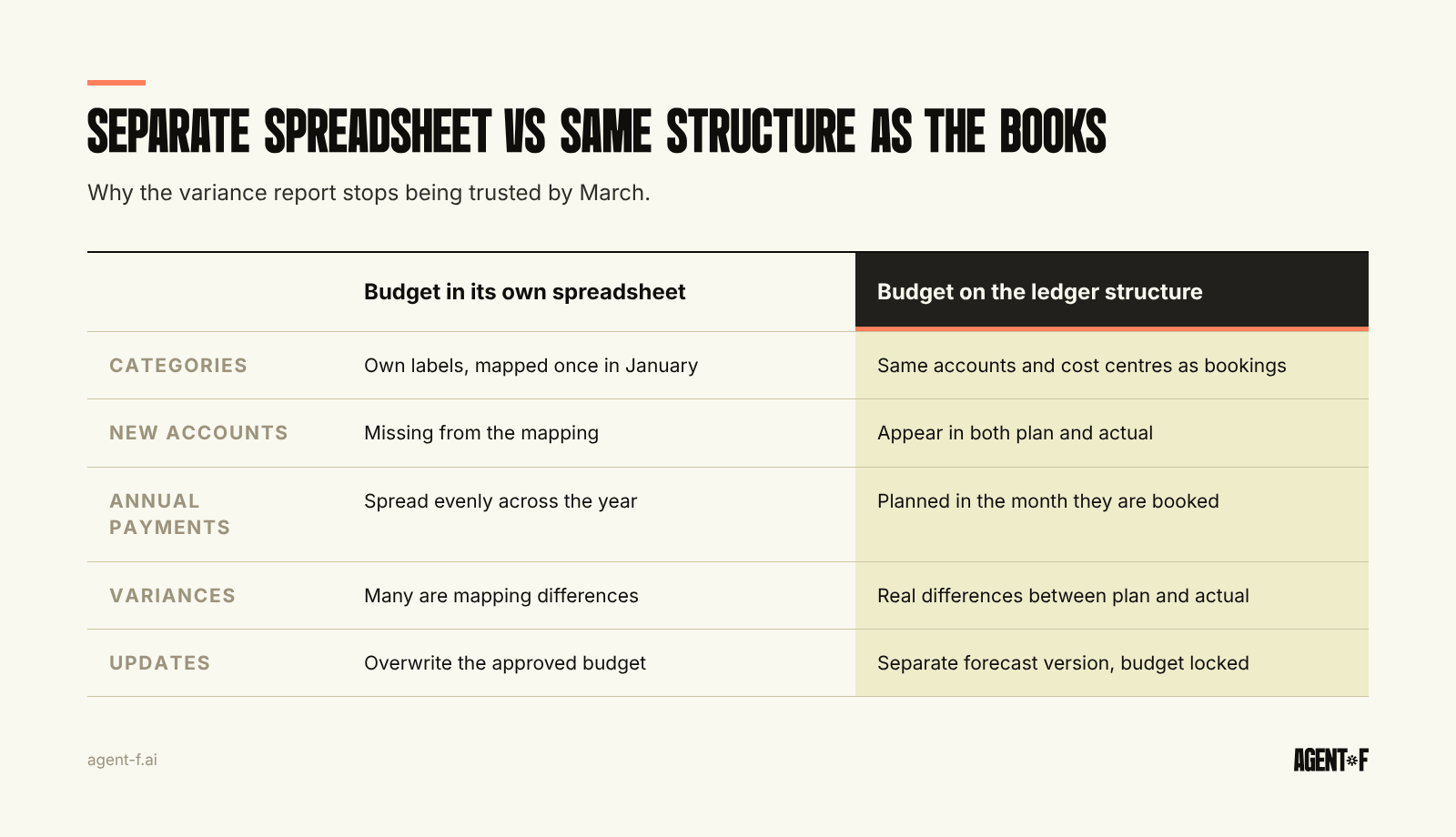
The budget is built in a spreadsheet with its own categories: "Marketing", "Software", "Travel", "Office". The bookkeeping, often done by the tax advisor (Steuerberater), uses the chart of accounts, typically SKR04, and the BWA (the monthly management report from your tax advisor) groups the accounts its own way. In January, someone maps the two. By March, new accounts have appeared, a cost centre has been split, and some costs are booked to a different account than the budget assumed.
The result is a variance report full of differences that are not real. Marketing looks well over budget because conference costs were booked to travel. Software looks under budget because annual licences are paid in one month but budgeted evenly. Owners stop trusting the comparison, and the budget is forgotten until next autumn.
Three rules prevent most of this:
- Budget on the accounts you book on. Use the same chart of accounts and the same cost centres as the ledger, grouped for presentation if needed. How to design that structure is covered in general ledger structure.
- Budget in the month the cost will be booked. Annual payments, bonuses and one-off projects go into the right month, not spread evenly.
- Lock the version. Keep the approved budget unchanged, and handle updates as a separate forecast version.
What happens to the budget after it is approved?
Locking the budget does not mean the plan stays right. Prices change, hires slip, a large customer arrives early. The approved budget remains the yardstick for the year, and a separate forecast shows where the year is actually heading.
Many growing companies move to a rolling forecast for exactly this reason: the budget sets the commitment once a year, the forecast updates the expectation every month. Both should sit on the same structure as the books, so the comparison between budget, forecast and actual is a matter of columns, not of mapping.
How does Agent F help with the budgeting process?
In Agent F, the budget is built on the same chart of accounts and cost centres as your bookings, so a variance is a real difference between plan and actual, not a mapping problem.
Budgeting and forecasting sit in the same system as the actuals. Owners enter their draft per cost centre with their assumptions, finance consolidates it and compares it with the targets, and the approved version becomes the reference for the year. Predictive planning can suggest changes to the plan, each with a confidence score for a person to approve. Scenarios, for example a slower hiring plan, can sit next to the base case, and a rolling forecast keeps the outlook current.
During the year, owners see budget against actual for their cost centre from live data, and the same structure feeds the BWA and the DATEV export for your tax advisor. Every change to the approved budget is recorded in the audit trail.
For this year's cycle, publish the calendar and the targets before the drafts start, give every owner one template on the real accounts, plan annual payments in the month they fall, and agree in advance that there is one reconciliation round.
Learn how Agent F works, or see it on your own cost centres at agent-f.ai/demo.
This article is for general information only and does not constitute tax or legal advice. Parts of it were generated with AI. Please consult your tax advisor or legal counsel before acting on it, and feel free to reach out at team@agent-f.com with any questions or for support.