Updated
Rolling forecast: replacing the annual budget ritual with a monthly update
A rolling forecast is a plan that always looks the same distance ahead, usually 12 months. Each month, the month just closed is replaced by actuals and a new month is added at the end. Instead of one large budget exercise in the autumn that is out of date by March, finance updates a few key drivers every month and the forecast stays current.
Most articles on the topic say the annual budget should go. For a German Mittelstand company, that is rarely realistic: the house bank, the shareholders and often the advisory board still expect a fixed annual plan. The practical answer is to keep the budget as the commitment and run the rolling forecast next to it as the working view.
What is the difference between a budget and a rolling forecast?
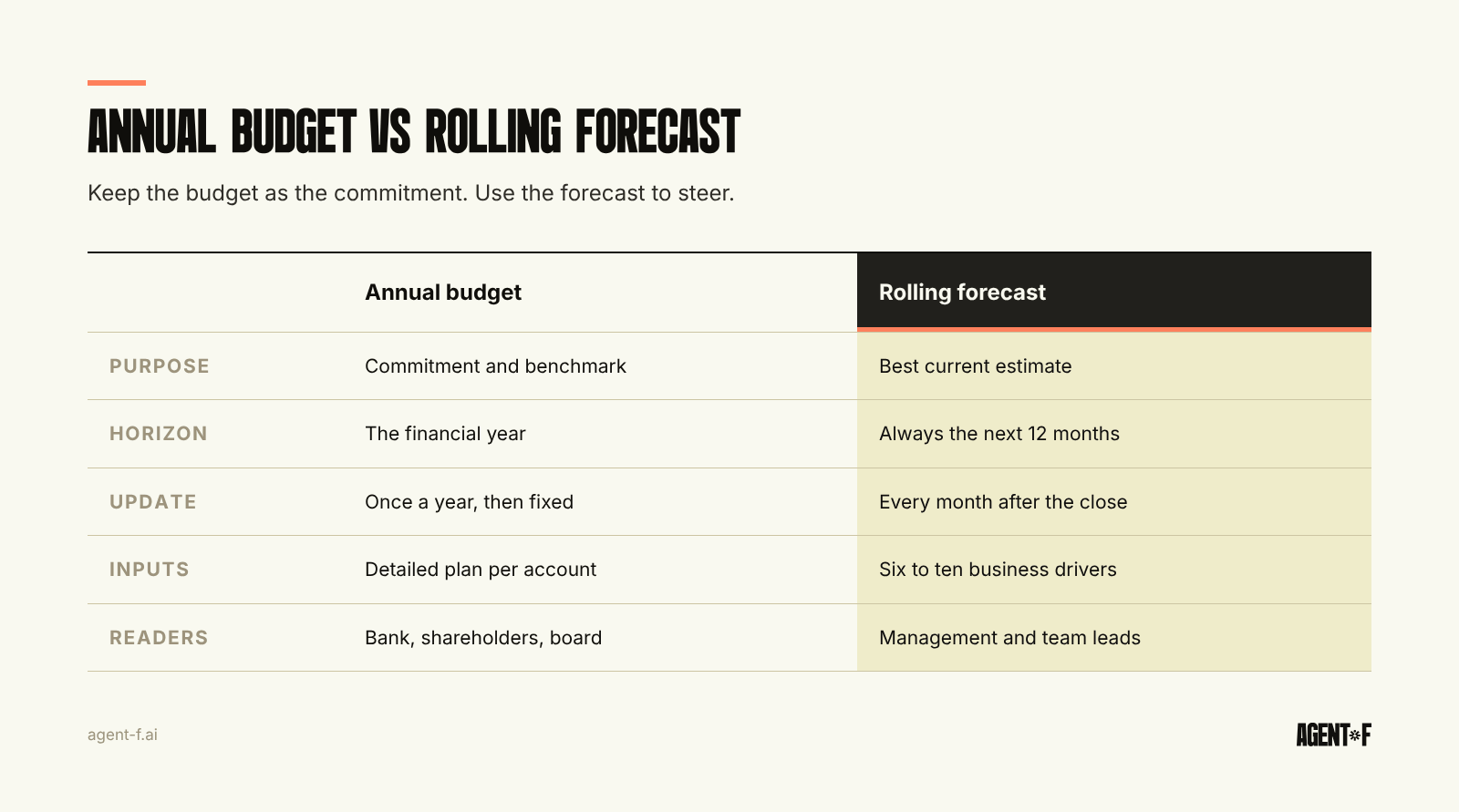
A budget is a commitment. It sets targets for the year, allocates money to cost centres and becomes the benchmark for performance. It is agreed once and should not move, because its purpose is to show whether you delivered what you promised.
A rolling forecast is an estimate. It shows what you now expect to happen, based on what you know today. It moves every month, because its purpose is to support decisions: hiring, purchasing, pricing, financing.
The two answer different questions. The budget asks: are we on track against what we agreed? The forecast asks: where are we heading, and what should we change? Teams that try to use one number for both end up either defending an outdated budget or quietly rewriting it, which destroys its value as a benchmark.
In practice you compare three figures each month: actual, budget and latest forecast. The difference between actual and budget tells you how you performed. The difference between budget and forecast tells you where the year will land. How to read the first comparison per cost centre is covered in budget vs actual reporting.
Why do Mittelstand companies still need the fixed budget?
Because people outside finance rely on it. Many house banks ask for an annual plan alongside the annual accounts and the BWA (the monthly management report from your tax advisor) to monitor a loan. Loan agreements may contain covenants that are tested against planned and actual figures. Shareholders and advisory boards approve the budget, and bonus targets are often tied to it.
None of these readers wants a number that changes every month. A bank officer comparing your BWA to your plan needs a stable reference. So the budget stays, prepared once a year and approved as before. The guide to annual budget planning explains how to build it from actuals rather than from last year's spreadsheet.
What changes is what management uses between budget rounds. The rolling forecast becomes the internal steering tool, and the budget becomes one of the reference lines in it. When the bank asks how the year will end, you answer from the forecast and explain the gap to the plan. That is a far better conversation than discovering the gap in the year-end accounts.
If the forecast moves far away from the budget, for example after losing a large customer or winning a new market, resist the urge to quietly change the budget. Agree a formal revised plan with the bank and the board instead, and keep the original budget visible as a reference. The rolling forecast is what tells you early enough that this conversation is needed.
How far ahead should a rolling forecast look?
Twelve months is the common choice, because it always covers at least one full budget cycle ahead. In November, a 12-month forecast already shows most of next year, which makes the next budget round much shorter: the forecast is the starting point.
Some companies use 18 months, especially when lead times are long. A manufacturer ordering components months in advance, or a company planning a new production site, needs to see further. Others go shorter, with a detailed 13-week view for liquidity and a coarser monthly view for the P&L. The two complement each other; the weekly cash view is covered in cash flow forecasting.
Detail should fall with distance. The next three months can be planned per cost centre and account. Months four to twelve work better at the level of a few drivers: revenue by product line, headcount, average cost per head, material cost ratio, large one-off items.
Which drivers belong in the forecast?
The aim is to forecast the things that move the result, not every account. For most mid-sized companies, six to ten drivers explain most of the P&L:
- Revenue drivers: order intake, backlog, price changes, churn or renewal rates for recurring revenue.
- People: headcount by team and start dates of open roles, with average cost per head including employer social security.
- Material and purchasing: cost of materials as a share of revenue, or known price increases from suppliers.
- Fixed costs: rent, software, insurance, mostly carried forward from contracts.
- One-off items: investments, financing, large projects, grants.
Each driver should have an owner outside finance. Sales owns order intake, the team leads own hiring plans, purchasing owns material prices. Finance owns the model and the consistency, not every assumption. This is the same principle as in a good budgeting process: the people who run the business supply the inputs.
What happens in a monthly forecast update?
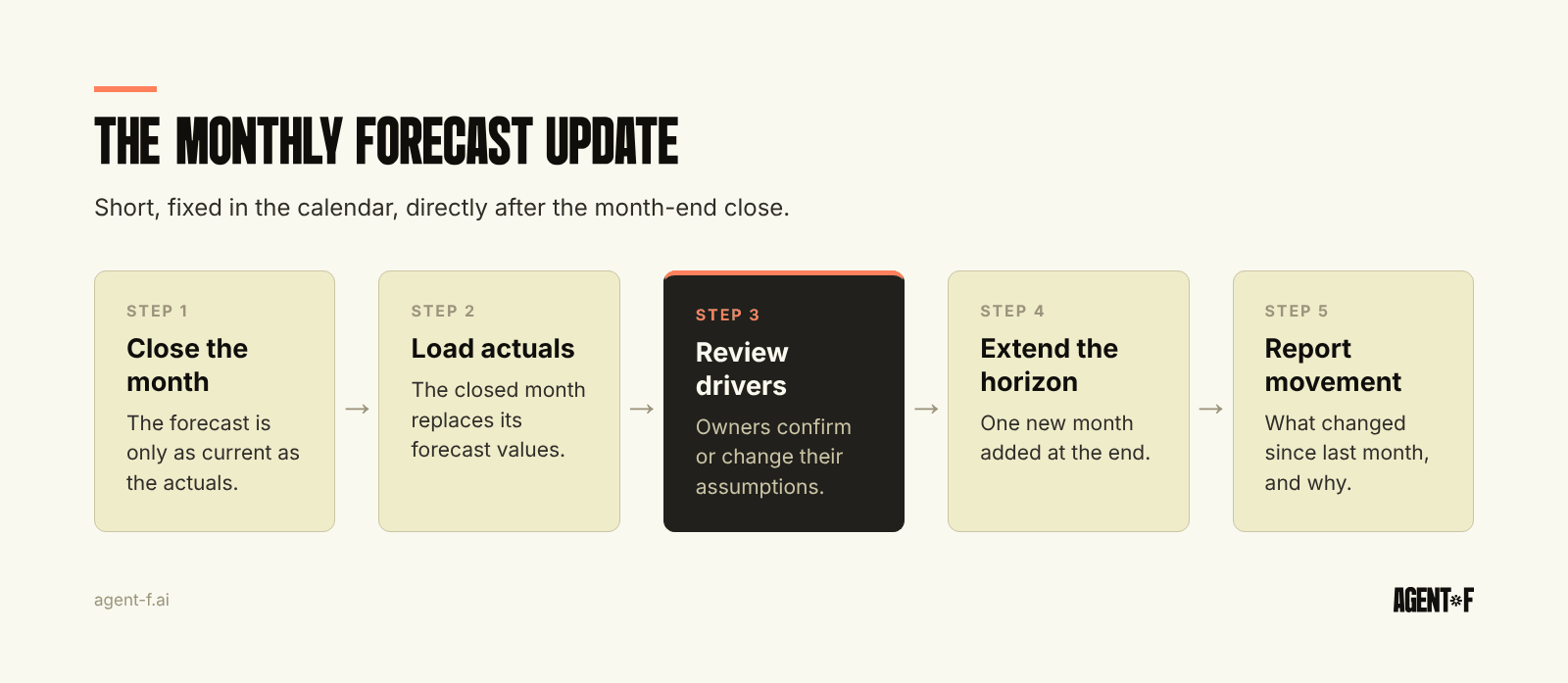
A rolling forecast fails when the update becomes a mini budget round. Keep it short and fixed in the calendar, directly after the month-end close.
- Close the month. The forecast can only be as current as the actuals. A slow close means a stale forecast. How to shorten it is described in the month-end close process.
- Load actuals. The closed month replaces its forecast values.
- Review the drivers. Each owner confirms or changes their assumptions. Most months, most drivers do not change.
- Extend the horizon. Add one new month at the end, usually from the driver model.
- Report the movement. Show what changed since last month's forecast and why, next to actual and budget.
The output for management fits on one page: expected full-year result, change since last month, the three largest reasons and any decision needed. If the update takes more than a day or two of finance time, the model is too detailed or the actuals arrive too late.
How does Agent F keep the forecast current from actuals?
Rolling forecasts usually die in the spreadsheet. Actuals arrive as an export from DATEV, are mapped into the planning file by hand, and the formulas break each time someone adds a cost centre. After a few months, the update takes so long that it slips to every quarter.
In Agent F, budgeting and forecasting sit on the same data model as the general ledger. When the month is closed, the actuals are already in the forecast, by account and cost centre, with no import step. Budget, actual and forecast are three views on the same numbers. You can keep the approved budget fixed for the bank and the board, and run rolling forecasts and scenarios next to it.
People change the assumptions, not the formulas. A team lead updates the hiring plan, sales confirms the order intake, and the forecast recalculates. The AI layer proposes forecast values from your actual trends and flags drivers that have moved away from recent actuals, each with a confidence score. Nothing changes the forecast until a person accepts it, and every change is logged with who made it and why. You can also ask questions in plain language, such as which cost centres are driving the gap to budget this quarter.
To start, pick the six to ten drivers that explain most of your result and name an owner for each. Set a fixed date for the update two days after your close. Run the first three months in parallel with your current quarterly forecast, then compare which one was closer to reality.
Learn how Agent F works, or see it on your own figures at agent-f.ai/demo.
This article is for general information only and does not constitute tax or legal advice. Parts of it were generated with AI. Please consult your tax advisor or legal counsel before acting on it, and feel free to reach out at team@agent-f.com with any questions or for support.