Updated
Corporate cards and spend control: limits, approvals and a calm month-end

Corporate cards give employees a company card with a limit, so they can pay for travel, software and small purchases without advancing their own money. They control spend at the moment of payment, but only per card. To control spend properly, each card payment also needs a receipt, a cost centre and a check against the budget it belongs to, ideally on the day it happens.
Most companies introduce cards to stop expense reports, and they succeed. Then the problem moves to month-end, where finance chases receipts and discovers which budget the spending came from. The fix is to treat a card limit and a budget as two different controls and connect them.
What does a corporate card actually control?
A card controls three things well: who can pay, how much per card and period, and sometimes where. Modern cards can be physical or virtual, restricted to merchant categories, set to expire, or issued for one supplier only. A virtual card for each software subscription, for example, makes it easy to see what each tool costs and to stop paying for one by freezing its card.
What a card does not control is whether the purchase makes sense for the business. It does not know the cost centre budget, the project the money is for, or whether three colleagues have just bought the same tool. It approves a payment when the limit allows it.
Card controls and finance controls sit in different places. The card is a payment instrument. The budget, the cost centre and the ledger live in your accounting system.
Why is a card limit not a budget?
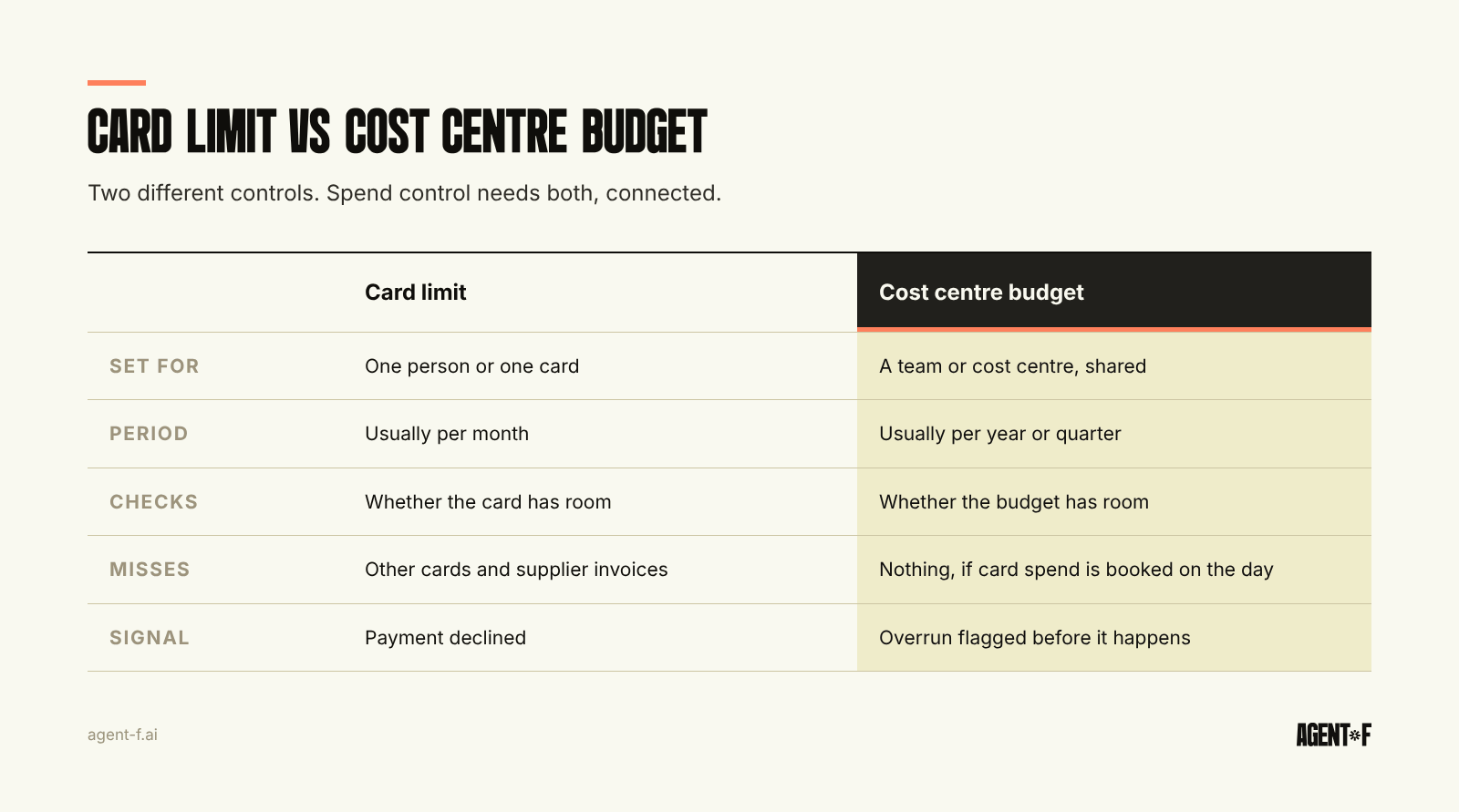
A card limit is set per person or per card, usually per month. A budget is set per cost centre, usually per year, and is shared by everyone who spends against it.
Take a marketing team of five, each with a 2,000 euro monthly card limit. In theory the team can spend 10,000 euros a month on cards without anyone noticing, plus whatever arrives as supplier invoices. If the quarterly marketing budget is 20,000 euros, the cards alone can use it up in two months, and the limits never trigger.
The opposite happens too. A limit set too low makes people ask colleagues to pay, use private cards and claim the money back, or wait for finance. Each workaround brings back the expense report the cards were supposed to remove.
A better approach links each card to a cost centre and checks spend against what is left in that budget, not only against the card's own limit. Then a payment that would take the budget over shows up while there is still time to decide, and the limit can stay generous for the people who need it. How to read the results afterwards is covered in budget vs actual reporting per cost centre.
Which rules should decide who gets a card and what limit?
A short card policy beats a long one that nobody reads. It should answer five questions:
- Who gets a personal card? Usually people who travel, buy for a team or manage suppliers.
- What is the card for? Travel, software, small purchases. Anything above a set amount, or any recurring contract, goes through a purchase order instead.
- Which cost centre does it belong to? Every card belongs to one by default, so bookings do not start as unassigned.
- What happens without a receipt? A reminder after a day or two, a reduced limit after repeated misses, and a clear owner for follow-up.
- When are subscriptions moved to virtual cards? Ideally always, so each recurring cost has its own card and a named owner.
Travel adds its own rules on per diems and mileage, which we cover in travel expense reporting in Germany.
What does finance need for every card payment in Germany?
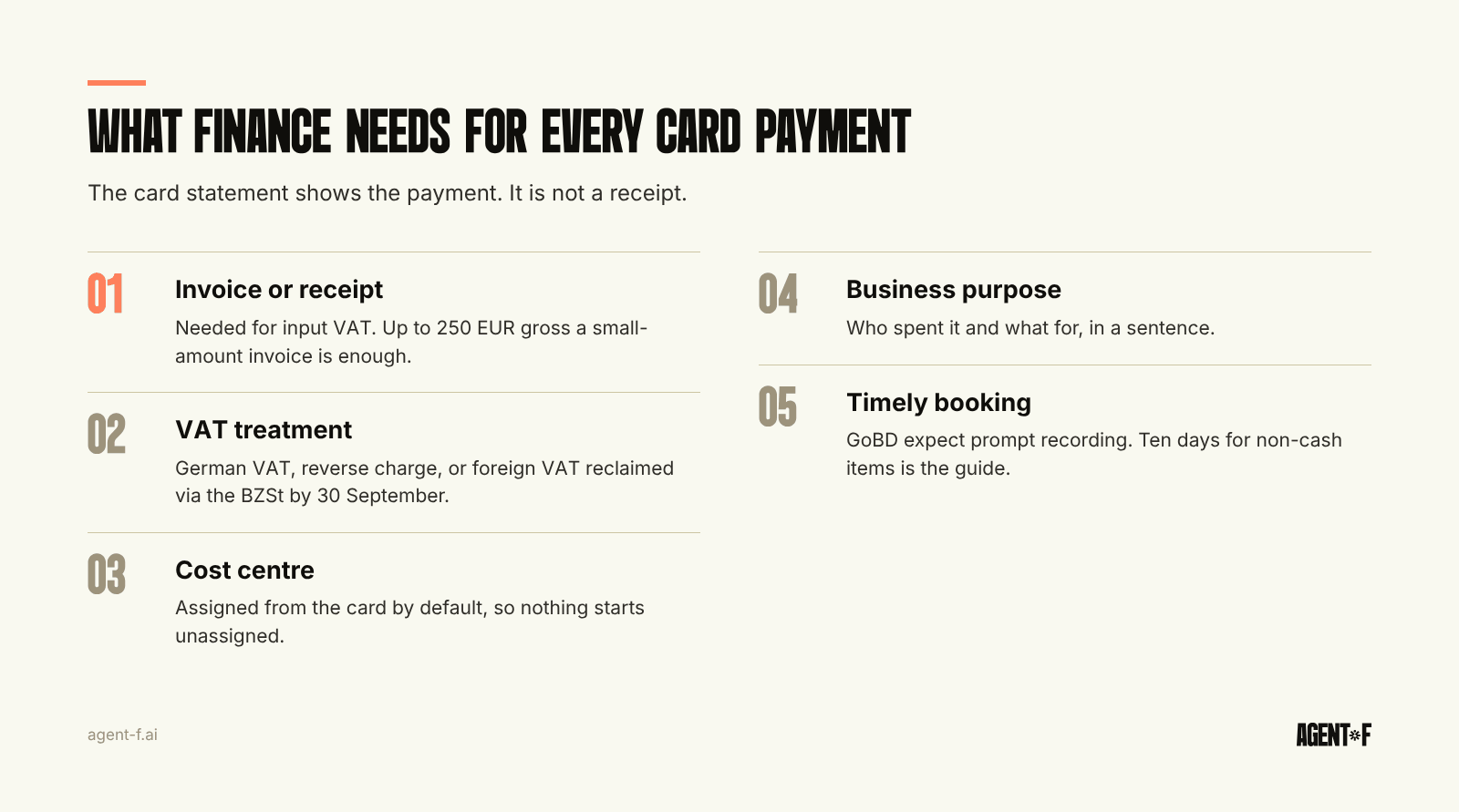
The card statement shows that money left the account. It is not a receipt, and on its own it does not support the booking or the input VAT. For each card payment, finance needs:
- The invoice or receipt. To deduct input VAT under § 15 of the German VAT Act (UStG), you need a proper invoice. For amounts up to 250 euros gross, a simplified small-amount invoice (Kleinbetragsrechnung) is enough under § 33 UStDV. Above that, the invoice must name your company. The details are in input VAT deduction.
- The VAT treatment. German VAT, foreign VAT, or reverse charge for many software services from other EU countries. Foreign VAT, such as on a hotel in Paris, cannot be claimed in the German advance VAT return. It goes through a separate refund application at the Federal Central Tax Office (BZSt), due by 30 September of the following year.
- The cost centre and purpose. Who spent it, for what, and from which budget.
- Timely booking. Under GoBD (German digital bookkeeping rules), transactions must be recorded promptly. The guidance treats recording non-cash transactions within ten days as unobjectionable. A pile of receipts collected at month-end works against that.
Card payments in other currencies also need the booking rate and the difference to the settled amount, which multi-currency accounting explains.
Why does month-end still mean chasing receipts?
Because the receipt is requested at the wrong moment. If the reminder comes at month-end, the employee is asked about a lunch from three weeks ago, the paper receipt is gone and the email confirmation is buried. Finance books to a suspense account, waits, and closes late.
Subscriptions are a special case. The card is charged every month, but the invoice sits in a supplier portal that only one person can log into. If that person has left, nobody downloads it, and the input VAT on a recurring cost is lost month after month. A named owner per subscription card, written into the policy, prevents this.
The receipt is easiest to get within minutes of the payment, when the employee still has it in hand. A photo taken right after the payment, matched to the transaction automatically, removes most of the chasing. What remains is a short list of exceptions instead of a full inbox, and the card section of your month-end close checklist becomes a review rather than a search.
How does Agent F tie card spend to the budget?
In Agent F, expense management, budgets and the general ledger share one data model, so a card payment is booked where the budget can see it.
Each card payment is captured as an expense with its receipt, assigned to a cost centre and categorised from your own booking history, with a confidence score. Agent F suggests the account and VAT treatment, checks the expense against your expense policy, and flags what does not fit for a person to review.
Clear cases go to the budget owner for approval, and nothing is booked without a person confirming it. Every step is in the immutable audit trail. Once booked, card spend shows up in budget vs actual per cost centre, and the bookings reach your tax advisor (Steuerberater) through the DATEV export.
To start, take last month's card statement and count three things: payments without a receipt, payments without a cost centre, and the days between payment and booking. Then compare the total card limits per team with the team's budget for the same period. If the limits add up to more than the budget, your cards are not part of your spend control yet.
Learn how Agent F works, or see it on your own card transactions at agent-f.ai/demo.
This article is for general information only and does not constitute tax or legal advice. Parts of it were generated with AI. Please consult your tax advisor or legal counsel before acting on it, and feel free to reach out at team@agent-f.com with any questions or for support.