Updated
Multi-currency accounting: FX differences without the spreadsheet
Multi-currency accounting means recording each transaction in its original currency, converting it into euros at a defined rate, and explaining every difference that appears when the rate moves. For a German company, that happens at three points: when an invoice is booked, when it is paid, and at month-end, when open foreign currency items are revalued under § 256a HGB. Subsidiaries abroad add a fourth step, translation into the group accounts.
The accounting rules are not the hard part. The hard part is that the rate, its date and its source usually live in a spreadsheet next to the ledger, and nobody can say afterwards why a large FX loss appeared in March.
What does multi-currency accounting actually involve?
A German company keeps its books and prepares its annual financial statements (Jahresabschluss) in euros. That is § 244 HGB, the German Commercial Code. The moment you invoice a US customer in dollars, pay a UK agency in pounds or hold a Swiss franc account, you have transactions in a foreign currency that need a euro value.
Three terms help keep this straight.
- Transaction currency: the currency on the invoice or bank statement, such as USD.
- Functional currency: the currency the entity keeps its books in. For a German GmbH this is the euro.
- Group or presentation currency: the currency of the consolidated accounts. For a German parent with foreign subsidiaries, again usually the euro.
A good ledger keeps the original amount, the currency, the rate and the rate date on every line. If it only stores the euro amount, every later question needs a lookup outside the system. That is where the spreadsheet starts.
Which exchange rate do you use, and when?
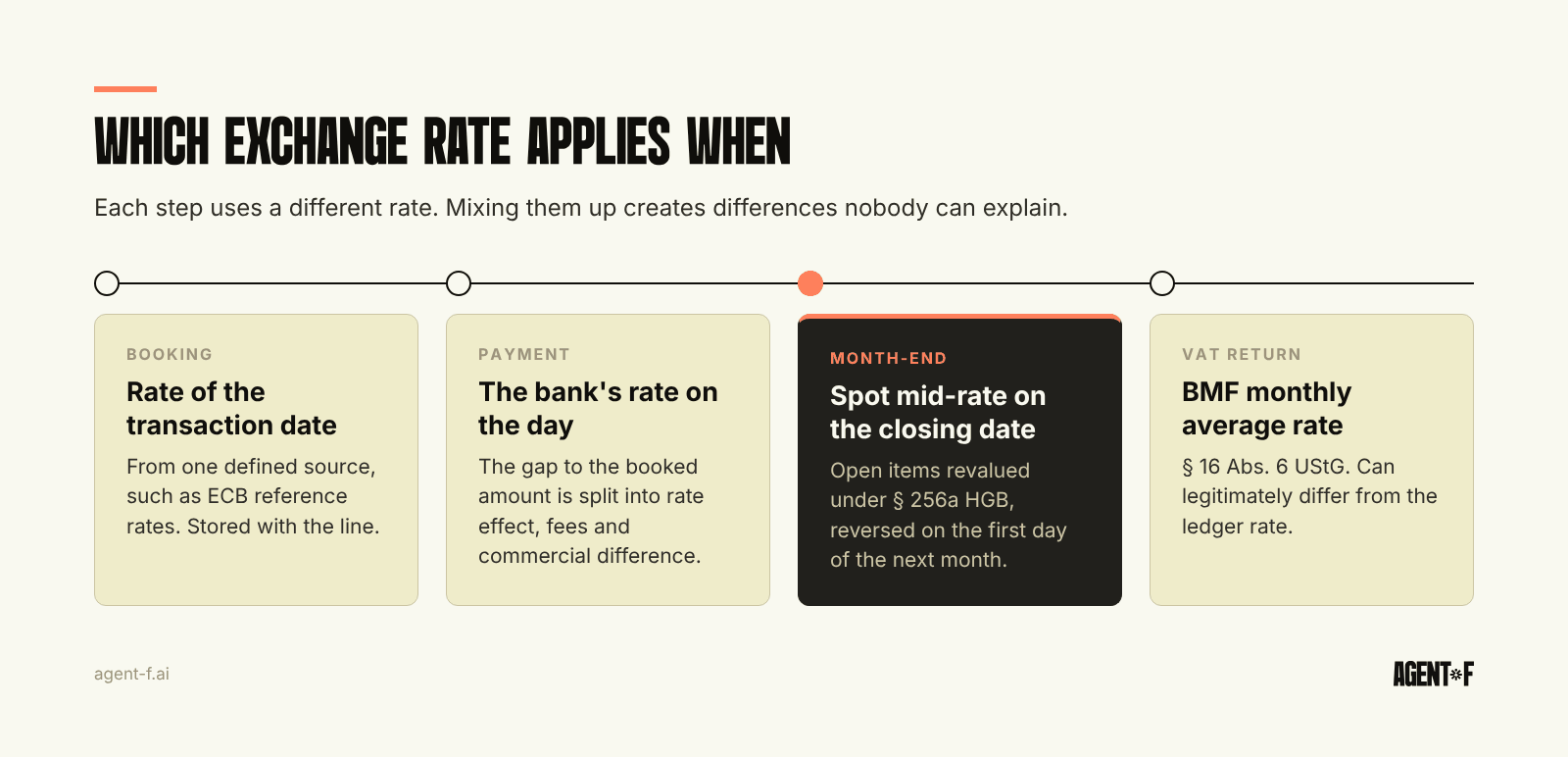
Each step in the life of a foreign currency item uses a different rate, and mixing them up is the most common source of unexplained differences.
- Booking. The invoice is converted at the rate of the transaction date, from a source you define once, for example the European Central Bank reference rates.
- Payment. The bank converts at its own rate on the day the money moves. The euro amount on the bank statement rarely matches the booked receivable or payable.
- Month-end. Open receivables, payables and foreign currency bank balances are revalued at the spot mid-rate on the closing date (Devisenkassamittelkurs, § 256a HGB).
- VAT. For the advance VAT return, foreign currency amounts are converted at the monthly average rates published by the Federal Ministry of Finance (BMF), under § 16 Abs. 6 UStG. The tax office can allow the daily rate instead, if it is documented.
Point 4 surprises many teams. The rate in your ledger and the rate in your VAT return can legitimately differ, so the system needs to hold both. Decide your rate source and cut-off time once, write it down, and apply it every month. Your tax advisor (Steuerberater) will want to see that it is consistent.
Where do realised FX differences come from?
A realised difference appears when an item is settled. You book a 50,000 dollar invoice to a US customer at one rate, the customer pays three weeks later, and your bank credits fewer euros than the receivable shows. The gap is an FX loss. If the dollar had risen, it would be a gain.
The trap is that other differences hide inside the same gap. The customer may have deducted a bank fee, paid a partial amount or taken a discount. A payment processor may have netted its fee before paying out. If all of this goes into one FX account, the account becomes a dumping ground and nobody trusts it.
Split the difference into its parts before booking it:
- the commercial difference, such as a short payment or a disputed line, which goes back to the customer or supplier;
- fees, which go to the bank charges account;
- the rate difference, which is the real FX result.
This only works if the payment is matched to the original invoice in its original currency first. Our guide to payment reconciliation covers that matching step.
How do you revalue open items at month-end under HGB?
At year-end, § 256a HGB requires foreign currency assets and liabilities to be converted at the spot mid-rate on the balance sheet date. For items due within one year, two rules are switched off: the historical cost cap and the realisation principle. In practice, that means short-term receivables and payables are revalued in both directions, so unrealised gains are shown as well as losses.
For items with a remaining term of more than one year, the usual prudence rules apply. You book unrealised losses but not unrealised gains. A five-year intercompany loan in dollars is the typical case.
The law only requires this at the balance sheet date. Doing it every month is a management choice, and a good one. Without monthly revaluation, the P&L shows FX results only when items are paid, often months after the rate moved, and the December revaluation lands as one large surprise.
The usual method is a revaluation entry at month-end that is reversed on the first day of the next month. Each month then starts from the original booked values, and the realised difference appears cleanly when the item is paid. Tax rules can differ from the commercial treatment, so agree the approach with your tax advisor before the first year-end.
What changes when a subsidiary reports in USD, GBP or CHF?
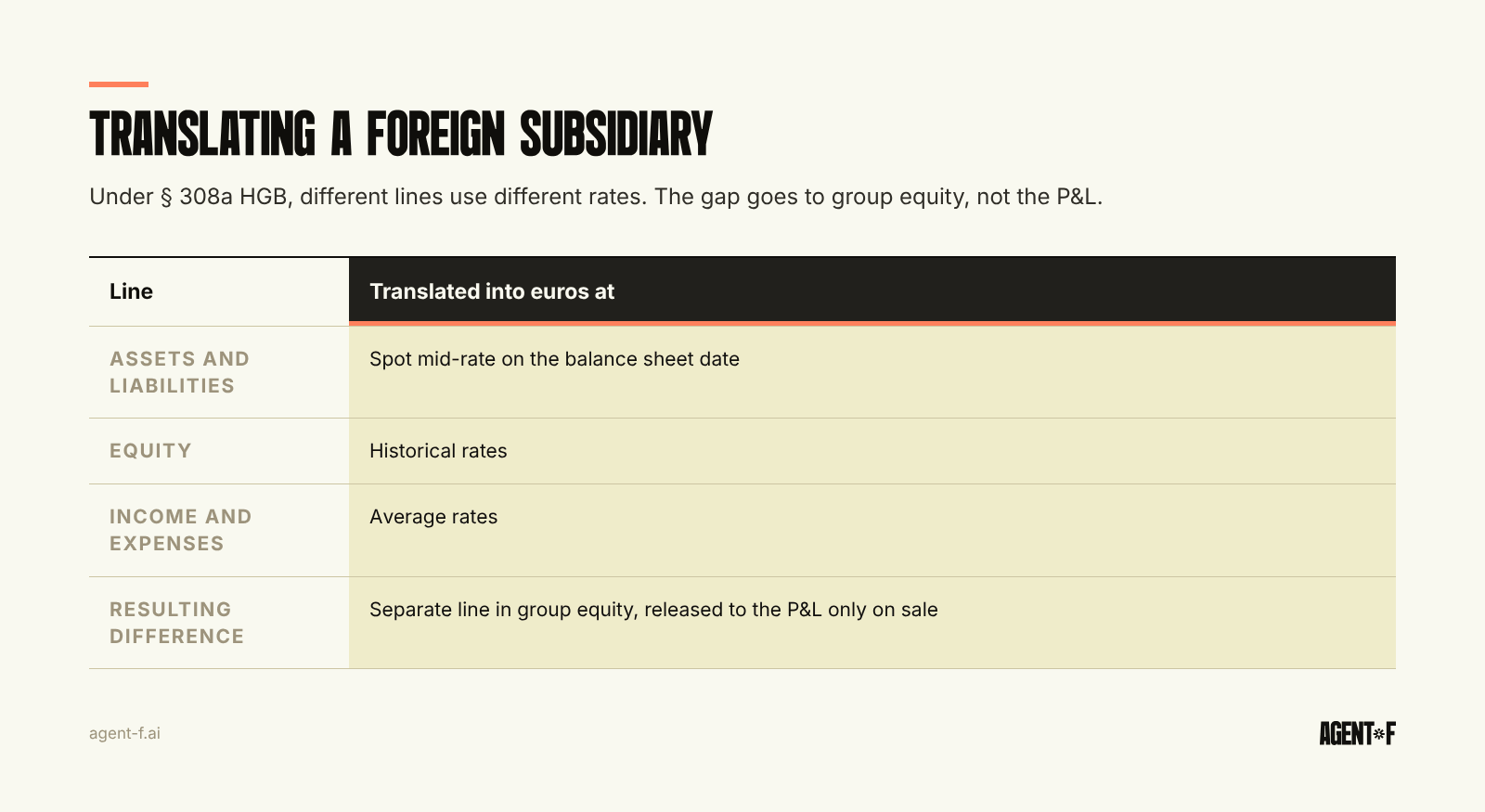
A subsidiary in the US, the UK or Switzerland keeps its books in its own currency. For the consolidated accounts, its figures are translated into euros under § 308a HGB:
- assets and liabilities at the spot mid-rate on the balance sheet date;
- equity at historical rates;
- income and expenses at average rates.
Because different lines use different rates, the balance sheet no longer balances after translation. The difference goes into a separate line in group equity (Eigenkapitaldifferenz aus Währungsumrechnung), not into the P&L. It is released through profit or loss only when the subsidiary is sold, fully or in part.
The practical problems sit before this step. Intercompany balances recorded in two currencies rarely agree, because each side books at a different rate on a different day. Those gaps must be explained before eliminations, as described in intercompany reconciliation. The wider group view is in consolidation, and what to check before adding a new entity is in multi-entity accounting.
How does Agent F help with FX differences?
In a typical setup, each entity has its own tool, rates come from a website or a bank PDF, and someone revalues open items in a spreadsheet at month-end. In Agent F, all entities run on one data model, so receivables, payables and bank lines for every entity sit in the same ledger rather than in separate tools.
When a payment arrives through the direct bank integration, AI-assisted reconciliation suggests the match to the open invoice, with a confidence score. A clear match scores high. A short payment with no remittance note scores lower and goes to a person. Nothing posts without approval.
At month-end, the close runs in the same system, with accrual suggestions and a period lock once the month is final. You can ask questions about your FX accounts in plain language on live data, which makes it quicker to find the bookings behind a figure. Every suggestion and approval is kept in the immutable audit trail, and the entries flow into the BWA (the monthly management report from your tax advisor) and the DATEV export. For the liquidity side across banks and currencies, see cash management.
As a next step, write down your rate source, cut-off time and revaluation policy in one paragraph and agree it with your tax advisor. Check whether your ledger stores the original currency and rate on every line. Then take last month's FX account and try to explain each entry. If that takes more than an hour, the process needs fixing before volume grows.
Learn how Agent F works, or see it on your own foreign currency transactions at agent-f.ai/demo.
This article is for general information only and does not constitute tax or legal advice. Parts of it were generated with AI. Please consult your tax advisor or legal counsel before acting on it, and feel free to reach out at team@agent-f.com with any questions or for support.