Updated
E-invoicing in Germany: what changes in 2027 and 2028, and what to prepare now
From 1 January 2027, German companies with more than 800,000 euros of turnover in the previous year must send their domestic B2B invoices as structured e-invoices. From 1 January 2028, the same applies to everyone. Receiving e-invoices has been mandatory since January 2025. A PDF sent by email does not count, and an invoice in the wrong form can cost the recipient the input VAT deduction.
Most companies treat this as a format question for the invoicing tool. It is a bigger change than that: for the first time, German law asks for invoice data rather than invoice documents.
When does the e-invoicing mandate apply to my company?
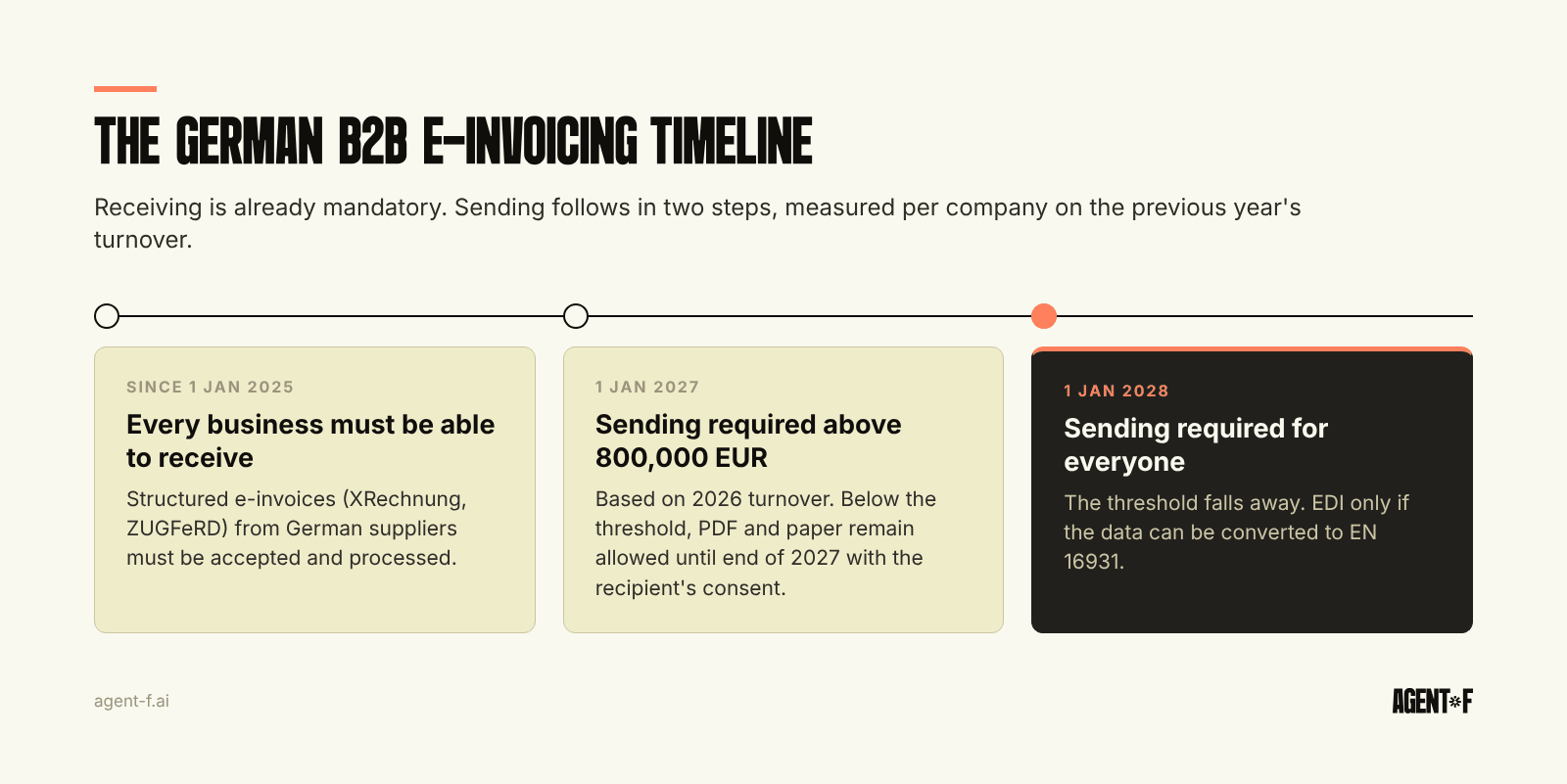
The mandate comes from the Growth Opportunities Act (Wachstumschancengesetz), which rewrote § 14 of the German VAT Act (UStG). It covers invoices between businesses that are both established in Germany, and it runs in three steps.
1 January 2025: receiving. Every business must be able to receive and process an e-invoice. There is no transition period for this.
1 January 2027: sending, above 800,000 euros. If your company's total turnover in 2026 was above 800,000 euros, domestic B2B invoices must be e-invoices from this date. Below the threshold, paper and PDF invoices stay allowed until the end of 2027, as long as the recipient agrees.
1 January 2028: sending, for everyone. The threshold falls away. Existing EDI procedures remain allowed only if the data can be converted into a format that follows the European standard EN 16931.
In its third letter on e-invoicing, dated 15 October 2026, the Federal Ministry of Finance (BMF) confirmed that these dates stand. The threshold applies per legal entity, so a group with one large and two small German entities will have different obligations per entity in 2027. Check it entity by entity, not at group level.
What counts as an e-invoice, and what does not?
An e-invoice is a structured data record, not a picture of an invoice. In practice, German companies use two formats that follow EN 16931:
- XRechnung, a pure XML file, common with public sector customers and larger companies.
- ZUGFeRD, a PDF with an embedded XML file. People read the PDF, the system reads the XML. It qualifies from version 2.0.1 in every profile except the two simplest ones, MINIMUM and BASIC WL, which do not carry enough data.
If the PDF and the XML in a ZUGFeRD file disagree, the XML counts. A scanned invoice, a Word document or a plain PDF is a "sonstige Rechnung" (other invoice): allowed during the transition and for exempt cases, but not an e-invoice. We compare the two formats in ZUGFeRD vs XRechnung.
Which invoices are exempt?
The main exceptions are small invoices up to 250 euros gross (§ 33 UStDV), travel tickets, invoices to private customers, invoices to customers abroad and certain VAT-exempt services. Small businesses under § 19 UStG (Kleinunternehmer) do not have to send e-invoices but must be able to receive them.
Cross-border invoices are not covered today. The EU plans a wider digital reporting system from 2030 under its VAT in the Digital Age initiative (ViDA), and Germany intends to align with it. In a typical B2B company, the exemptions cover a small share of invoice volume. Most supplier and customer invoices fall under the mandate.
What changes on the receiving side?
Receiving looks simple, and it is where most finance teams lose time today. Most supplier invoices still arrive as PDFs, because smaller suppliers do not have to switch yet. The e-invoices that do arrive are not always valid, since suppliers are still learning the formats.
That raises three practical questions. First, can you read the file? An XRechnung opened in a mail client is a wall of XML, so someone needs a viewer or a system that turns it into something a person can check. Second, do you check it? A file can pass the format check and still miss details required by § 14 UStG, such as the correct VAT ID or a separate amount for each VAT rate, and missing details can block the deduction. The rules are in input VAT deduction. Third, where do you keep it? Under the German bookkeeping rules (GoBD), the XML is the original and must be stored unchanged. Printing the PDF part is not enough, as explained in archiving invoices under GoBD.
What changes on the sending side?
Producing the file is the easy part. Most invoicing software can export XRechnung or ZUGFeRD. The harder part is the master data behind each invoice.
Customer VAT IDs and addresses must be complete and correct, and many customer records were created years ago without a check. Each VAT rate needs its own amount, so mixed invoices with 7 and 19 percent need a clean split. Payment terms, order references and delivery dates move into fixed fields, and customers increasingly reject invoices without their purchase order number. Credit notes and corrections must be issued as e-invoices too.
The October 2026 letter also brought relief for complex cases. Construction invoices can attach their detailed bill of quantities, and final invoices can list the down payments already received in an unstructured attachment until 30 June 2030. If you invoice in instalments or against milestones, check these rules with your tax advisor.
Why does the format change matter more than it seems?
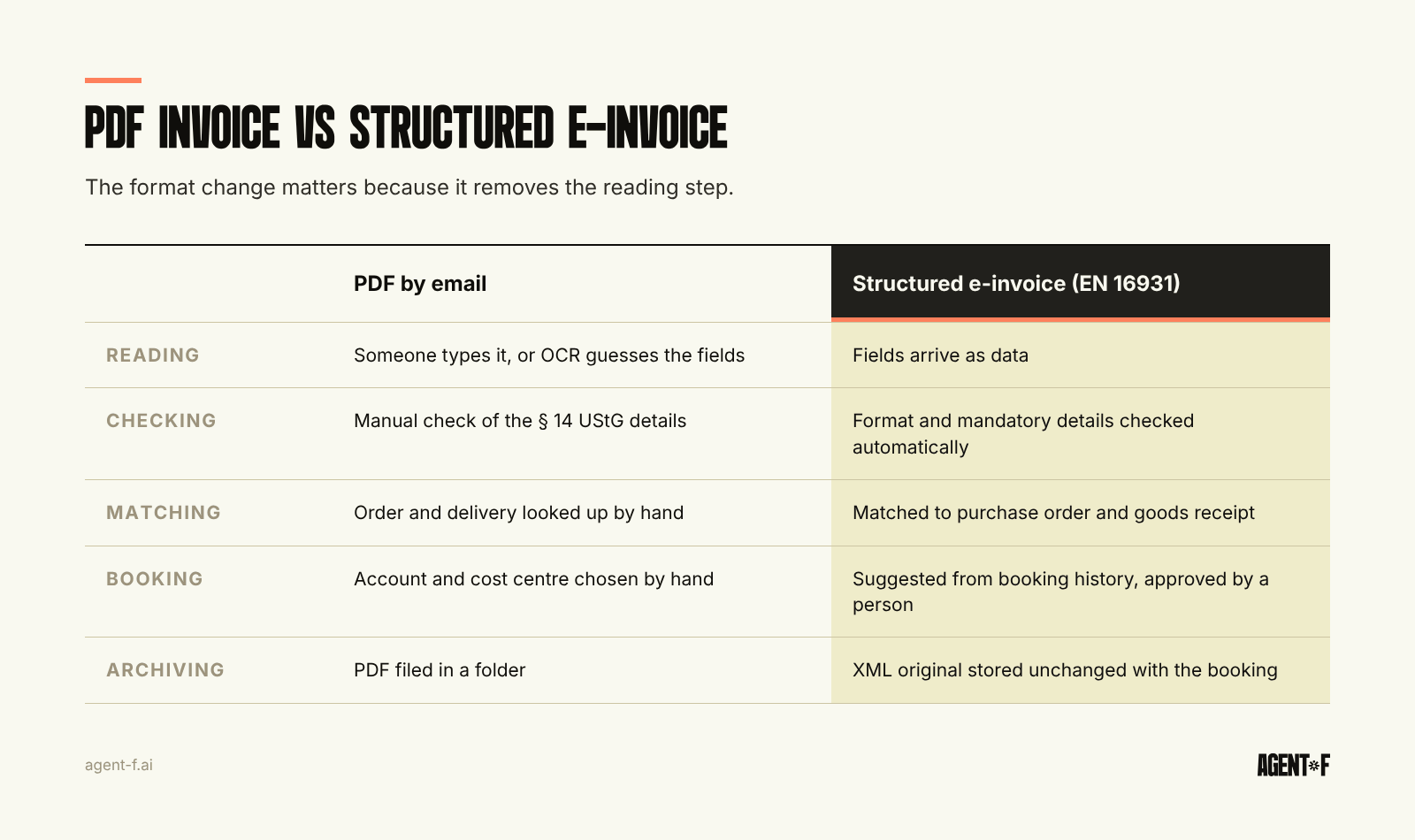
A PDF has to be read before anything can happen with it. Someone types it, or OCR software guesses the fields and someone corrects the guesses. A structured invoice arrives as data: supplier, amounts, VAT, order number and due date are already in fields.
That is what makes the next steps automatic. The invoice can be matched against the purchase order and goods receipt, as described in our article on the three-way match. It can be routed to the right approver, booked to the right account and cost centre, and paid on time. The mandate does not build that workflow, but it removes the reason it was manual.
How does Agent F help you handle e-invoices?
In an AI-native ERP, an e-invoice is input to a workflow that already exists. In Agent F, incoming XRechnung and ZUGFeRD files are read directly. The system checks the format and the mandatory details, flags what is missing, and links the invoice to its purchase order and delivery.
Agent F then suggests the account, cost centre and VAT treatment from your own booking history, each with a confidence score. The invoice goes to the person who owns the budget, and nothing is booked or paid without approval. Every step is logged in the audit trail, the same flow described in accounts payable automation.
Outgoing invoices are created from the order and the customer record, so VAT IDs, rates and references come from one place and leave as valid e-invoices. Bookings, the XML originals and the VAT figures flow into the DATEV export and the advance VAT return without being typed again.
Before January, check your 2026 turnover per entity, ask two or three suppliers for a test e-invoice and run it through your process end to end, clean your customer master data, and agree with your tax advisor where the XML originals live. If your team would end up reading XML files and retyping them into another tool, the mandate has created work instead of removing it.
Learn how Agent F works, or see it on your own invoices at agent-f.ai/demo.
This article is for general information only and does not constitute tax or legal advice. Parts of it were generated with AI. Please consult your tax advisor or legal counsel before acting on it, and feel free to reach out at team@agent-f.com with any questions or for support.