Updated
GoBD archiving: what to keep, how long, and in what form
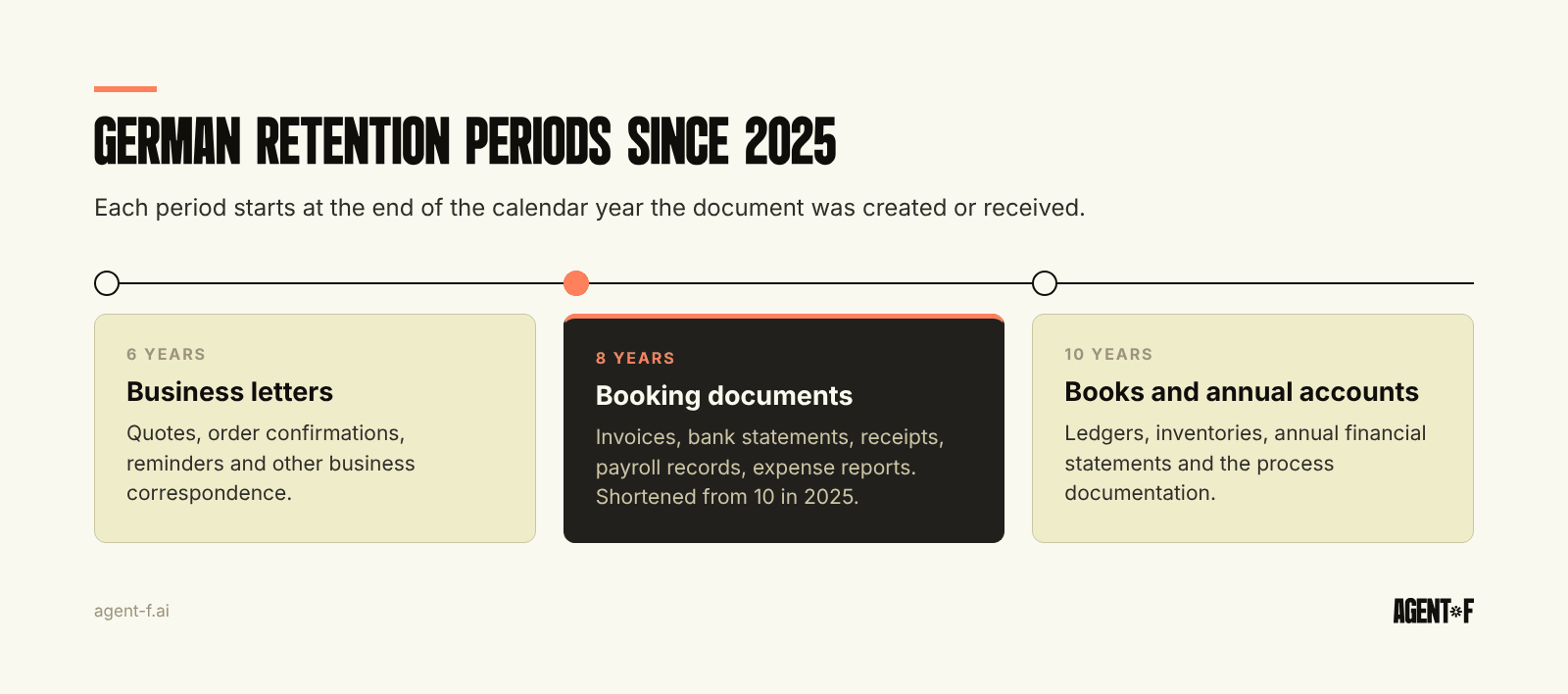
Under the GoBD (German digital bookkeeping rules), German companies must keep invoices, bank statements and other booking documents for eight years, and books, inventories and annual accounts for ten. Business letters such as quotes and order confirmations stay at six. Electronic documents must be kept in the format they arrived in, unchanged and machine-readable. For a structured e-invoice, that means the XML file is the original.
Most companies treat archiving as a storage problem: find a safe place for the files and keep them long enough. The real test comes years later, when a tax auditor picks one booking and asks to see the document, the approval and the payment behind it. An archive passes that test only if it stays linked to the ledger.
Which documents does the GoBD require you to keep?
The duty to keep records comes from two laws: § 147 of the German Fiscal Code (AO) for tax purposes and § 257 of the German Commercial Code (HGB) for commercial purposes. The GoBD is the administrative guidance from the Federal Ministry of Finance (BMF) that explains how those duties apply to electronic records.
In practice, everything that explains or supports a booking is in scope. That includes incoming and outgoing invoices, credit notes, bank statements, cash records, payroll records, travel expense reports, delivery notes where they serve as booking records, and contracts that drive bookings.
The rule is wider than many teams expect. An email is only a cover letter and can be deleted once the attached invoice is kept. But an email that changes a price, confirms an order or approves a payment is a business letter or a booking document in its own right. The test is content, not channel.
How long do you have to keep invoices and records?
The Fourth Bureaucracy Relief Act (Bürokratieentlastungsgesetz IV) shortened the period for booking documents from ten to eight years with effect from 1 January 2025. Today there are three periods:
- Ten years: books and records, inventories, annual financial statements, management reports, opening balance sheets, and the organisational documents needed to understand them, including your process documentation.
- Eight years: booking documents, which covers supplier and customer invoices, bank statements, receipts, payroll records and expense reports.
- Six years: other business letters received and sent, such as quotes, order confirmations and reminders.
Each period starts at the end of the calendar year in which the document was created or received, or the last entry was made. An invoice dated March 2026 is therefore kept until at least the end of 2034. The shorter eight-year period applies to all documents whose old ten-year period had not yet expired on 1 January 2025.
A period can also run longer. Documents stay relevant while the tax assessment for that year is still open, for example during a tax audit or an objection. Before deleting a year, check with your tax advisor (Steuerberater) that nothing is still open.
What form must electronic invoices and documents take?
The GoBD set six principles for every record: traceable, complete, correct, timely, orderly and unchanged. Two of them cause most practical problems.
Unchanged means a document must not be altered once it is in the archive, or every change must be logged so the original stays visible. A shared drive where anyone can rename, move or overwrite files does not meet that standard on its own.
Machine-readable means that data received electronically must be kept electronically, in the format it arrived in. Printing a PDF invoice and filing the paper is not enough. A bank statement received as a file stays a file.
E-invoices made this concrete. In its second amendment to the GoBD, dated 14 July 2025, the BMF confirmed that for an e-invoice the structured XML part is what you must keep. For a hybrid ZUGFeRD invoice, the PDF part can be dropped if it contains nothing tax-relevant beyond the XML. If someone added booking notes to the PDF, those notes must be kept too. Converting the XML into an image format and deleting the original is not allowed. The formats themselves are covered in e-invoicing in Germany.
Paper invoices can be scanned and destroyed after scanning, as long as the scan is complete and readable and the scanning process is described. Some originals, such as annual accounts and notarial deeds, must still be kept on paper.
What is process documentation, and do you need it?
The process documentation (Verfahrensdokumentation) describes how documents enter your company, how they are checked, booked, stored and protected, and who does what. The GoBD expect every company that keeps records electronically to have one. It is kept for ten years, because it explains how the books of each year were produced.
Many mid-sized companies have a version written once for a scanning project and never updated when the tools changed. An auditor reads it to understand whether your records can be trusted. Its absence alone does not make the books irregular, but it makes it harder to defend them if anything else looks wrong.
A useful process documentation is short and concrete: which systems hold which documents, how an invoice moves from receipt to booking to payment, how originals are protected against change, how access is controlled, and how backups work. If your process is spread across five tools, the document has to describe five tools and every hand-off between them.
Why does a separate archive create audit risk?
In a tax audit, the auditor has three ways to access your data under § 147 (6) AO: read-only access to your systems, an evaluation run by you on their instructions, or a data export handed over in a machine-readable format. In each case, the auditor will follow bookings back to their documents and forward to payments. How an audit runs is covered in tax audit preparation in Germany.
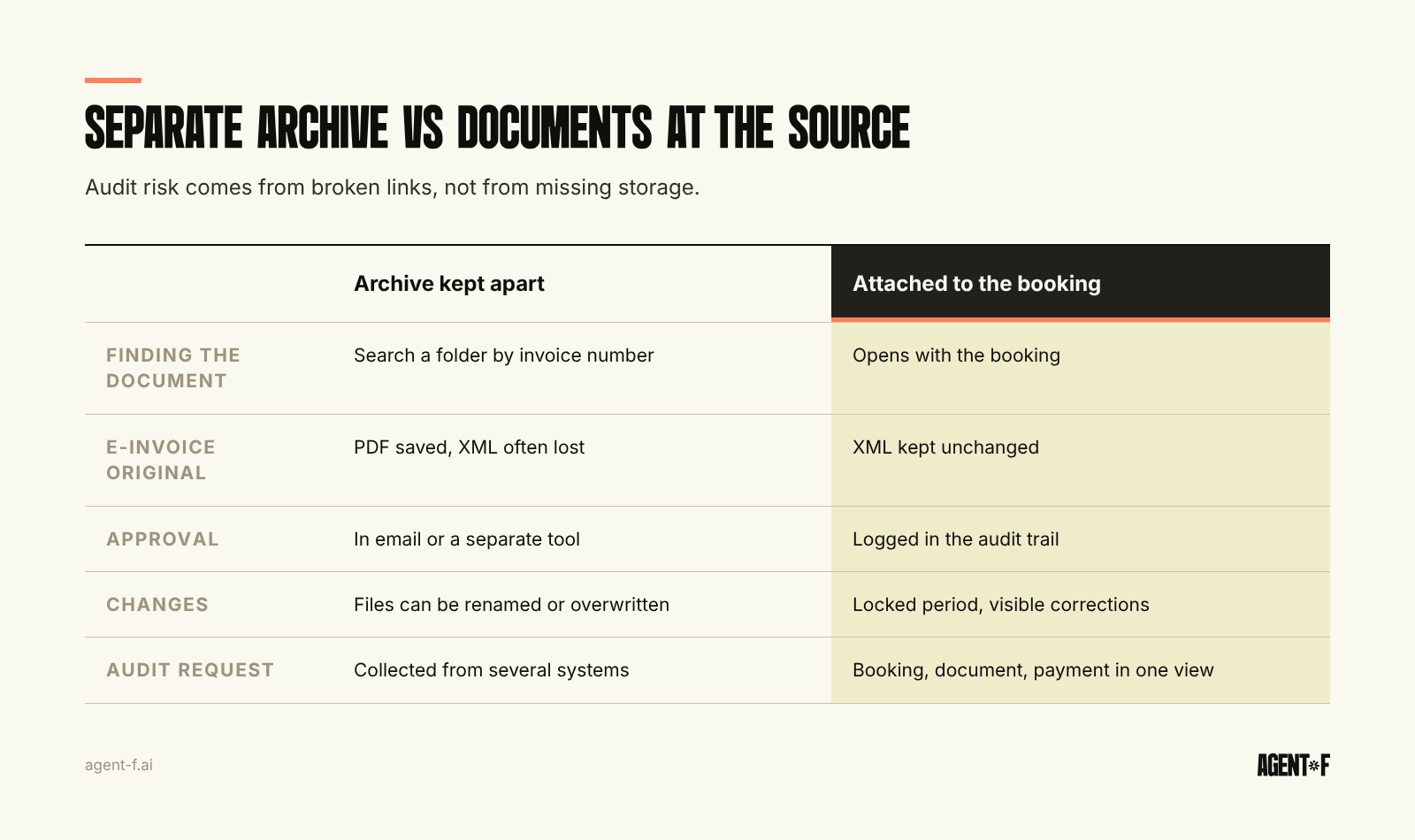
That trail breaks easily when the archive and the ledger live apart. A typical setup looks like this: invoices arrive by email, get saved to a document folder, are approved in a separate tool, are booked by the tax advisor in DATEV and are paid from the bank portal. The link between a booking and its document is often only an invoice number typed by hand, and the approval lives somewhere else again.
The risks are specific. A document cannot be found for a booking. Two versions of the same invoice exist, and no one knows which was booked. The XML of an e-invoice was never saved, only its PDF. An approval cannot be proven because the email account of the approver was deleted when they left the company. None of these is a storage problem. They are linking problems.
How does Agent F help keep archiving out of a separate project?
In Agent F, a document is stored as part of the booking it supports, not as a file to be filed later. When a supplier invoice arrives, the original is kept unchanged, including the XML of an e-invoice, and it stays attached to the booking, the purchase order, the approval and the payment.
The AI layer reads the invoice and suggests the account, cost centre and VAT treatment from your booking history, each with a confidence score. A person approves, and the approval is recorded in an immutable audit trail with the time and the user. The same flow is described in accounts payable automation. Once a period is locked at month-end, its bookings cannot be changed without a visible correction, as part of the month-end close checklist.
Because the documents are linked at the source, there is nothing to archive separately. The ledger, the documents and the audit trail are one data model, hosted in Germany with daily backups. When your tax advisor needs the data, the DATEV export carries the bookings without a second round of filing. When an auditor asks for a booking, you show it with its document, its approval and its payment on one screen.
Three things are worth doing this quarter. List every place where invoices and bank statements are stored today, and check that e-invoice XML files are among them. Pick ten bookings from 2024 at random and try to find the document, approval and payment for each within five minutes. Then ask your tax advisor when your process documentation was last updated, and whether it still describes the tools you use.
Learn how Agent F works, or see it on your own invoices at agent-f.ai/demo.
This article is for general information only and does not constitute tax or legal advice. Parts of it were generated with AI. Please consult your tax advisor or legal counsel before acting on it, and feel free to reach out at team@agent-f.com with any questions or for support.