Updated
Inventory management software: why the stock count never matches the books
The stock count rarely matches the books because the warehouse and accounting record the same events in different systems, at different times. A goods receipt is scanned on Monday, the supplier invoice is booked two weeks later, a return sits on a shelf without a credit note. Inventory management software only closes that gap when every movement creates its booking at the moment it happens, in the same data.
Most companies treat a count difference as a warehouse problem: someone miscounted, something went missing. In practice, many differences are bookkeeping timing. The fix is one record for each movement that both the warehouse and finance read from.
Why does the stock count never match the books?
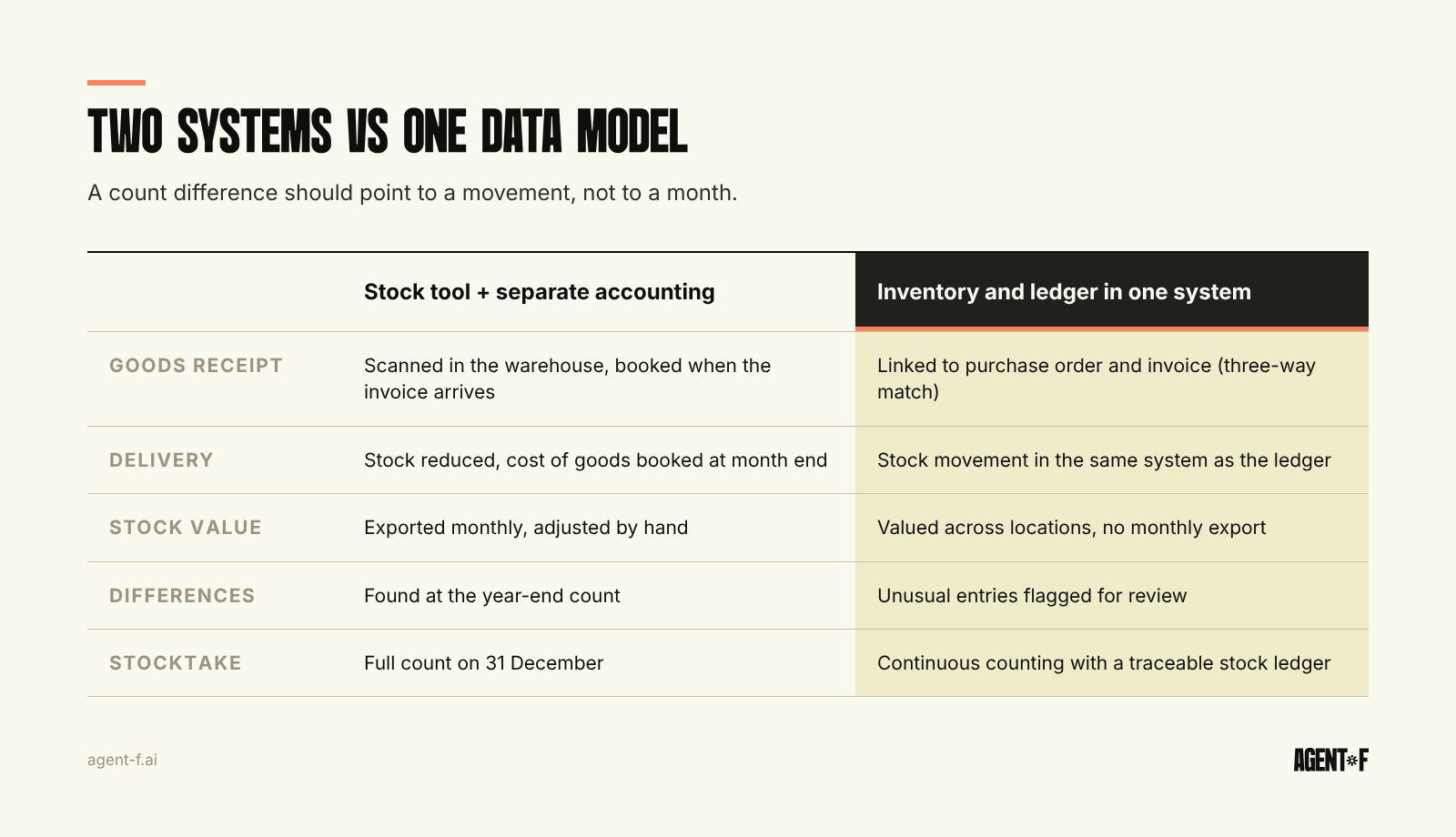
Picture a typical setup in a growing product company. The warehouse runs on a stock tool or a shop backend. Accounting runs in a separate system, often at the tax advisor (Steuerberater). Once a month, someone exports stock values and books an adjustment. At year end, the physical count produces a number, the books show another, and the difference is booked to cost of goods without anyone knowing exactly where it came from.
Each system is correct on its own terms. The stock tool knows quantities and locations. The ledger knows values and accounts. Neither knows what the other has recorded since the last export. Every day between two exports adds movements that exist in one place but not yet in the other.
This gets worse with growth. More products, a second warehouse, an online shop next to wholesale, a production step that turns raw material into finished goods. Each adds a place where a movement can be recorded once and missed once.
Where do the differences come from?
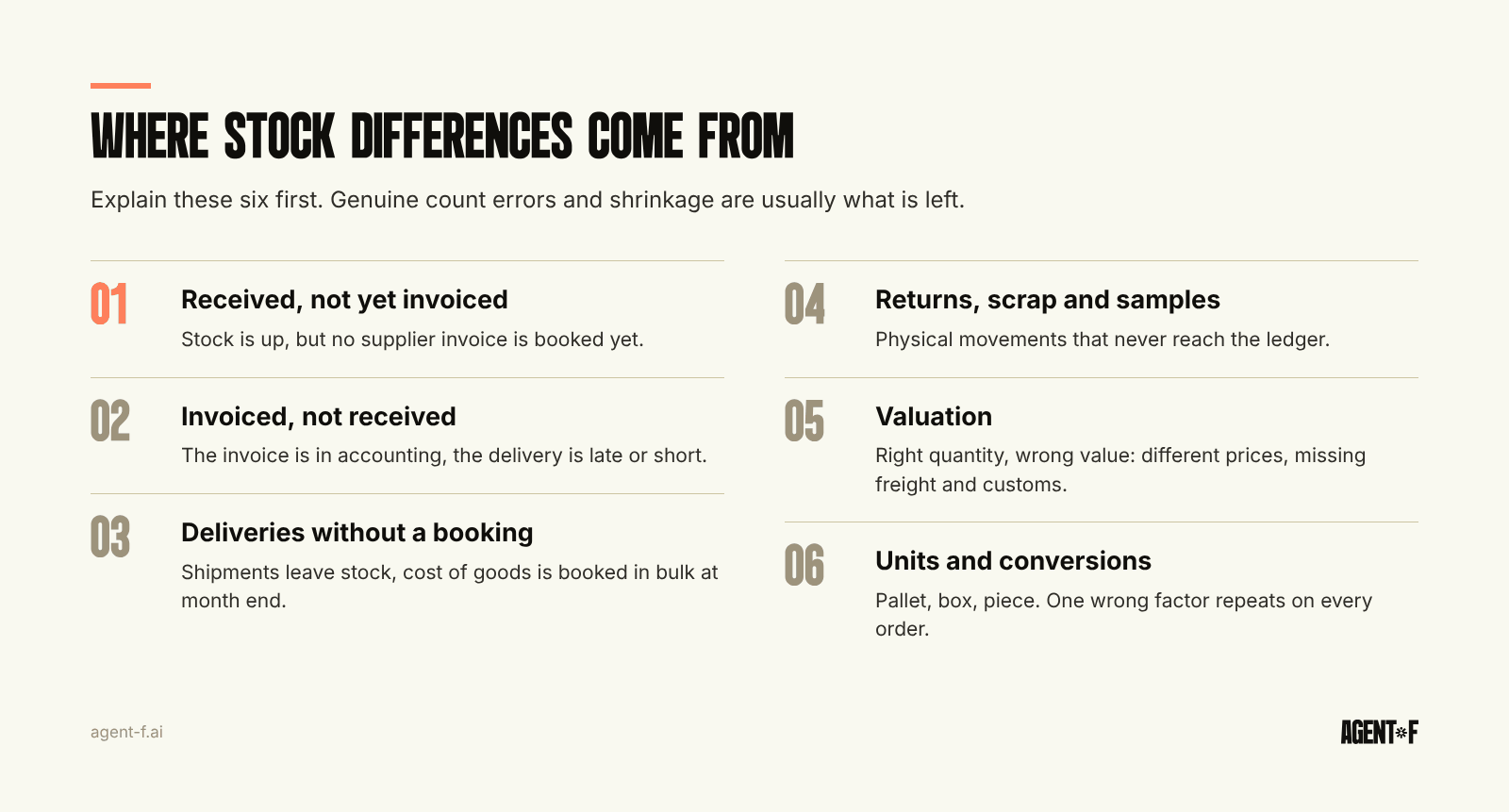
When finance and operations sit down to explain a difference, the causes are usually the same few:
- Goods received, not yet invoiced. Stock is up, but there is no supplier invoice in the books yet. At month end this needs an accrual for goods received not invoiced, or the stock value is too high against the payables.
- Invoice booked, goods not received. The reverse: the invoice is in accounting, the delivery is still on a truck or was short.
- Deliveries without a booking. Shipments from the shop or the warehouse leave stock, but the cost of goods sold is only booked in bulk at month end.
- Returns, scrap and samples. A returned item goes back on the shelf, a damaged one goes into the bin, a sample goes to a trade fair. None of them reach the ledger unless someone books them.
- Valuation. The quantity can be right and the value still wrong, because the stock tool and the ledger use different prices, or because landed costs such as freight and customs were never added. The methods are explained in inventory valuation.
- Units and conversions. Bought by the pallet, stored by the box, sold by the piece. One wrong conversion factor repeats on every order.
Only after these come genuine count errors and shrinkage. A team that can explain the first six usually finds that the remaining difference is small.
What does German law require at the stocktake?
Under the German Commercial Code (HGB), every merchant must prepare an inventory at the start of the business and at the end of each financial year, listing assets and debts with their value (§ 240 HGB). For stock, that traditionally means a physical count on the balance sheet date, the stocktake (Inventur).
§ 241 HGB allows three simplifications, and each depends on the quality of your records:
- Sampling. Stock may be determined by recognised statistical sampling, as long as the result is as informative as a full count.
- Permanent inventory. No count on the balance sheet date is needed if a stock ledger reliably shows the stock for that date. The tax guidelines (EStR/EStH 5.3) add that the book stock must be checked by a physical count at least once in each financial year. For items of high value or high shrinkage it is generally not accepted.
- Count before or after year end. The count may take place within the last three months before or the first two months after the year end, if the stock can be rolled forward or back to the balance sheet date.
All three rest on the same condition: a stock ledger in which every receipt, issue and correction is recorded and traceable. A company whose stock and books only meet once a month cannot use them with confidence and ends up counting everything on 31 December. How the count fits into the annual accounts is covered in year-end close in Germany.
What should inventory management software connect to?
Comparing stock tools on features misses the main point. The question is what each movement is connected to. Four links matter most:
- Purchasing. The goods receipt should refer to a purchase order, and the supplier invoice to both. That is the three-way match, and it is what turns a goods receipt into a reliable liability.
- Sales and the shop. Every delivery should reduce stock and book the cost of goods at the same time, whether the order came from wholesale or the online shop. See connecting your online shop to the ERP.
- Production. If you produce, consuming raw material and receiving finished goods are two movements with their own values. Leaving them to a monthly adjustment hides the real margin.
- The general ledger. Stock value in the warehouse view and on the stock accounts should be the same figure, not two figures reconciled by hand.
When these links exist, a count difference points to a specific movement rather than to a month.
How do you find differences before year end?
Do not wait for 31 December. Three habits make the year-end count a confirmation rather than a surprise.
First, reconcile the stock value with the stock accounts every month as part of the close, the same way you reconcile bank accounts. Our month-end close checklist shows where this fits. Second, count continuously. Count fast-moving and high-value items more often, slow items once a year, and book each difference when it is found, with a reason. Third, review open goods receipts and open purchase invoices every month. Anything older than a few weeks is either a missing invoice, a missing delivery or a booking error.
How does Agent F help keep stock and books in line?
In Agent F, inventory and warehouse, procurement, order management and the general ledger share one data model. Procurement runs from quotation to purchase order to goods receipt, with a three-way match against the supplier invoice. Stock levels, movements and valuation are tracked across locations, so the warehouse and finance work from the same data rather than from a monthly export.
The three-way match shows where a supplier invoice and a goods receipt do not agree, and anomaly detection flags unusual entries for review. Each finding comes as a suggestion with a confidence score, a person decides what to book, and every correction is recorded in the immutable audit trail. The figures flow into your DATEV export for the tax advisor like any other booking.
To start, pick last month's stock difference and try to explain it with the six causes above. List open goods receipts and open purchase invoices older than 30 days. Agree with your tax advisor which inventory method you want to use this year, and check whether your stock records are good enough to support it.
Learn how Agent F works, or see it on your own stock data at agent-f.ai/demo.
This article is for general information only and does not constitute tax or legal advice. Parts of it were generated with AI. Please consult your tax advisor or legal counsel before acting on it, and feel free to reach out at team@agent-f.com with any questions or for support.