Updated
Multi-book accounting: running HGB and IFRS from the same ledger
Multi-book accounting means recording each transaction once and reporting it under more than one set of rules. For a German company, that usually means HGB books for the annual accounts and the tax advisor, and IFRS figures for investors or a group parent. The differences between the books are recorded as separate, explained adjustments, so neither set of numbers is rebuilt in a spreadsheet at year-end.
Most mid-sized companies meet IFRS for the first time through an investor's reporting package or a new parent company. The common reaction is to keep the books in HGB and convert once a year in Excel. That works for one year. It becomes the slowest part of every close once investors want IFRS figures each quarter.
What is multi-book accounting?
A book, in this sense, is a complete set of accounts under one framework. Multi-book accounting keeps several of them on top of the same transactions. An invoice, a payroll run or a bank payment is booked once. Where the frameworks agree, which is most of the time, the booking appears identically in every book. Where they disagree, an adjustment is posted to the book that differs, and only there.
The opposite is parallel bookkeeping: two ledgers, two sets of entries, and a reconciliation that drifts. Or, more commonly in the Mittelstand, one ledger and a conversion workbook that only one person understands.
Multi-book accounting is not the same as multi-entity accounting, although the two often arrive together. Multi-entity means several companies. Multi-book means several views of the same company. A group with three German subsidiaries and a US investor needs both.
Why would a German company need more than one set of books?
Because HGB (the German Commercial Code) is not optional, and IFRS often is not either.
HGB is the legal base. Every German GmbH prepares its single-entity annual accounts under HGB. They determine distributable profit, they are filed, and through the link between commercial and tax accounts in § 5 EStG they are the starting point for the tax balance sheet. Your tax advisor (Steuerberater) works in HGB, usually on SKR04.
The tax balance sheet is already a second book. Many companies run multi-book accounting without calling it that. Tax rules differ from HGB in places, for example on goodwill, which is amortised over 15 years for tax, or on self-created intangible assets, which may not be capitalised for tax at all. The tax advisor handles these differences, often outside the ledger.
IFRS comes from outside. Capital-market-oriented parent companies must prepare their consolidated accounts under IFRS (§ 315e HGB), and other parents may choose to. In practice, mid-sized companies meet IFRS because a group parent reports under it, because venture or private equity investors ask for it, or because a sale or listing is planned. In each case, the German entity still files HGB accounts and adds IFRS figures on top.
Where do HGB and IFRS differ for a growing company?
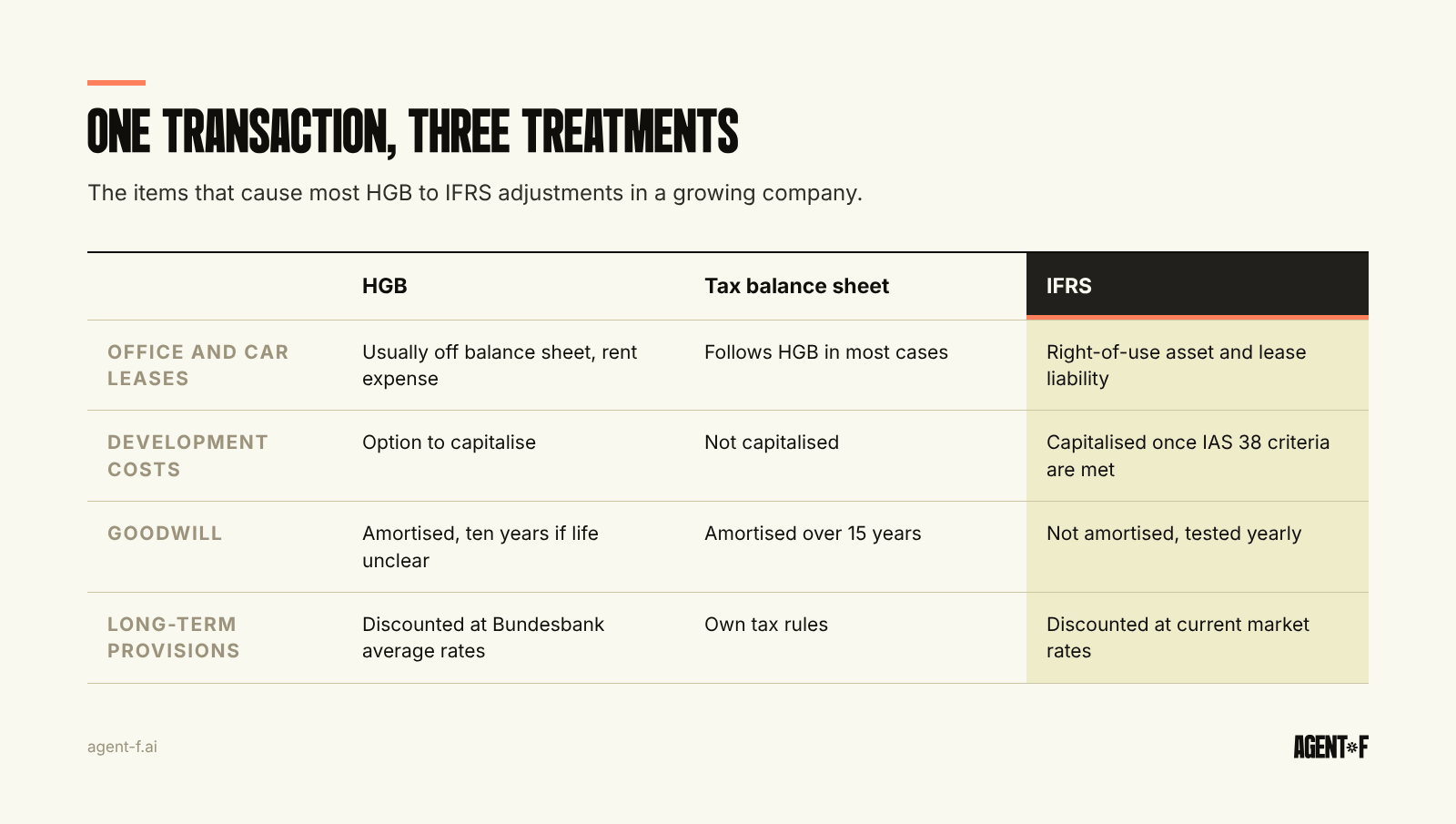
The full list of differences is long. For a 50 to 500 person company, a handful of items cause most of the adjustments.
Leases. Under IFRS 16, a lessee shows most leases on the balance sheet as a right-of-use asset and a lease liability, with depreciation and interest instead of rent. Under HGB, an office lease or a car lease usually stays off the balance sheet and the rent is an expense. For a company with several offices or a vehicle fleet, this changes EBITDA, total assets and debt.
Development costs. HGB allows, but does not require, capitalising self-created intangible assets such as software development (§ 248 (2) HGB). IFRS requires capitalisation once the conditions in IAS 38 are met. Tax law prohibits it. One sprint of engineering work can therefore sit in three places.
Goodwill. HGB amortises goodwill over its useful life, ten years if that cannot be estimated reliably (§ 253 (3) HGB). IFRS does not amortise goodwill at all but tests it for impairment every year (IAS 36).
Provisions. HGB discounts long-term provisions at average rates over seven years, ten years for pensions, published by the Bundesbank (§ 253 (2) HGB). IFRS uses current market rates. The same pension obligation has two values.
Revenue. Multi-element and prepaid contracts can recognise revenue at different times under the two standards. We cover this in revenue recognition under IFRS 15 and HGB.
Depreciation of tangible assets is the quiet one: useful lives often differ slightly, and the asset register needs a second schedule. The asset side is covered in fixed assets and depreciation.
Should you keep a second ledger or book adjustments?
There are three common setups, and they differ in where the truth lives.
- Year-end conversion in a spreadsheet. HGB books, IFRS adjustments calculated once a year outside the system. Cheap at first, slow and hard to audit later, and impossible to run quarterly.
- Two full ledgers. Every transaction is booked twice. Accurate in theory, but it doubles the work and the two ledgers drift whenever someone corrects one and forgets the other.
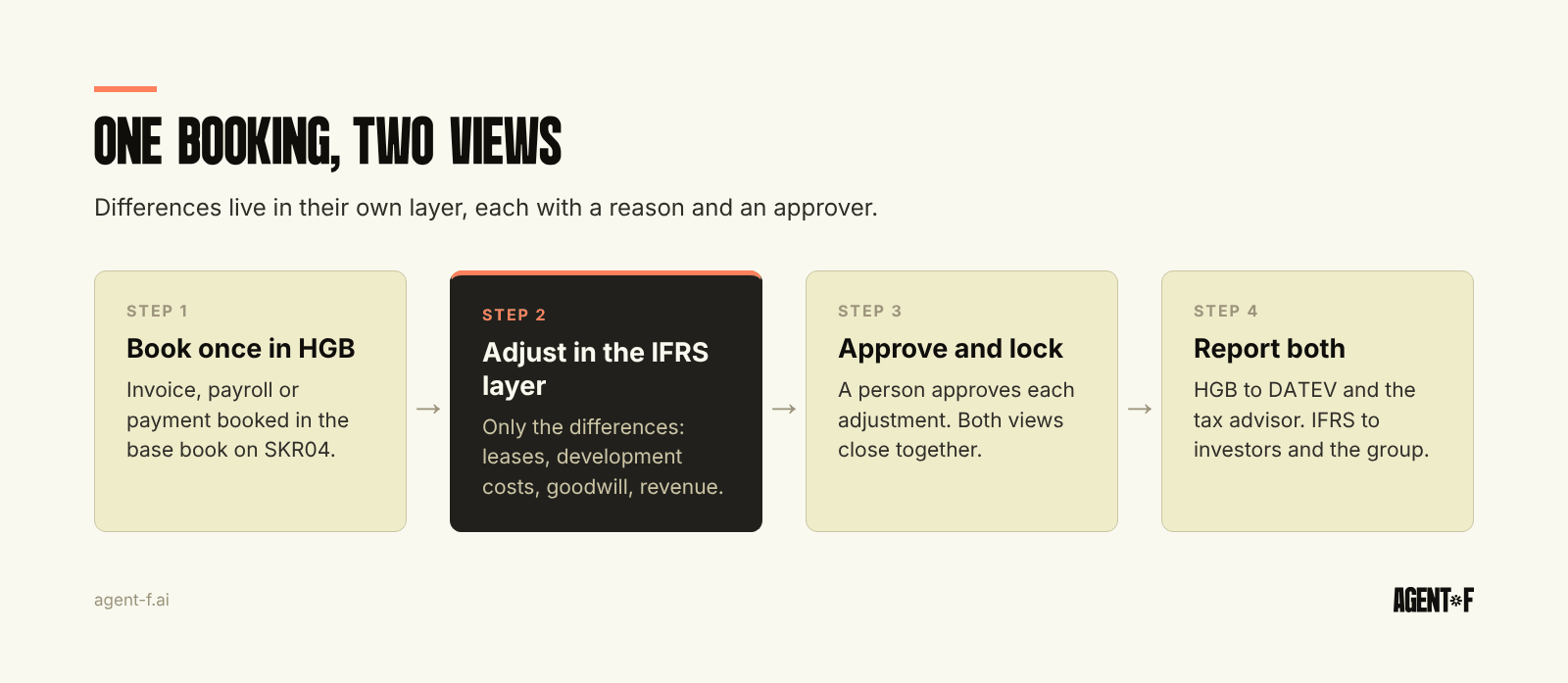
- One ledger with an adjustment layer. Every transaction is booked once in the base book, HGB for a German entity. IFRS adjustments are posted to a separate book that only contains the differences. The IFRS view is the base book plus that layer.
The third setup is what multi-book accounting usually means. It has a practical advantage beyond speed: each adjustment is a visible entry with a reason, an amount and an approver. Recurring adjustments, such as the monthly lease depreciation under IFRS 16, can run from a schedule. One-off adjustments, such as a goodwill impairment, are booked once and explained once.
Which framework is the base book is a choice. For a German subsidiary whose tax advisor files HGB accounts, HGB as the base usually keeps the DATEV export and the BWA (the monthly management report from your tax advisor) unchanged.
What makes the IFRS figures audit-ready?
An auditor reviewing IFRS figures for a group or an investor wants to see the bridge from the local accounts. That bridge should exist as a list of adjustments, not as a narrative.
Three things make it hold up. First, every adjustment links to its source: the lease contract, the project time records behind capitalised development, the impairment test. Second, both books close together. If the HGB period is locked but the IFRS layer stays open, the two drift, and the next adjustment overwrites a figure someone has already reported. Third, the adjustments are reconciled every period, so the difference between HGB equity and IFRS equity can be explained line by line.
In a group, the IFRS layer feeds the consolidation, and the auditor's questions about it look much like those in preparing for your first audit.
How does Agent F keep HGB and IFRS on one ledger?
In Agent F, the general ledger supports HGB and GoBD (German digital bookkeeping rules) on SKR04 by default, as well as IFRS, on one data model. Each transaction is booked once, and the HGB books your tax advisor receives through the DATEV export come from the same entries.
Revenue recognition under IFRS 15 runs in the revenue module, and depreciation and prepayment schedules handle recurring entries. When Agent F suggests an entry, it shows a confidence score, a person approves it, and the period lock closes the month once the work is done. Everything is recorded in the immutable audit trail. With multi-entity accounting and consolidation in the same system, each entity's figures flow into the group view without an export. Because every setup is configured for the company, ask to see how your own lease and development cost differences would be handled before you decide.
To start, list the items where your IFRS figures differ from HGB today and how each is calculated. Decide which framework is the base book for each entity. Move the recurring adjustments, usually leases and development costs, into schedules. Then agree with your auditor and tax advisor on the format of the HGB to IFRS bridge.
Learn how Agent F works, or see it on your own ledger at agent-f.ai/demo.
This article is for general information only and does not constitute tax or legal advice. Parts of it were generated with AI. Please consult your tax advisor or legal counsel before acting on it, and feel free to reach out at team@agent-f.com with any questions or for support.