Updated
Financial consolidation software: one set of numbers for the board and the Konzernabschluss
Financial consolidation software combines the books of several legal entities into one group result: it maps local accounts to a group structure, translates currencies and eliminates everything the entities did with each other. In Germany, a parent company must prepare group accounts (Konzernabschluss) under § 290 HGB once it controls a subsidiary, unless the group stays below the size limits in § 293 HGB for two years running.
Most growing groups run multi-entity consolidation twice: once a month for the board, in a spreadsheet, and once a year for the statutory accounts, with the tax advisor or auditor. The two rarely agree. The real job of consolidation software is to make them the same calculation.
When does a German group have to prepare consolidated accounts?
The duty sits in § 290 of the German Commercial Code (HGB). It applies when a corporation based in Germany, typically a GmbH or AG, and by extension a GmbH & Co. KG, can exercise controlling influence over another company. A majority of voting rights is the most common case, but control agreements and certain appointment rights count too.
The group accounts and a group management report must be prepared within the first five months of the following financial year. For capital-market-oriented parents, the deadline is four months.
Smaller groups are exempt under § 293 HGB if at least two of three criteria are met on two consecutive balance sheet dates. There are two ways to test:
- Gross method: the simple sum of the parent and all subsidiaries, before eliminations, stays at or below 30 million euros balance sheet total, 60 million euros revenue and 250 employees on average.
- Net method: a trial consolidated statement, after eliminations, stays at or below 25 million euros balance sheet total, 50 million euros revenue and 250 employees.
Many growing groups use the gross method first because it needs no consolidation at all. Once the gross figures get close, the net method is worth running, because eliminating internal revenue often keeps the group under the limit for another year. That trial run is itself a consolidation, which is a good reason to have one available before you are obliged to publish it.
Being exempt from the statutory duty rarely means being exempt from consolidation. Investors, banks and the board want one group view, usually every month.
What actually happens in a consolidation under HGB?
Before anything is eliminated, the entity figures have to be comparable. § 300 HGB requires the group accounts to combine all entities as if they were one company, and § 308 HGB requires uniform valuation. In practice, that means every entity's accounts map to one group chart of accounts, and differences in local policy, such as depreciation periods, are adjusted.
Foreign subsidiaries are translated into euros under § 308a HGB: assets and liabilities at the closing rate, equity at the historical rate, and income and expenses at the average rate. The resulting difference goes to equity, not to profit. The mechanics of rates and revaluation are covered in multi-currency accounting.
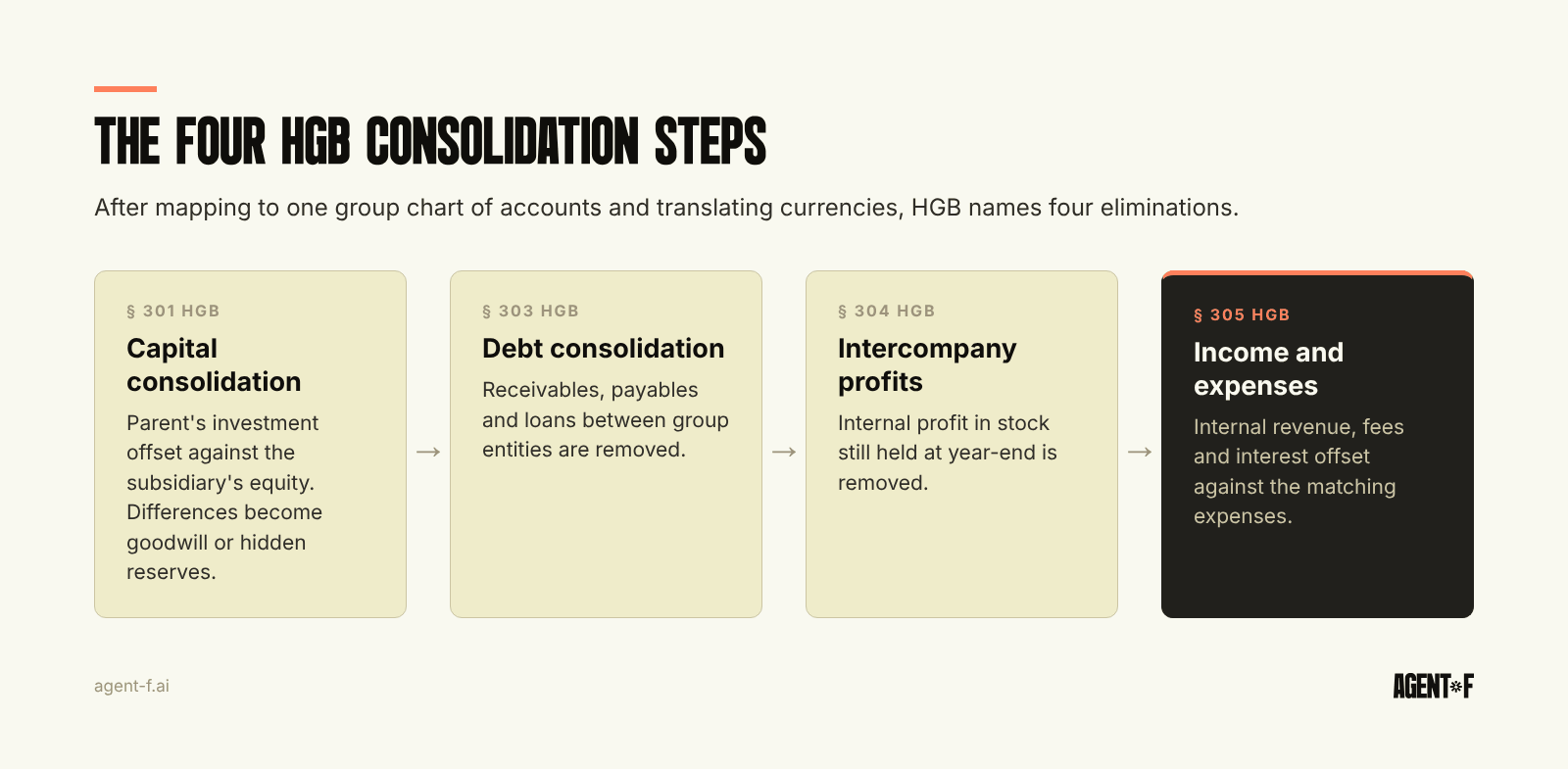
Then come the four eliminations HGB names:
- Capital consolidation (§ 301 HGB): the parent's investment in each subsidiary is offset against the subsidiary's equity. Any difference becomes goodwill, hidden reserves or a negative difference.
- Debt consolidation (§ 303 HGB): receivables and payables between group entities are removed, including intercompany loans.
- Elimination of intercompany profits (§ 304 HGB): if one entity sells goods to another and they are still in stock at year-end, the internal profit in that stock is removed.
- Income and expense consolidation (§ 305 HGB): internal revenue, management fees and interest are offset against the matching expenses.
Debt, intercompany profit and income and expense consolidation may be skipped where the effect is of minor importance. That exception helps in the first years, but it is a judgement to agree with your auditor, not a default. Eliminations only work when both sides of every intercompany transaction agree, which is why intercompany reconciliation comes before consolidation, not during it.
Why do the board numbers and the Konzernabschluss drift apart?
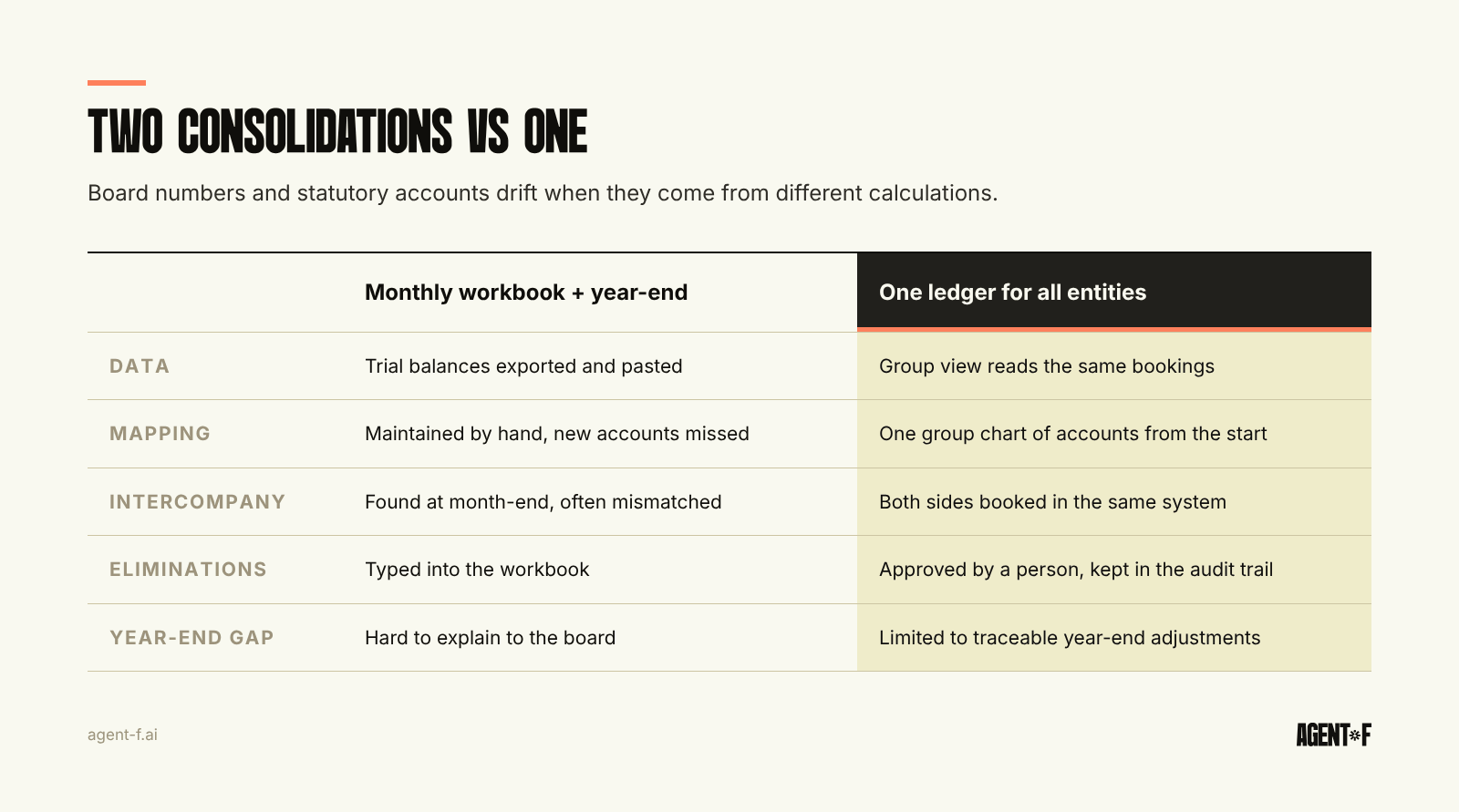
The monthly board report and the annual statutory consolidation usually start from different data. During the year, finance exports trial balances from each entity, pastes them into a workbook, maps accounts by hand and eliminates the intercompany items it knows about. At year-end, the tax advisor or auditor builds the statutory consolidation from the final entity accounts, with year-end adjustments the monthly workbook never saw.
Three things then go wrong. The mapping in the workbook drifts as entities add accounts, and a new account that nobody mapped ends up in the wrong line without an error. Intercompany items are booked in different months on each side, so the monthly elimination is a best guess. And when the statutory result differs from the December board figure, nobody can explain the gap quickly, because the two calculations share no history.
For the board, this is worse than late numbers. A group result that changes after the year-end raises questions about every monthly figure before it. Our guide to board reporting covers what investors expect each month. Consolidation is where that report most often loses its credibility.
What should financial consolidation software actually do?
The common advice is to buy a consolidation tool that sits on top of the entity ledgers. That reduces spreadsheet work, but the tool still works from copied data, and every mapping and import is another place for the numbers to diverge. Before you choose, test any option against your own group with these questions:
- Where does the data come from? If entity balances are imported, ask how often, and what happens when an entity posts a correction after the import.
- Who owns the mapping? A shared group chart of accounts, used by every entity from the start, removes most mapping work. Otherwise, check that unmapped accounts are flagged, not silently grouped.
- How are intercompany items found? Ideally, an intercompany invoice creates both sides at once, with the counterparty recorded on each line.
- Can you trace a group figure back to bookings? A reviewer should be able to click from a consolidated line to the entity bookings and the eliminations behind it.
- Does the same logic run monthly and at year-end? If the board consolidation and the Konzernabschluss use different tools, they will drift.
- Does it fit your tax advisor's process? In most German groups, entity accounts still go to the tax advisor through DATEV. Consolidation should not break that flow.
The ledger questions behind these tests, such as when to add an entity and how to structure it, are covered in our guide to multi-entity accounting.
How does Agent F help with consolidation?
In Agent F, all entities run on one data model, with a chart of accounts based on SKR04 and adapted to your structure. Multi-entity accounting and consolidation sit in the same system, so there is nothing to import into a consolidation: the group view reads from the same bookings, and the DATEV integration keeps the handover to your tax advisor in place.
Because both sides of an intercompany transaction are booked in the same system, finance can compare them before the close rather than across two exports, and anomaly detection flags unusual entries for review. Where the AI layer suggests an entry, the suggestion carries a confidence score and a person approves it. Nothing is posted without a person, and every suggestion, change and approval is kept in an immutable audit trail.
Because the monthly group result and the year-end figures come from the same ledger, the gap between the December board figure and the statutory accounts is limited to genuine year-end adjustments, and each one is traceable. For multi-entity groups, this is how the close moves from around 15 days to around 3. Capital consolidation and judgements such as goodwill and the minor-importance exception still sit with your auditor or tax advisor. Agent F gives them clean, traceable inputs.
Before your next year-end, run both § 293 tests on your 2025 and 2026 figures, list every intercompany relationship with its counterparty account, check that each entity maps to one group structure, and agree with your auditor which eliminations they expect. The steps for the statutory year-end are in our guide to the year-end close in Germany.
Learn how Agent F works, or see it on your own group structure at agent-f.ai/demo.
This article is for general information only and does not constitute tax or legal advice. Parts of it were generated with AI. Please consult your tax advisor or legal counsel before acting on it, and feel free to reach out at team@agent-f.com with any questions or for support.