Updated
Order to cash: why invoices get forgotten when nothing links order and invoice
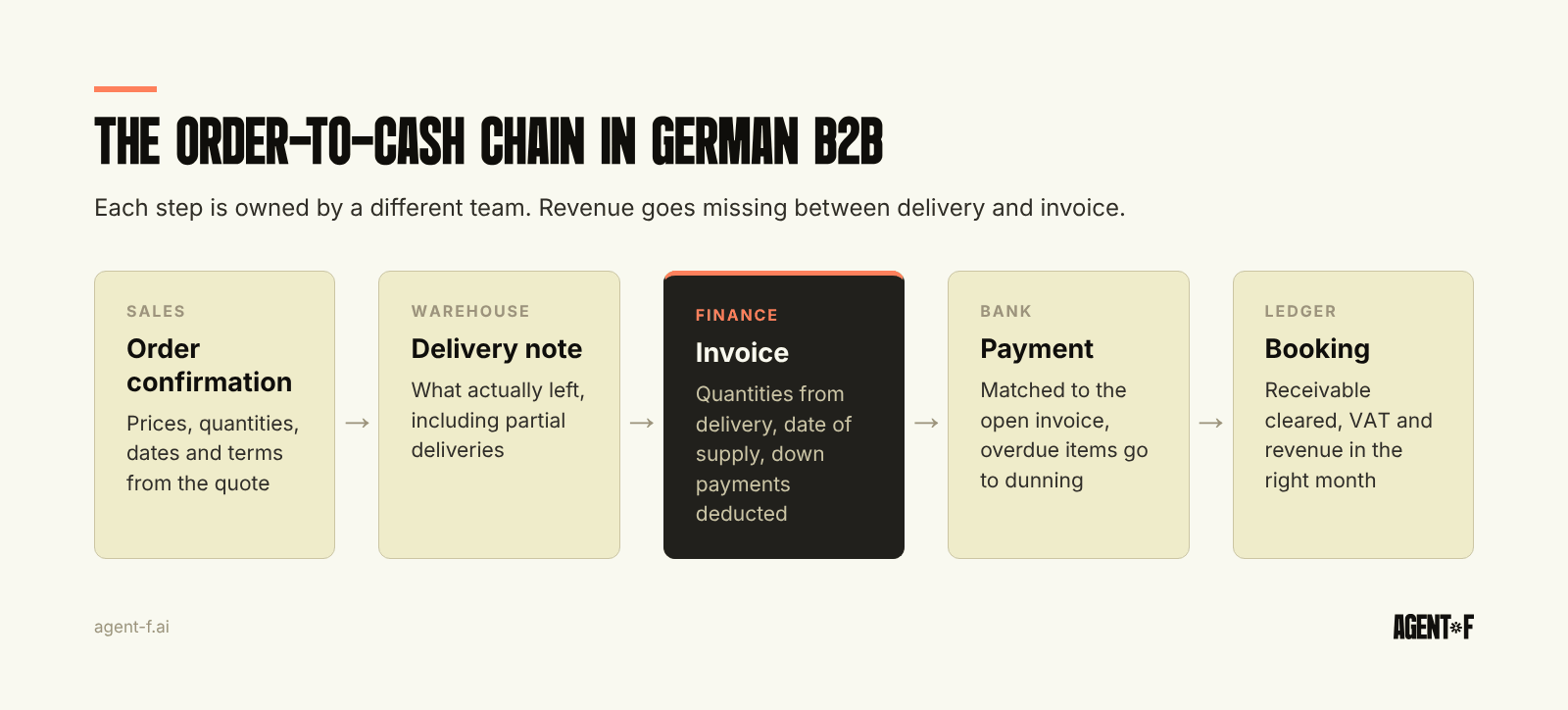
Order to cash is the process from a customer's order to the payment booked in your ledger: order confirmation, delivery, invoice, payment, matching and, if needed, dunning. In most German B2B companies the weakest point is not collection but the step before it. Goods leave the warehouse or a service is completed, and the invoice is written late, wrong or not at all, because nothing in the system connects the delivery to the invoice.
Advice on order to cash usually focuses on getting paid faster. That matters, but a company cannot collect an invoice it never sent. This guide looks at the gap between delivery and invoice, why partial deliveries and down payments widen it, and what it costs in VAT and revenue.
What does order to cash cover in a German B2B company?
A typical order-to-cash chain has six documents or events, each created by a different team:
- Order and order confirmation (Auftragsbestätigung). Sales confirms prices, quantities, delivery dates and payment terms. The terms ideally come straight from the quote, as described in quotes to orders.
- Delivery and delivery note (Lieferschein). The warehouse ships, or the project team completes the service. The delivery note records what actually left, which is not always what was ordered.
- Invoice. Finance invoices what was delivered, with the date of supply, which is a mandatory detail under § 14 (4) No. 6 of the German VAT Act (UStG).
- Payment. The customer pays, often in part, often with a deduction.
- Matching and booking. The payment is matched to the open invoice and the receivable is cleared.
- Dunning. Overdue invoices get reminders.
Steps 4 to 6 are covered in our articles on payment reconciliation and receivables and dunning. The rest of this guide is about the handover between steps 2 and 3, where revenue quietly disappears.
Why do delivered orders go unbilled?
Nobody decides not to invoice. The invoice is forgotten because the trigger for it sits in a different place from the person who writes it.
The usual patterns look like this. The warehouse uses its own tool, and delivery notes reach finance as a PDF or a printout at the end of the week. Services have no delivery note at all, so the invoice depends on a project manager remembering to say the work is done. Sales agrees an extra item by phone and it ships without being added to the order. A customer orders by email and the order is entered only after delivery, if at all. Returns and replacement deliveries create documents that nobody links to the original order.
Each case is small. Together they produce a list of deliveries without invoices that nobody owns, because no report shows it. Finance sees the invoices it has written and the open items they create, but not the deliveries that never became an invoice. The gap often shows up only at year-end, when stock movements and revenue do not reconcile, or when a customer asks why they never received a bill.
How do partial deliveries and down payments make it harder?
Two situations common in German B2B multiply the number of documents per order.
Partial deliveries (Teillieferungen). A customer orders 1,000 units, receives 400 this month and 600 next month. If each delivery is invoiced, finance must track what has already been billed against the order. If the company invoices only once everything has shipped, the first delivery sits unbilled for weeks. Either way, someone has to know, per order line, what was ordered, delivered and invoiced.
Down payments (Anzahlungen). Machinery, projects and custom production often require a payment before delivery. VAT on a down payment arises when the money is received, not when the goods are delivered. The final invoice must then deduct the down payments already received and the VAT on them (§ 14 (5) UStG). A final invoice that forgets a down payment overcharges the customer. One that deducts it twice undercharges, and both create VAT errors. We go through the billing logic in detail in down-payment and partial invoices.
Neither case is complicated on its own. The trouble starts when the order lives in one tool, the deliveries in another and the down payment in the accounting system, and a person has to put the three together each time.
What happens to VAT and revenue when a delivery is not invoiced?
The consequences go beyond the missing cash.
VAT is owed anyway. Most German companies pay VAT on agreed amounts (Sollbesteuerung). Under § 13 (1) No. 1a UStG, VAT arises at the end of the advance VAT return period in which the supply was made, whether or not an invoice exists. A delivery made in March and invoiced in May belongs in the March return. If it is reported in May, the March return was wrong. The filing rules are in our guide to the advance VAT return.
The invoice has a deadline. For supplies to other businesses, § 14 (2) UStG requires an invoice within six months of the supply. For domestic B2B supplies, that invoice increasingly has to be a structured e-invoice as the German mandate phases in.
Revenue belongs to the month of delivery. Under the realisation principle of the German Commercial Code (§ 252 (1) No. 4 HGB), revenue from a sale is generally realised when the goods are delivered or the service is completed. An unbilled delivery at month-end means the profit and loss account and the BWA (the monthly management report from your tax advisor) understate revenue, and the margin per customer is wrong.
The cash arrives later, or never. Every week between delivery and invoice is a week added to the payment term. And a delivery that is invoiced months later invites disputes about quantities and prices.
Which links must exist between order, delivery and invoice?
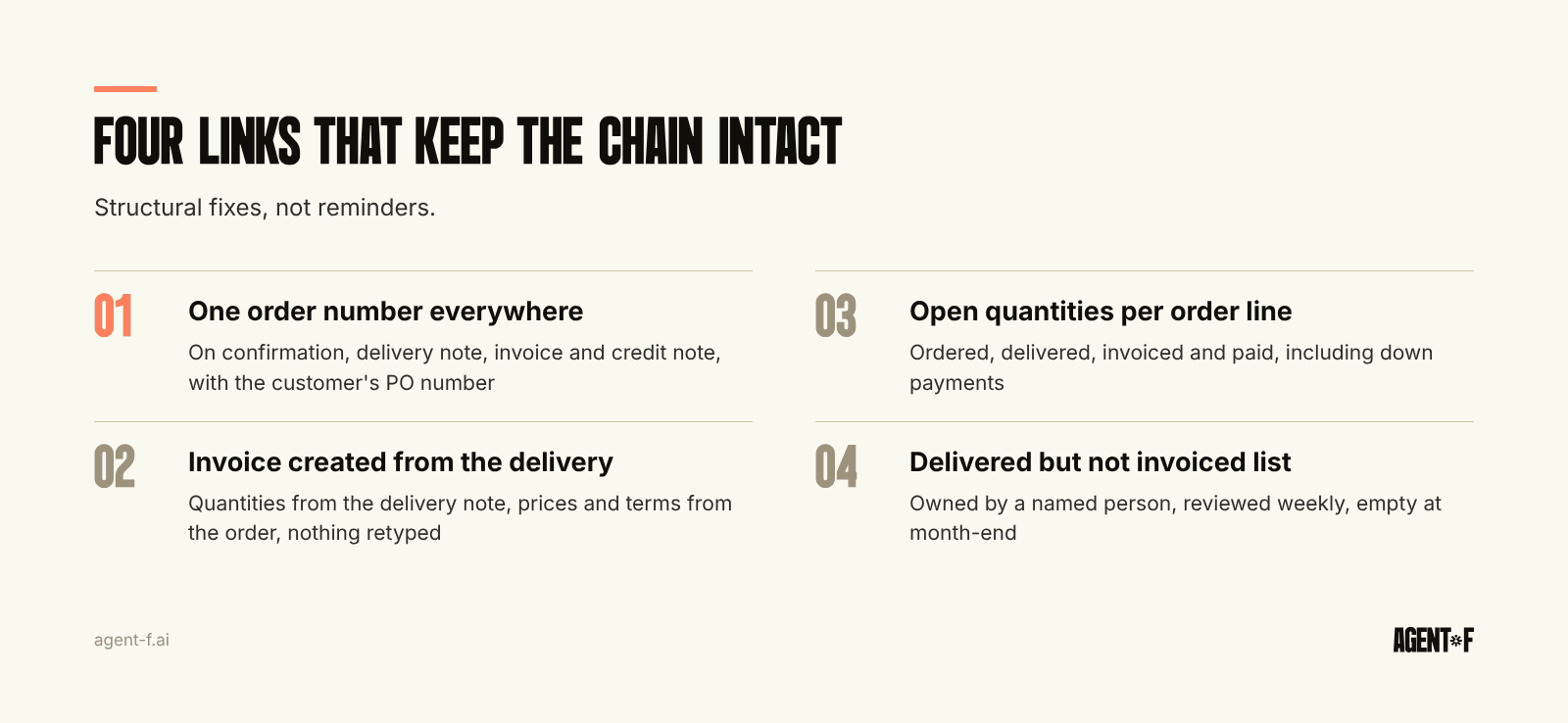
The fix is structural, not a reminder. Four links keep the chain intact:
- One order number on every document. Order confirmation, delivery note, invoice and credit note all carry it, and the customer's purchase order number is stored with it. Many larger customers reject invoices without their order number.
- Invoices created from the delivery, not typed. The invoice takes quantities from the delivery note and prices and terms from the order. Nobody re-enters them.
- Open quantities per order line. For every line the system knows ordered, delivered, invoiced and paid. Partial deliveries and down payments are then just states of the same order.
- A daily list of deliveries without invoices. Delivered but not invoiced is a report, owned by a named person, reviewed every day or week and empty at month-end.
The last point is the cheapest and most effective. Even without new software, a weekly comparison of delivery notes against invoices finds most of the gap.
How does Agent F help close the order-to-cash loop?
In Agent F, order management covers the path from order to cash, and it sits on one data model with inventory, invoicing and accounts receivable. Orders, stock movements, invoices and payments live in the same system rather than in three tools, so the gap between delivery and invoice can be seen in one place instead of reconstructed from a warehouse list and a billing spreadsheet.
Workflow automation and anomaly detection run on that same data. Every AI action is a suggestion with a confidence score, the responsible person approves it, and every step is recorded in the immutable audit trail. Whatever system you use, keep the list of delivered but uninvoiced orders and the open down payments per order under one named owner, and review both before each VAT return.
Outgoing invoices leave as e-invoices (XRechnung) where required. Payments are matched to open invoices from the bank feed, overdue items move into dunning, and the bookings reach your tax advisor through the DATEV export.
As a first step, pull all delivery notes from the last three months and match them against invoices issued. Then check how many orders with down payments are still open and whether each final invoice deducted them correctly. Finally, name one person who owns the list of deliveries without invoices.
Learn how Agent F works, or see it on your own orders and deliveries at agent-f.ai/demo.
This article is for general information only and does not constitute tax or legal advice. Parts of it were generated with AI. Please consult your tax advisor or legal counsel before acting on it, and feel free to reach out at team@agent-f.com with any questions or for support.