Updated
Accounts receivable automation: why dunning stops when matching is manual
Accounts receivable automation means invoices, payment matching and reminders run as one process: an incoming payment is matched to its open invoice, the open item list updates, and reminders go only to customers who have really not paid. Most companies automate the reminder and leave the matching manual. That is why their dunning runs late, stops entirely, or chases customers who paid last week.
The reminder is the visible part of receivables, so it is the part people try to automate first. The work that decides whether a reminder is right happens earlier, in the bank account. This guide follows the process in that order, and explains the German rules that give a reminder its weight.
Why do reminders stop when matching is manual?
A reminder is only as good as the open item list behind it. If that list is a week old, every reminder is a guess.
In many growing companies, matching works like this. Payments arrive in two or three bank accounts and a payment provider. Once a week, someone exports the statements, compares them with the invoice list and marks what was paid. Customers pay two invoices in one transfer, leave out the invoice number, deduct a discount or pay a slightly different amount. Each of those needs a person to look it up.
When the person is busy with month-end, matching waits. And because nobody wants to send a reminder to a customer who has already paid, the dunning run waits too. After a few weeks, overdue invoices pile up, the first reminder goes out late, and the second one never goes out at all. On paper, the company has a dunning process. In practice, it has one person's spare time.
The fix is daily matching, so the open item list is current when the dunning run starts. Our article on payment reconciliation explains why matching stays manual in most setups and what changes when it runs continuously.
What has to be true before a reminder goes out?
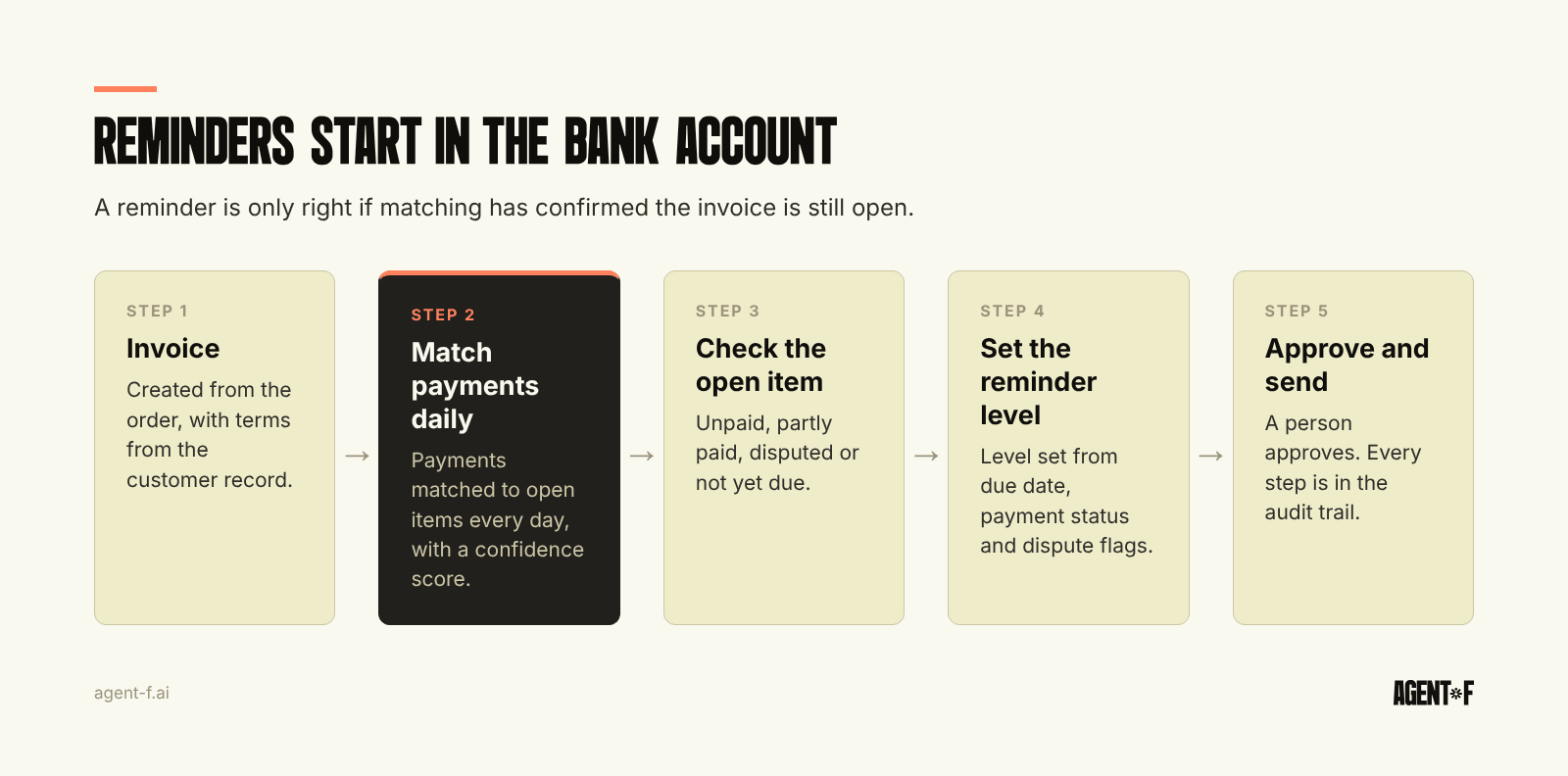
Before the first reminder, four things should be checked for each invoice. In a manual process, they are checked from memory, if at all.
- Is it really unpaid? The payment may have arrived in another account, under another customer number, or bundled with other invoices.
- Is it partly paid? A short payment can be a discount taken late, a bank fee or a deduction for a complaint. Each needs a different reaction.
- Is it disputed? If the customer has raised a problem with the delivery or the invoice, a reminder damages the relationship and rarely speeds up payment.
- Is it really due? Payment terms, agreed extensions and discount periods have to come from the customer record, not from a default.
If any of these is unclear, the right next step is a question to the account owner, not a reminder. Short payments from discounts deserve their own rules, covered in payment terms and Skonto.
How does dunning work in Germany?
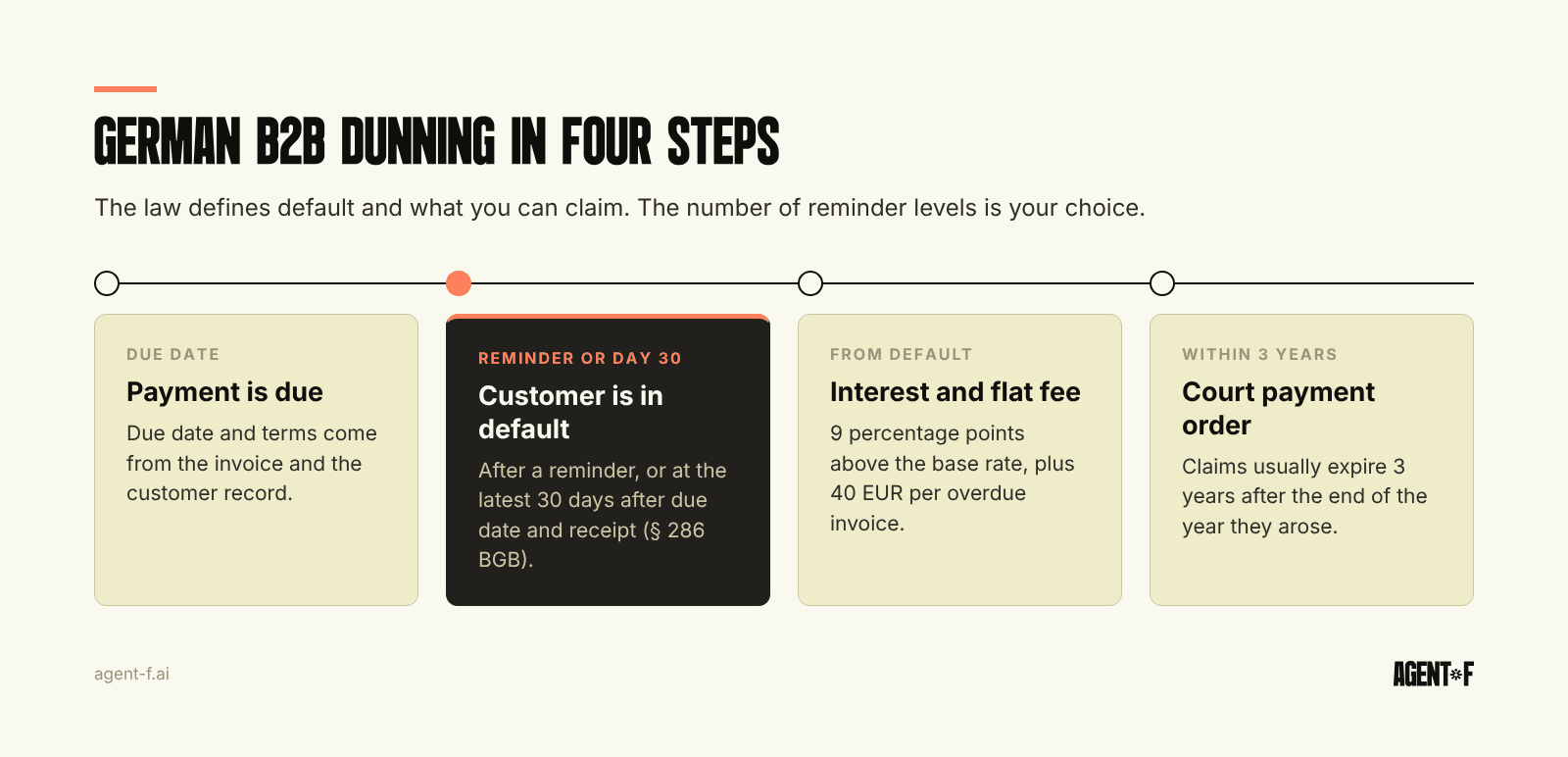
German law does not require a fixed number of reminder levels. The three-step Mahnstufen (dunning levels) used by many companies are a convention. What the law defines is when a customer is in default (Verzug), and what you can claim from that point.
Under § 286 of the German Civil Code (BGB), a customer is in default once they do not pay after a reminder that follows the due date. A reminder is not needed if the payment date was fixed in the calendar, for example "payable by 15 December". For B2B invoices there is also a fallback: a business customer is in default at the latest 30 days after the due date and receipt of the invoice, even without a reminder.
From default, § 288 BGB gives you two claims against business customers:
- Default interest (Verzugszinsen) of nine percentage points above the base rate. The Bundesbank set the base rate at 1.52 percent from 1 July 2026, so the B2B rate is currently 10.52 percent a year. The base rate changes on 1 January and 1 July; the next change is on 1 January 2027.
- A flat fee of 40 euros per overdue invoice, also for instalments and down payments.
Claims usually expire three years after the end of the year in which they arose (§ 195 and § 199 BGB). An invoice from 2023 that was never chased can expire on 31 December 2026. If reminders do not settle it, the court dunning procedure (gerichtliches Mahnverfahren) with a Mahnbescheid (court payment order) is the next formal step.
What tone works for B2B reminders?
In German B2B, the first contact is usually a polite payment reminder (Zahlungserinnerung). It assumes an oversight, names the invoice, the amount and the due date, and attaches the invoice again. It does not mention interest. Most late payments are settled at this stage.
The second level is firmer. It refers to the first reminder, sets a concrete payment date and can mention default interest and the 40-euro flat fee. The third level states the consequences: the next step is the court dunning procedure or a collection agency.
Tone should follow the customer, not only the level. A strategic customer who pays late once a year needs a call from the account owner, not a template. A customer who always pays on the second reminder may benefit from a reminder before the due date. A new customer with a first overdue invoice deserves the friendly version, even at day 20. This is where a fixed rule set reaches its limit: the rules decide the level, but someone still has to decide the words.
Which parts of receivables can you automate safely?
Not every step should run without a person. A sensible split looks like this:
- Invoicing. Invoices created from the order or contract, with terms from the customer record. Fully automatic once the master data is clean.
- Matching. Payments matched to open items daily. Clear matches can be booked automatically, unclear ones go to a person with a suggestion.
- Dunning run. Reminder levels calculated from due date, payment status and dispute flags. Drafts are prepared automatically.
- Sending. First reminders can go out on approval in bulk. Second and third levels, and anything to key accounts, deserve a look.
- Write-off and provisions. Always a person, together with your tax advisor (Steuerberater).
The open item list then feeds the cash flow forecast and month-end. Doubtful receivables need a value adjustment under HGB (German commercial code), which is one of the checks in the month-end close checklist.
How does Agent F help with receivables and dunning?
In Agent F, invoicing, bank feeds and the ledger share one data model, so the dunning run starts from the same open item list your accounting uses.
Payments arrive through the direct bank integration and from payment providers. Agent F suggests a match to the open invoice for each one, with a confidence score, and a person confirms it. Teams typically reach 90 percent or more reconciliation accuracy by month three, as the categorisation learns from their own corrections. Aging is real time, so the open item list is current on the day the dunning run starts, not on the day someone last exported a statement.
Dunning runs on that same open item list, so reminders go to customers who have actually not paid. Approvals follow the workflows you define, and everything is recorded in the immutable audit trail. The choice of words for a key account stays with the account owner. Bookings and open items flow into the DATEV export for your tax advisor.
To start, run three checks this month. Compare your open item list with the bank accounts and count how many "overdue" invoices are in fact paid. Check how many overdue invoices had no reminder at all. And look for invoices from 2023 that are still open before the year ends. The answers show whether your problem is the reminder or the matching. Our article on working capital shows what faster collection means for cash.
Learn how Agent F works, or see it on your own receivables at agent-f.ai/demo.
This article is for general information only and does not constitute tax or legal advice. Parts of it were generated with AI. Please consult your tax advisor or legal counsel before acting on it, and feel free to reach out at team@agent-f.com with any questions or for support.