Updated
AI in FP&A: what finance teams use today and what is still hype
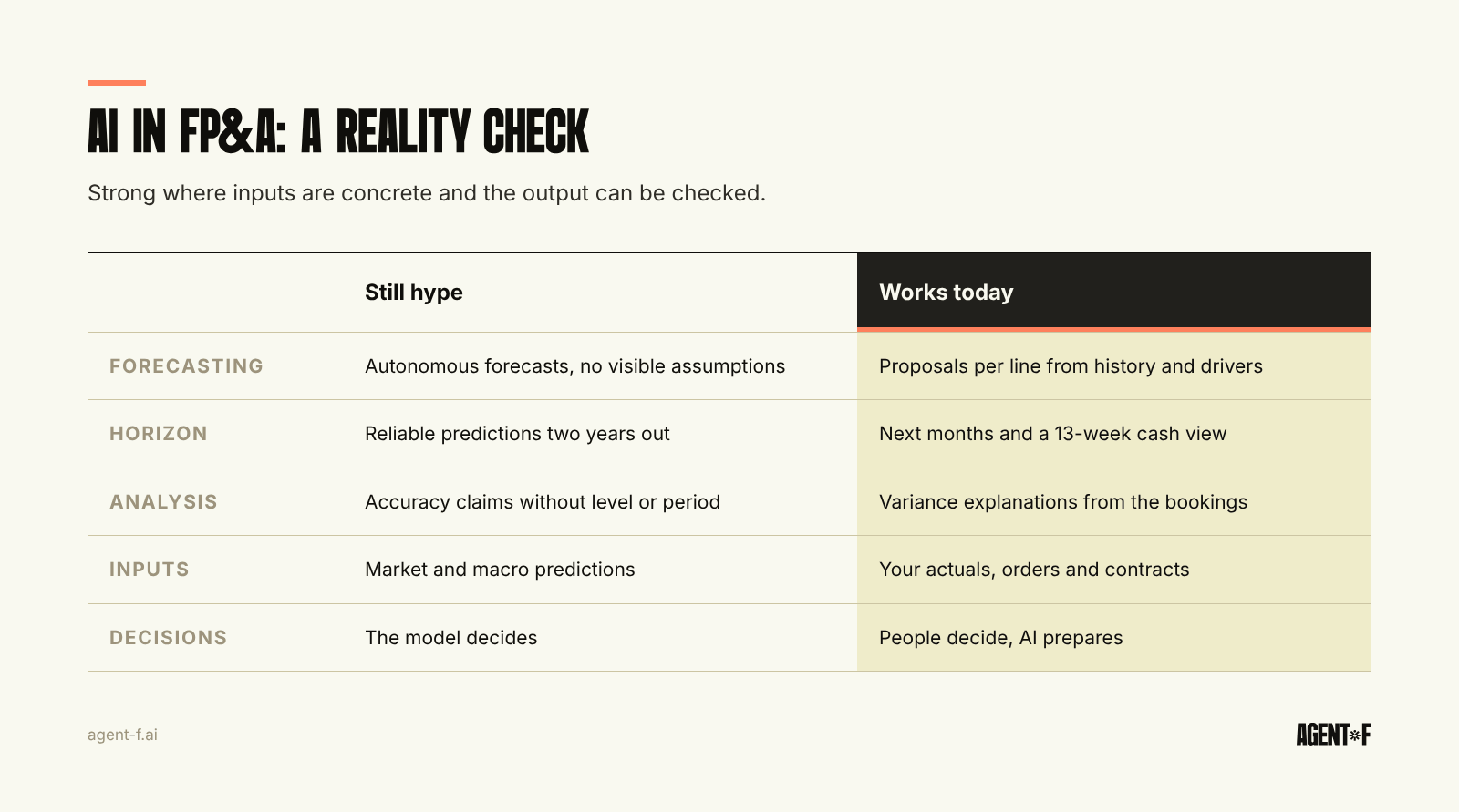
AI in FP&A works today for three jobs: explaining variances between plan and actual, proposing forecast values from your own history and drivers, and answering planning questions in plain language. It is still hype when it promises forecasts that run without assumptions you can see, or predictions of markets, prices and customer behaviour from a few years of a mid-sized company's data.
What matters more than the model is which numbers it sees. An AI that plans on live actuals can explain what changed since yesterday.
What does AI in FP&A actually do today?
Financial planning and analysis is mostly three activities: building a plan, comparing it with what happened, and updating the view of the future. AI helps with each, but not equally.
Variance explanation. This is the most mature use. Given a budget, the actuals and the bookings behind them, an AI can find the lines that drive a gap and draft the explanation: marketing is 40,000 euros over because two trade fair invoices arrived in one month, not because spending changed. A controller still checks the draft, but no longer starts from a blank page.
Forecast proposals. From actual trends, seasonality, open orders and contracted costs, an AI can propose next month's figures per account and cost centre. That is the extrapolation a good analyst does in a spreadsheet, done for every line and repeated every month.
Plain-language questions. "What happens to the cash position in March if we hire four engineers in January?" can now be put to an AI finance assistant instead of a new tab in the model. The answer is only as good as the plan and the actuals it works from, which is the point of the next section.
Cash and anomaly signals. Short-term cash forecasts from open receivables and payables, and alerts when a cost line behaves differently from its history, both work well because the inputs are concrete. A 13-week view is covered in cash flow forecasting.
Why does the data source matter more than the model?
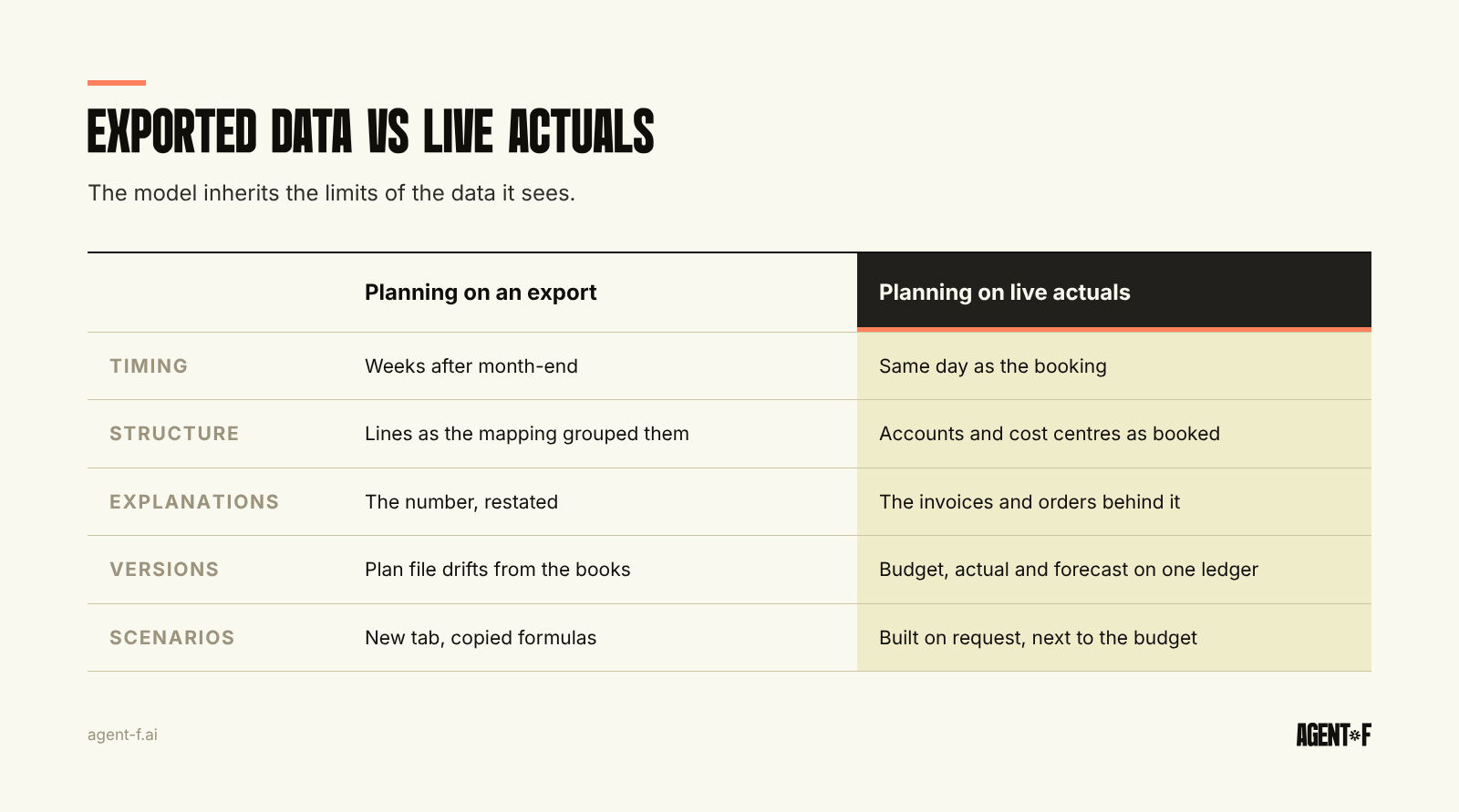
In most German mid-sized companies, the planning cycle starts with an export. The tax advisor (Steuerberater) closes the month in DATEV, the BWA (the monthly management report from your tax advisor) arrives weeks after month-end, and someone maps its lines into the planning file. Then the analysis begins, on numbers that are already a month old and have passed through a manual mapping step.
Put an AI on top of that file and it inherits all three problems. It sees the month late. It sees accounts as the mapping grouped them, not as they were booked. And it cannot look behind a number, because the invoices, orders and contracts that explain the number are in another system.
Planning on live actuals changes what the AI can do. If the forecast sits on the same data model as the ledger, the AI can see that a cost line is high because an invoice is booked but the matching credit note has not arrived, or that revenue is behind plan because three orders are delivered but not yet invoiced. That is the difference between "marketing is over budget" and "marketing is over budget because of these two invoices, and one of them belongs to next quarter".
It also removes the question of which version is right. When budget, actual and forecast are views on the same bookings, the forecast cannot drift from the books. The comparison itself is explained in budget vs actual reporting per cost centre.
Which AI FP&A promises are still hype?
Four claims deserve scepticism.
- "Fully autonomous forecasting." A forecast is a set of decisions: hiring, pricing, investment. An AI can propose the arithmetic, but the decisions belong to the people who will be held to them.
- Long-range prediction from your own history. A company with five years of monthly data has sixty data points per account, and the business looked different in most of them. That supports trend and seasonality, not reliable predictions two years out.
- Market and macro predictions. Interest rates, energy prices and customer demand depend on things outside your books. Treat them as scenario inputs you choose, not as outputs the model knows.
- Accuracy figures without context. A forecast that is "95 percent accurate" on total revenue can still be wrong on every cost centre. Ask what was measured, over which period and at which level.
The pattern is the same as in accounting generally: AI is strong where the inputs are concrete and the output can be checked, and weak where judgement is the actual work. We discuss the approval side in AI agents for finance.
How do you check whether an AI forecast deserves trust?
Treat an AI forecast like a forecast from a new analyst: useful, but unproven. Four tests help.
- Can it explain each number? Every proposed value should come with its assumption in a sentence: "based on the last six months, adjusted for the price increase in the supplier contract". A number without a reason cannot be reviewed.
- Does it hold up against the past? Run the method on last year's data and compare its forecasts with what actually happened, line by line.
- Can you see what changed? Each forecast version should show who or what changed which value, and why. Otherwise a quiet AI update and a deliberate management decision look the same.
- Can you overrule it? The planner must be able to replace any value and keep it, without the model writing over it next month.
If a tool fails the first test, the rest does not matter.
What should stay with people is easy to name: the approved budget that goes to the bank or the shareholders, the assumptions about hiring, prices and large investments, and the final forecast that management signs off. An AI can prepare each of these faster and point at what looks inconsistent. It should not be the one that decides. A bank or an investor will ask who stands behind the plan, not which model produced it.
For the governance questions around introducing AI at all, see the cautious CFO's guide to AI.
How does Agent F support planning on live actuals?
In Agent F, budgets, rolling forecasts and scenarios sit on the same data model as the general ledger, the orders, the open items and payroll. There is no export step between closing the month and planning the next one, and the actuals behind every plan line can be opened down to the booking.
The AI layer proposes forecast values per account and cost centre and explains each assumption in plain language, so a reviewer can see why a number is where it is. Each proposal has a confidence score, nothing changes the forecast until a person accepts it, and every change is in the audit trail. Scenarios are created on request: you ask what happens if a customer pays 60 days late or if hiring moves by a quarter, and the scenario is built next to the approved budget rather than over it. The monthly forecast rhythm itself is described in our article on the rolling forecast.
To start, take last quarter's largest three variances and time how long it took to explain each one. Check how many days pass between month-end and the moment your planning file has the actuals. Then ask any AI tool you evaluate to explain one of those variances from the underlying bookings. If it can only restate the number, it is working on the wrong data.
Learn how Agent F works, or see it on your own plan at agent-f.ai/demo.
This article is for general information only and does not constitute tax or legal advice. Parts of it were generated with AI. Please consult your tax advisor or legal counsel before acting on it, and feel free to reach out at team@agent-f.com with any questions or for support.