Updated
Cash flow forecast: a 13-week liquidity plan you can trust

A 13-week cash flow forecast shows, week by week, the cash you expect to receive and pay over the next quarter, starting from today's bank balance. It is reliable when it is built from commitments already in your books: open customer invoices, open supplier invoices, purchase orders, payroll and recurring costs. In Germany it also needs the fixed tax and social security dates, which arrive on schedule whether the customers pay or not.
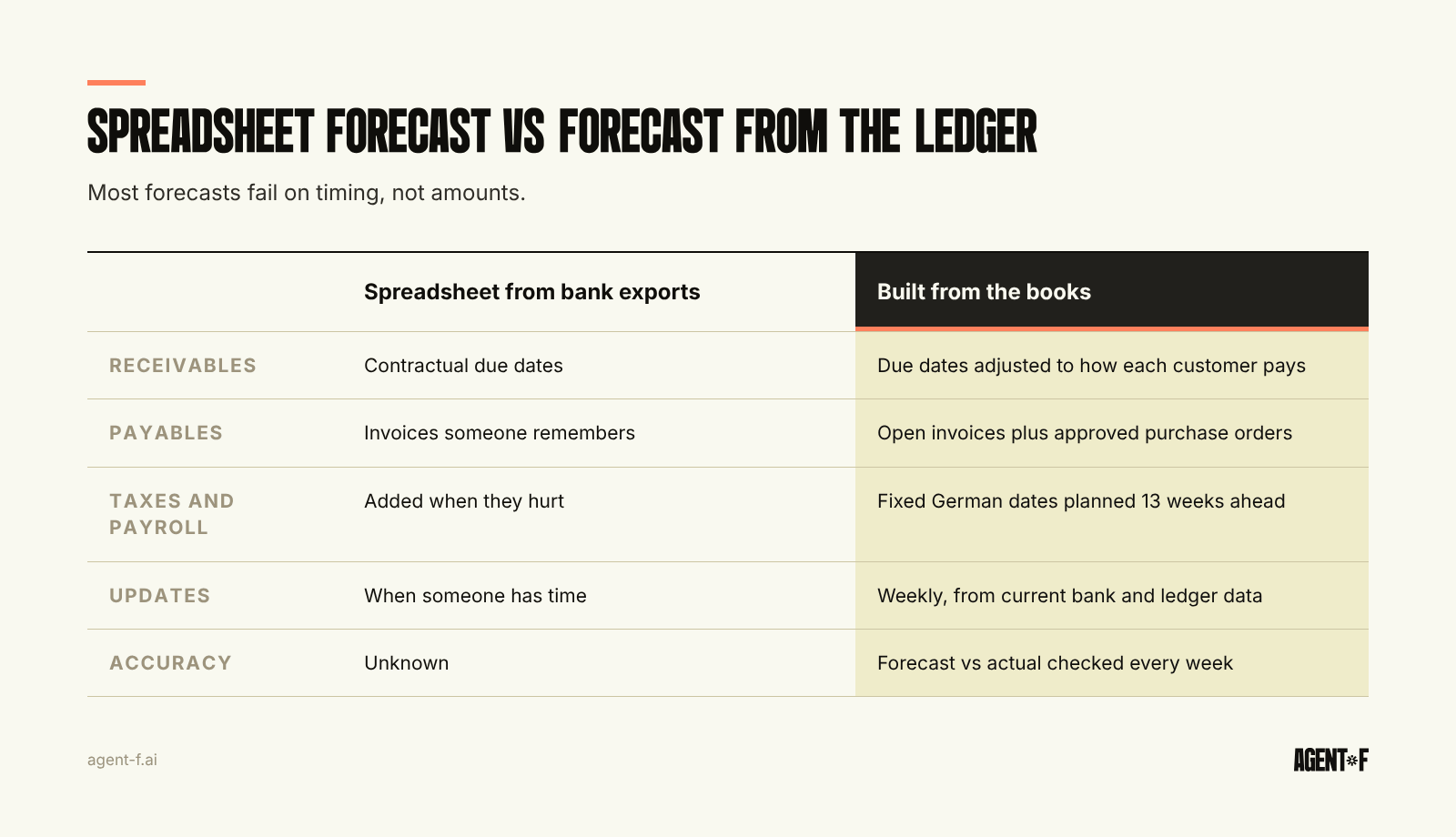
Most forecasts do not fail on the big numbers. They fail on timing: the customer who pays three weeks late, the VAT payment that lands in the same week as payroll, the trade tax prepayment nobody remembered. A plan you can trust is one where the dates are as right as the amounts.
What is a 13-week forecast, and why 13 weeks?
Thirteen weeks is one quarter. It is long enough to see a problem coming while there is still time to act, and short enough to plan from known items rather than assumptions. Most of what will move through your bank account in the next 13 weeks is already visible today: invoices you have sent, invoices you have received, orders you have placed and salaries you will pay.
The weekly view matters. A monthly plan can show a positive balance at month end while the account dips below zero in the third week, when payroll, social security and a large supplier payment fall together. Weeks show those dips. Months hide them.
A 13-week forecast is a different tool from the annual budget or a 12-month plan. The budget asks what the year should look like. The forecast asks whether you can pay everyone on time between now and the end of the quarter. If you update the longer view monthly, our article on the rolling forecast explains how the two fit together.
Which data should the forecast be built from?
The most common setup is a spreadsheet filled from bank exports and memory. It works until the person who maintains it is on holiday. A forecast you can rely on draws on five sources, roughly in this order of certainty:
- Opening balance. The actual balance of every bank account today, including accounts in other entities or currencies.
- Open receivables. Every sent invoice with its due date, adjusted for how each customer really pays. A customer with 30-day terms who pays after 45 days belongs in week seven, not week five.
- Open payables and purchase orders. Received supplier invoices by due date, plus approved purchase orders that will turn into invoices. Orders are the early signal: the invoice is still weeks away, but the commitment exists.
- Payroll and fixed costs. Salaries, rent, leases, loan repayments, insurance and subscriptions. These are predictable and often forgotten because they feel routine.
- Taxes and social security. The German fixed dates described in the next section.
Only after these come the assumptions: new sales not yet invoiced, planned hires, investments. Mark them separately, so you can see how much of the forecast rests on fact and how much on hope.
The quality of the forecast depends on how current the ledger is. If bank transactions are matched to invoices only at month end, the open items list is weeks out of date, and so is the forecast. That is why payment reconciliation is the base of a good liquidity plan, not a separate task.
Which German payment dates belong in every liquidity plan?
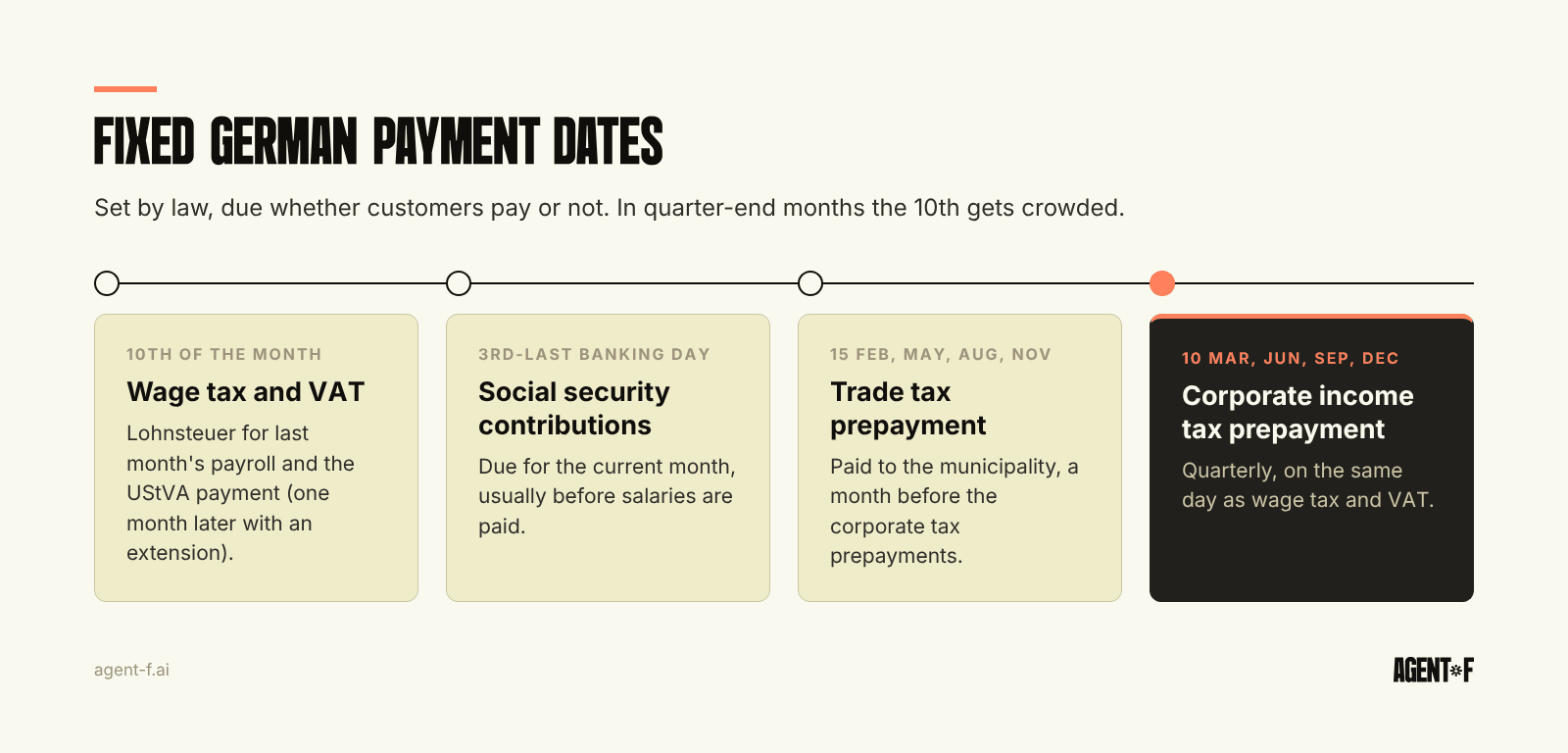
German companies pay taxes and contributions on dates set by law. They are easy to plan and painful to miss. The ones that belong in almost every plan:
- Social security contributions are due on the third-last banking day of the month in which the work is done (§ 23 SGB IV). That is usually before the salaries themselves are paid, so the payroll week is often the tightest week of the month.
- Wage tax (Lohnsteuer) withheld from salaries is filed and paid by the 10th of the following month (§ 41a EStG), for most employers monthly.
- The advance VAT return (UStVA) and the VAT payment are due on the 10th after the period ends (§ 18 UStG). Monthly filers with a permanent extension (Dauerfristverlängerung) pay one month later, but pay a special prepayment of one eleventh of the previous year's VAT prepayments in February (§ 47 UStDV). Details are in our guide to the advance VAT return.
- Corporate income tax prepayments are due on 10 March, 10 June, 10 September and 10 December (§ 37 EStG, applied to corporations through § 31 KStG).
- Trade tax (Gewerbesteuer) prepayments go to the municipality on 15 February, 15 May, 15 August and 15 November (§ 19 GewStG).
Two practical points follow. First, the 10th of the month is crowded: wage tax and VAT fall on the same day, and in the last month of each quarter the corporate income tax prepayment joins them. Second, the tax advisor (Steuerberater) controls part of this timing. If your advisor runs payroll and the VAT return, ask for the payroll figures and the expected VAT amount a few days before they are due, so the forecast uses real numbers instead of last month's.
Also plan for the irregular items: back payments after a tax assessment, the annual Christmas bonus, holiday pay and the annual insurance premiums that often fall in January.
How do you keep the forecast accurate week after week?
A forecast is only trusted when people can see how well it predicted last week. Update it on a fixed day, usually Monday, and do three things each time.
First, roll forward: drop the week that has passed and add week 13. Second, compare forecast with actual for the past week, line by line. Large differences usually have a simple cause: a customer paid late, an invoice was not in the system yet, a payment run moved. Third, adjust the pattern, not just the number. If one customer group pays ten days later than its terms every month, change the assumption for that group.
Over a few weeks this builds a record of how accurate the forecast is, and which lines are reliable. That record is what makes the plan believable to a bank, an investor or your own managing directors.
What should you do when the forecast shows a gap?
The value of a 13-week view is the time it buys. A shortfall seen in week nine leaves room for calm measures: chasing overdue receivables, agreeing a later payment date with a supplier, moving a non-urgent purchase, using an unused credit line or drawing on cash held in another entity. Which levers release cash fastest depends on where it is tied up, as described in working capital.
A gap seen in week two leaves very little room. If the forecast shows that you may not be able to meet your obligations, involve your tax advisor and your bank early. The warning signs and the steps for the first two weeks are covered in liquidity problems.
How does Agent F help you build a cash flow forecast?
In Agent F, the forecast reads from the same data model as the books. Open customer invoices, supplier invoices, approved purchase orders, payroll from the connected payroll system and recurring costs are already there, with their due dates. Bank balances come in through the direct bank integration, so the opening position is today's, not last Friday's.
Predictive planning suggests changes to the plan, and every suggestion comes with a confidence score for a person to approve. You can ask in plain language which week is the tightest and which payments cause it, for example a VAT payment and a large supplier invoice in the same week. Whatever tool you use, keep the customer payment patterns from your weekly review in the plan itself, not in one person's head. Every assumption you change is recorded in the audit trail, so the reasons behind last month's forecast stay visible. Scenarios and rolling forecasts sit in the same system as the actuals.
To start this week: list every German tax and contribution date for the next quarter, pull open receivables and payables with due dates, add payroll and fixed costs, and compare the result with actual bank movements next Monday. If building that list takes more than an hour, the data is the problem, not the spreadsheet.
Learn how Agent F works, or see it on your own cash flows at agent-f.ai/demo.
This article is for general information only and does not constitute tax or legal advice. Parts of it were generated with AI. Please consult your tax advisor or legal counsel before acting on it, and feel free to reach out at team@agent-f.com with any questions or for support.