Updated
Burn rate and runway: calculating them from the books, not from the bank balance
Burn rate is the amount of cash a company loses per month. Gross burn is everything that goes out, net burn is outflows minus inflows. Runway is available cash divided by net burn: 1.2 million euros in the bank and a net burn of 100,000 euros a month gives twelve months. The formula is simple. The inputs are where most runway numbers go wrong.
Most founders read both figures off the bank balance. That works for the first year, then it stops working. Once a company has unpaid supplier invoices, annual customer prepayments, VAT refunds, grant tranches and perhaps venture debt, the bank balance tells you where you are today, not how long the money lasts. The more reliable number comes from the books.
What are gross burn, net burn and runway?
Gross burn is total cash out in a month: salaries, social security, rent, software, contractors, suppliers. It shows the size of the machine and is the number to watch when hiring.
Net burn is gross burn minus cash in from customers and other operating sources. It shows how much the company actually consumes. If a startup pays out 250,000 euros in a month and collects 150,000 euros, net burn is 100,000 euros.
Runway is available cash divided by net burn, in months. It answers the question every board and investor asks first: how much time is left to reach the next milestone or raise the next round.
Two practical rules make the figures more useful. Use an average of the last three months rather than a single month, because one large invoice or a quarterly payment can make any month look strange. And track gross and net burn separately. A falling net burn can hide a rising gross burn if one large customer paid early, and that customer will not pay early every month. For growth companies, net burn also feeds the burn multiple.
Why does the bank balance give you the wrong runway?
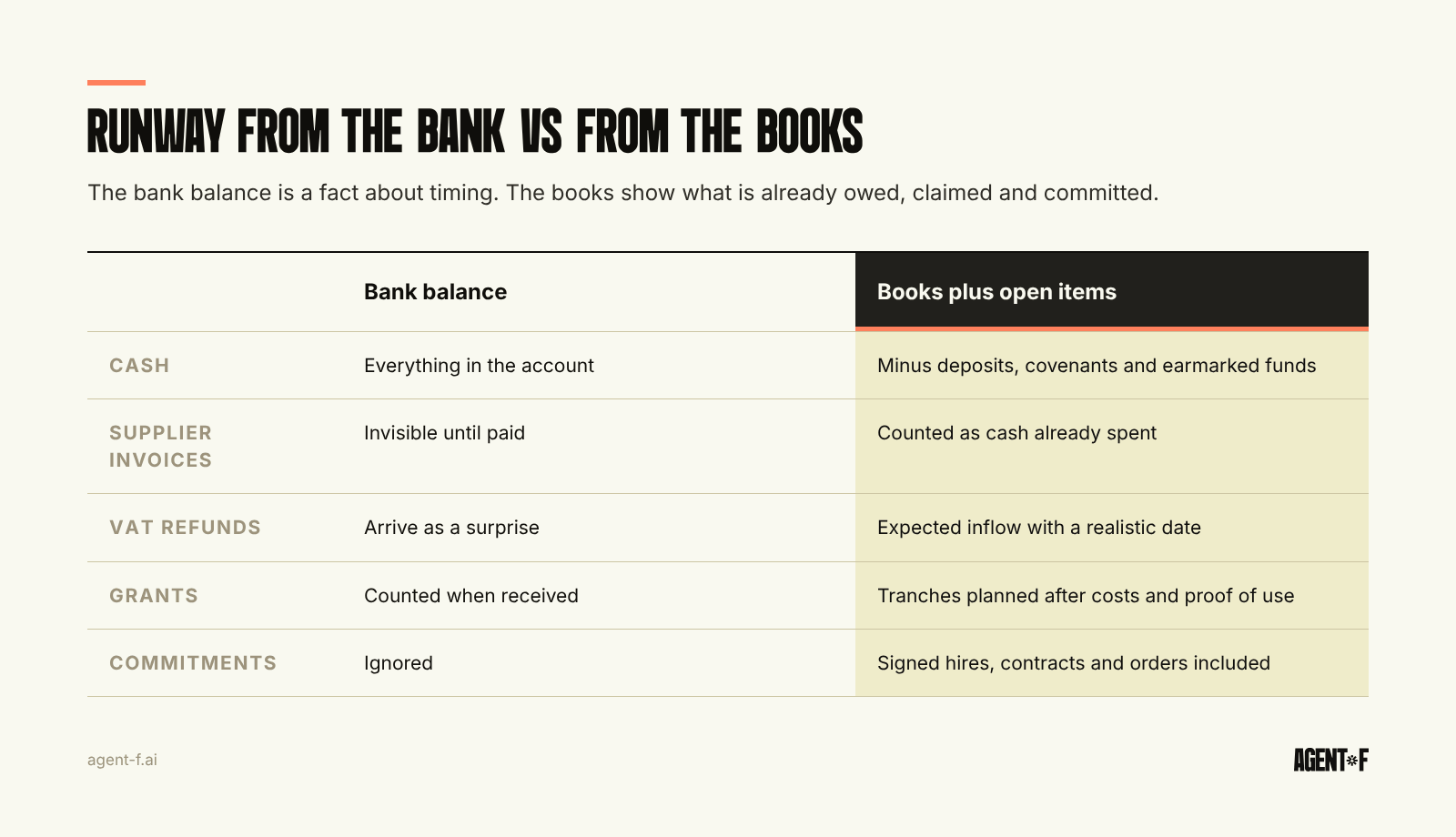
The bank balance is a fact, but a fact about timing. Several common situations make it look better or worse than the business really is.
- Unpaid supplier invoices. Bills booked but not yet paid are cash that is already spent. A company that pays on 30-day terms has roughly a month of costs sitting in its payables.
- Annual prepayments. A customer who pays a year upfront lifts the balance once. The next eleven months bring no cash from that contract, while the costs of serving it continue.
- Payroll timing. In Germany, social security contributions are due on the third-last banking day of the month (§ 23 SGB IV), often before salaries go out. A balance taken mid-month does not show that.
- One-off inflows. A funding round, a loan tranche or a large refund is cash, but not operating cash. Mixing it into net burn makes the business look less hungry than it is.
The books correct for all of this. They show what has been invoiced, what is owed, what was paid in advance and what belongs to which month. That is why burn and runway calculated from the ledger, plus open items, are more stable and more honest than a balance check.
What makes runway different for a German startup?
Three items appear in almost every German startup's cash position and are rarely handled well in a simple runway calculation.
Grants are paid after the cost. Public funding usually reimburses costs that have been incurred or are about to fall due, under the terms of the grant notice (Zuwendungsbescheid). The startup pays salaries first and claims the money later, and part of the grant is often paid only after the proof of use (Verwendungsnachweis) has been checked. An approved grant extends runway, but not on the day of approval. It belongs in the calculation as a series of expected inflows with realistic dates. We cover the process in grant management.
VAT refunds are real cash with a delay. A startup that buys more than it sells pays more input VAT than it charges, so the tax office owes it money. That refund arrives only after the advance VAT return (UStVA) is filed and processed, and tax offices sometimes check new companies before paying out. Quarterly filers wait up to three months for their money. A company with a refund of more than 7,500 euros in the previous year can opt for monthly returns (§ 18 (2a) UStG) and get the cash faster. The deadlines are in our guide to the advance VAT return.
Venture debt has its own schedule. Interest and repayments are fixed outflows, and many loan agreements include covenants such as a minimum cash balance. If the agreement requires a minimum balance, that amount is not available for runway. The effective runway ends when the covenant is at risk, not when the account reaches zero.
There is a legal dimension too. Under German insolvency law, threatened illiquidity (drohende Zahlungsunfähigkeit) is assessed over a forecast period of normally 24 months (§ 18 InsO). A managing director who cannot show a credible liquidity outlook has a problem beyond fundraising. The stages are explained in liquidity problems.
What counts as available cash?
Not every euro in the account is available. A cleaner starting point removes:
- rent deposits and other pledged or blocked balances,
- any minimum balance required by a loan agreement,
- money held for a specific purpose, such as advance grant payments that must be spent on the funded project,
- VAT collected but not yet paid to the tax office.
Undrawn credit lines and future venture debt tranches can be shown separately as extended runway, but they should not be mixed into the base figure. If a lender can withdraw the line, it is an option, not cash.
How do committed costs change the calculation?
The bank balance shows the past. Runway is about the future, and much of that future is already decided. A signed employment contract with a start date in February, an annual software renewal, a purchase order for equipment, a lease: these are commitments the company cannot easily undo.
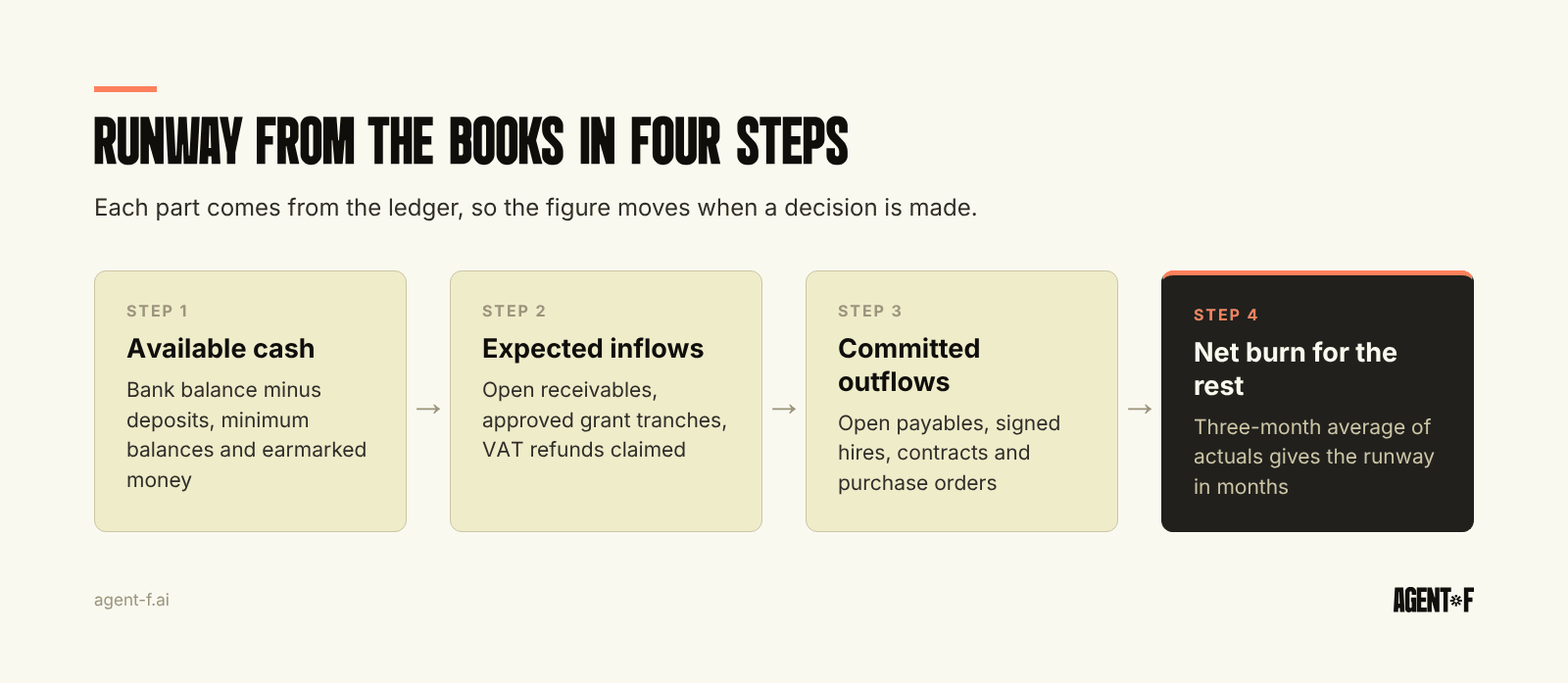
A runway calculated from the books therefore has four parts:
- Available cash, cleaned as above.
- Expected inflows: open customer invoices weighted by how reliably each customer pays, approved grant tranches with realistic dates, and VAT refunds already claimed.
- Committed outflows: open supplier invoices, payroll including new hires already signed, recurring contracts and approved purchase orders.
- Monthly net burn for the rest, based on the three-month average of actuals.
The result usually differs from the bank-balance version by a few months, in either direction. More importantly, it changes as soon as a decision is made rather than weeks later when the money moves. For week-by-week detail, the same inputs drive a 13-week cash flow forecast.
How can an ERP keep runway current?
A runway calculated this way needs live data from several places: bank accounts, receivables, payables, payroll, purchase orders and grants. In spreadsheets, someone collects it once a month, and the number is out of date by the time it reaches the board.
In an AI-native ERP like Agent F, those inputs already sit on one data model. Bank transactions are matched to invoices as they arrive, purchase orders and contracts are recorded as commitments, and grant tranches and VAT positions are part of the books. Runway can then be recalculated every day from actuals plus committed costs, and a founder can ask in plain language how a new hire or a delayed grant payment changes it. The figures are suggestions built from the ledger, and the finance team decides what goes into the management report and board report.
For a first step, calculate runway twice this month: once from the bank balance and once from the books with the four parts above. Then list every grant, VAT refund and loan covenant with its expected date and amount. If the two numbers differ by more than a couple of months, the difference is where the conversation with your investors should start.
Learn how Agent F works, or see it on your own cash and commitments at agent-f.ai/demo.
This article is for general information only and does not constitute tax or legal advice. Parts of it were generated with AI. Please consult your tax advisor or legal counsel before acting on it, and feel free to reach out at team@agent-f.com with any questions or for support.