Updated
Working capital optimisation: where the cash is stuck and how to release it

Working capital optimisation means shortening the time between paying for something and getting paid for it. For a company with inventory, cash is stuck in three places: stock on the shelf, invoices customers have not paid, and supplier terms you do not use. The fastest gains usually come from stock and receivables, not from negotiating longer payment terms.
Most working capital advice treats it as a set of ratios for the annual report. The ratios are useful, but they hide the answer. The cash sits with three specific customers, in forty slow-moving items and with a supplier you pay on day ten for no reason. Finding those is the work.
What is working capital, and why does a growing company run short of it?
On the balance sheet, working capital is current assets minus current liabilities: cash, receivables and stock on one side, supplier invoices, short-term debt and tax liabilities on the other. Under the German Commercial Code (HGB), stock and receivables both sit in current assets (Umlaufvermögen).
The definition explains less than the mechanism. Every euro of growth needs working capital before it produces cash. A company that sells more has to buy more material first, hold more stock, and wait longer for more customers to pay. Profit shows up in the income statement when you invoice. Cash shows up weeks or months later.
That is why profitable, growing companies run short of cash. A producer that doubles its revenue may need roughly twice the stock and twice the receivables, financed months before the customers pay. If supplier payments run faster than customer payments, every new order makes the bank balance worse, at least for a while.
How do you measure how long cash is tied up?
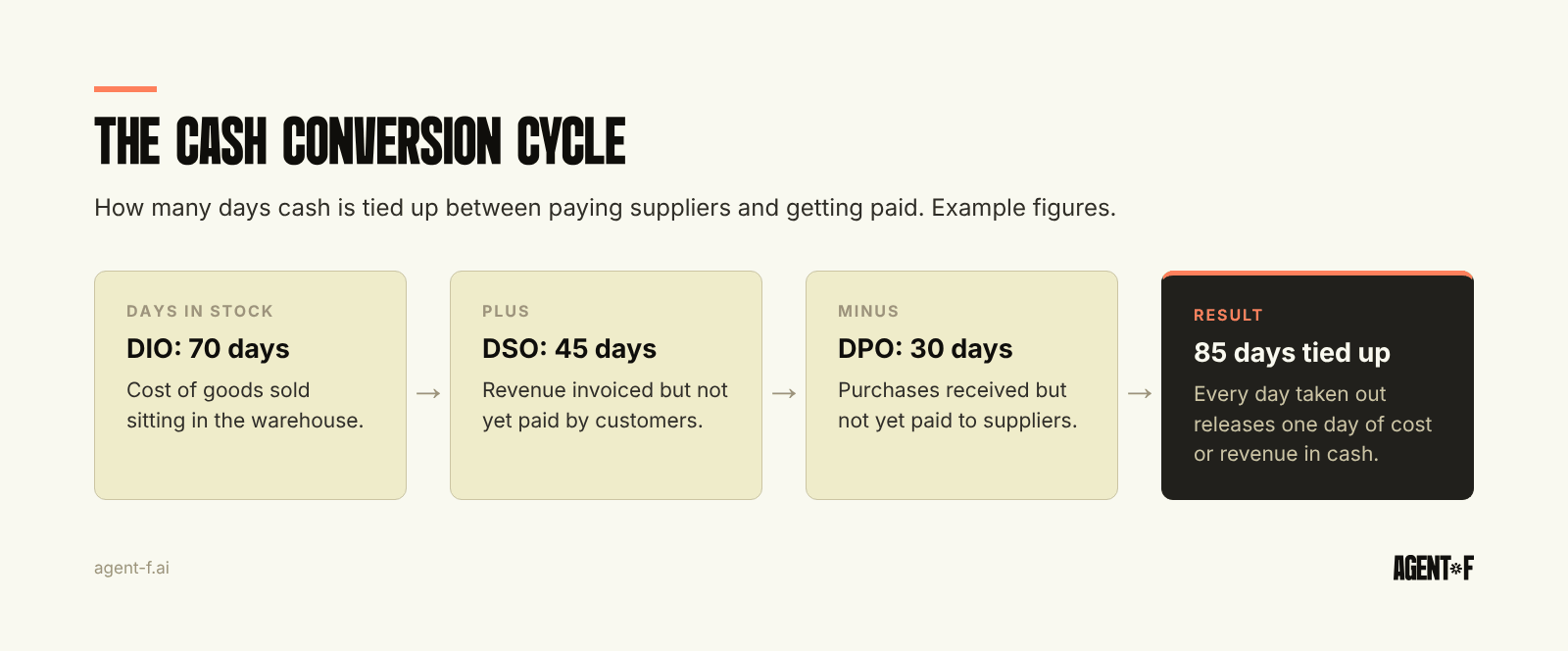
The most useful single figure is the cash conversion cycle. It adds the days cash spends in each stage and subtracts the days your suppliers finance you:
- Days inventory outstanding (DIO): how many days of cost of goods sold sit in stock.
- Days sales outstanding (DSO), or accounts receivable days: how many days of revenue are still unpaid by customers.
- Days payable outstanding (DPO): how many days of purchases you have not yet paid.
The cash conversion cycle is DIO plus DSO minus DPO. If stock sits for 70 days, customers pay after 45 days and you pay suppliers after 30, your cash is tied up for 85 days. Every day you take out of that cycle releases one day of cost or revenue in cash.
Two warnings apply. First, averages hide the problem. A DSO of 45 days can mean everyone pays on day 45, or most pay on day 20 and one large customer pays on day 120. Second, the figures are only as good as the books behind them. If customer payments are matched to invoices only at month-end, the DSO you calculate mid-month is wrong. Getting cash matched daily is covered in payment reconciliation.
Why is stock usually the biggest lever?
In companies that make or trade physical goods, stock is often the largest single item in working capital, and the least examined. Finance sees one number on the balance sheet. Operations sees thousands of items, each ordered for a good reason at the time.
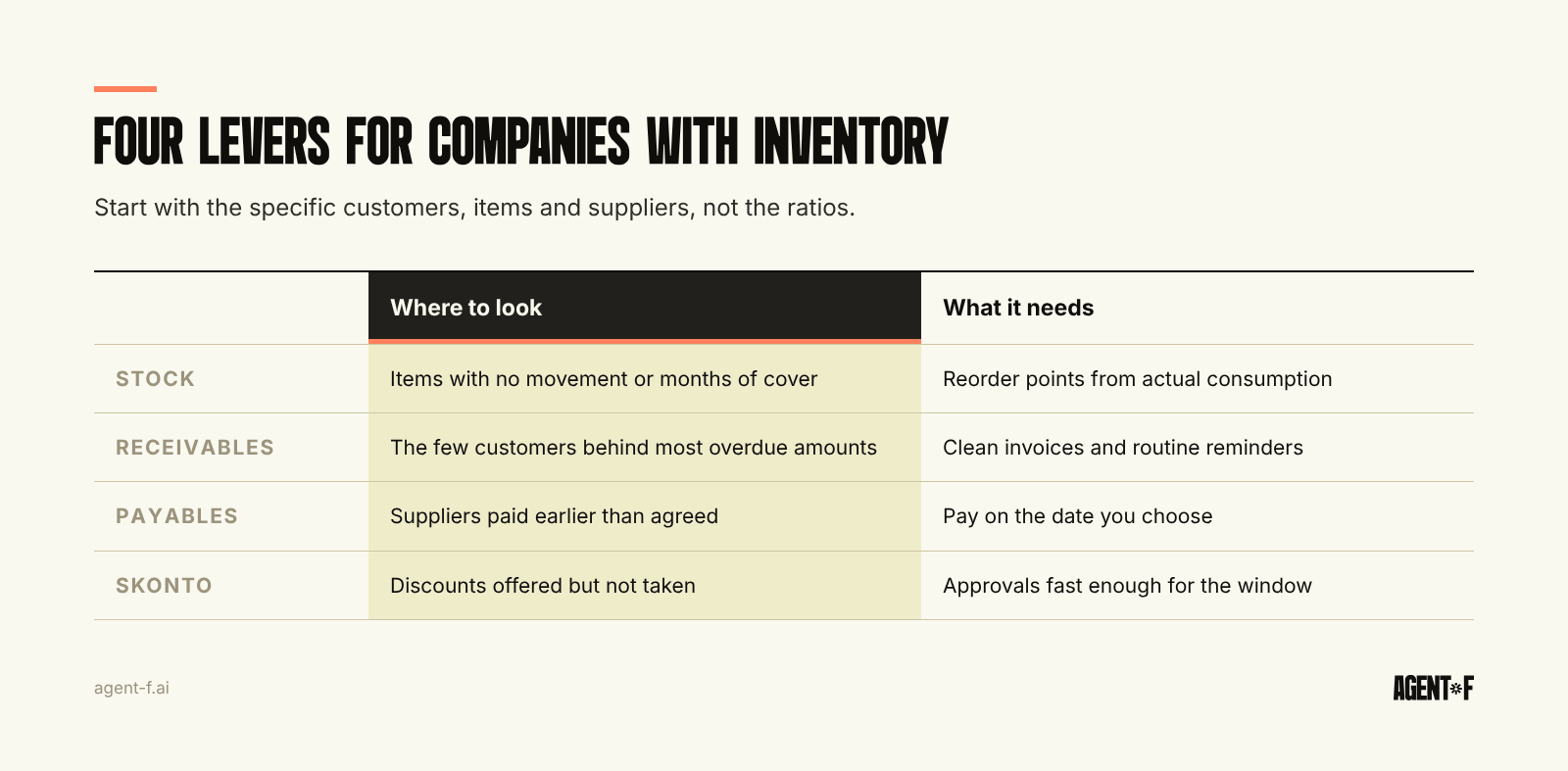
The questions that release cash are specific. Which items have not moved in six months? Which have more than a few months of cover at current sales? Which were ordered in large batches for a price discount that the holding cost has since eaten up? Which components were bought early because lead times were long, and are those lead times still long?
Three practical steps work in most companies:
- Rank stock by value and movement. A small share of items usually carries most of the value. Start there, not with the full list.
- Set reorder points from actual consumption, not from the last order quantity. Many reorder levels were set years ago and never revisited.
- Agree a clear-out route for slow movers: return to supplier, sell at a discount, or write down. A write-down does not release cash, but it stops the item from distorting the stock figure.
Stock and the books often disagree, which makes all of this harder. Why the count rarely matches the ledger is explained in inventory management.
How do you collect from customers faster without damaging the relationship?
Most late payments are invoices that went to the wrong person, lacked a purchase order number, or were never chased. Fixing the process releases more cash than tougher terms.
Start with the invoice itself: correct legal entity, the customer's order number, a clear due date, and an e-invoice where the customer expects one. Then make the reminder routine. A short, polite reminder a few days after the due date works better than a firm one after six weeks. Why reminders stop when matching is manual is covered in our article on dunning and receivables.
German law also sets a frame. Under § 271a of the Civil Code (BGB), payment terms longer than 60 days between businesses are only effective if expressly agreed and not grossly unfair to the supplier. If a business customer pays late, you can charge default interest of nine percentage points above the base rate and a flat fee of 40 euros under § 288 BGB. Few companies charge it, but knowing it exists changes the tone of a conversation with a customer who pays on day 90.
Should you take Skonto or stretch your payables?
Paying suppliers later improves the cycle on paper, but it is the lever with the most side effects. Suppliers notice, prices rise at the next negotiation, and a supplier who feels squeezed delivers last when capacity is short.
The cash discount (Skonto) is the clearest case where paying early pays. A typical offer of 2 percent for payment within 10 days, or the full amount within 30, means you get 2 percent for paying 20 days earlier. Annualised, that is a return of roughly 37 percent, far above what the cash earns in the bank or costs on a credit line. If you have the cash, taking Skonto is almost always right. If you do not, a short-term credit line to take it can still pay.
The reverse also holds. Offering Skonto to your own customers is an expensive way to collect faster, and it often gets deducted by customers who pay late anyway. We go through the calculation in payment terms and Skonto.
The discipline that matters is to pay on the date you choose, not the date the invoice happens to be approved. That needs approvals fast enough to catch the discount window, and a payment run that knows which invoices carry one.
How does Agent F help you see where cash is tied up?
In Agent F, stock, orders, receivables, payables and the general ledger share one data model. That means the cash tied up can be shown per customer, per supplier and per item from live data, rather than calculated from three exports at month-end.
You can ask in plain language which customers account for most overdue receivables this month, or which items have more than six months of cover, and get the list behind the number. Customer payments are matched to invoices as they arrive from the bank, with a confidence score on each suggestion and a person confirming it, so DSO reflects today. Dunning runs from the same data. Supplier invoices carry their due dates and discount terms, so you can see which ones to approve and pay first.
Stock valuation across locations feeds the balance sheet directly, and the same bookings reach the DATEV export for your tax advisor (Steuerberater). Working capital targets can sit alongside the budget, so you can follow them per cost centre as you would in budget vs actual reporting.
To start, calculate your cash conversion cycle for the last three months, then break each part down: your ten largest overdue customers, your twenty most valuable slow-moving items, and every supplier that offers Skonto you did not take. Those three lists usually hold the first release of cash.
Learn how Agent F works, or see it on your own stock and receivables at agent-f.ai/demo.
This article is for general information only and does not constitute tax or legal advice. Parts of it were generated with AI. Please consult your tax advisor or legal counsel before acting on it, and feel free to reach out at team@agent-f.com with any questions or for support.