Updated
Intercompany reconciliation: matching both sides before the eliminations
Intercompany reconciliation means checking that what one group company has booked against another matches what the other has booked in return: every receivable has its payable, every recharge its cost, every loan its liability. Only when both sides agree can they be eliminated in the consolidated accounts. Differences block the group close and tend to surface late, when they are hardest to explain.
The usual advice is to reconcile more often and with better tools. That helps, but it treats the symptom. In intercompany accounting, balances differ because each entity books its own side, at its own time, often with its own tax advisor and chart of accounts. The more lasting fix is to keep both sides in one place, where differences show up while the month is still open.
What has to match between group companies?
Every transaction between two entities of the same group appears twice: once in each set of books. Typical cases in a mid-sized group are:
- Recharges and management fees. The German parent charges subsidiaries for shared services, software or management time.
- Sales of goods. A production entity sells to a sales entity in another country.
- Loans and cash pooling. The parent finances a subsidiary, with interest booked on both sides.
- Costs paid on behalf of another entity. One company pays an invoice that belongs to another and recharges it.
For each pair, four things should agree at month-end: the receivable and the payable, the income and the expense, the currency and amount, and the period. When they do, the consolidation step is mechanical. When they do not, someone has to find out why before the group numbers can be trusted.
The HGB (German Commercial Code) sets out what the consolidation removes. Intercompany receivables and payables are eliminated (§ 303), profits on goods still held within the group are removed (§ 304), and intercompany income and expenses are offset (§ 305). All three depend on both sides being booked the same way. How the full consolidation works is covered in consolidation for the board and the Konzernabschluss.
Why do intercompany balances not match?
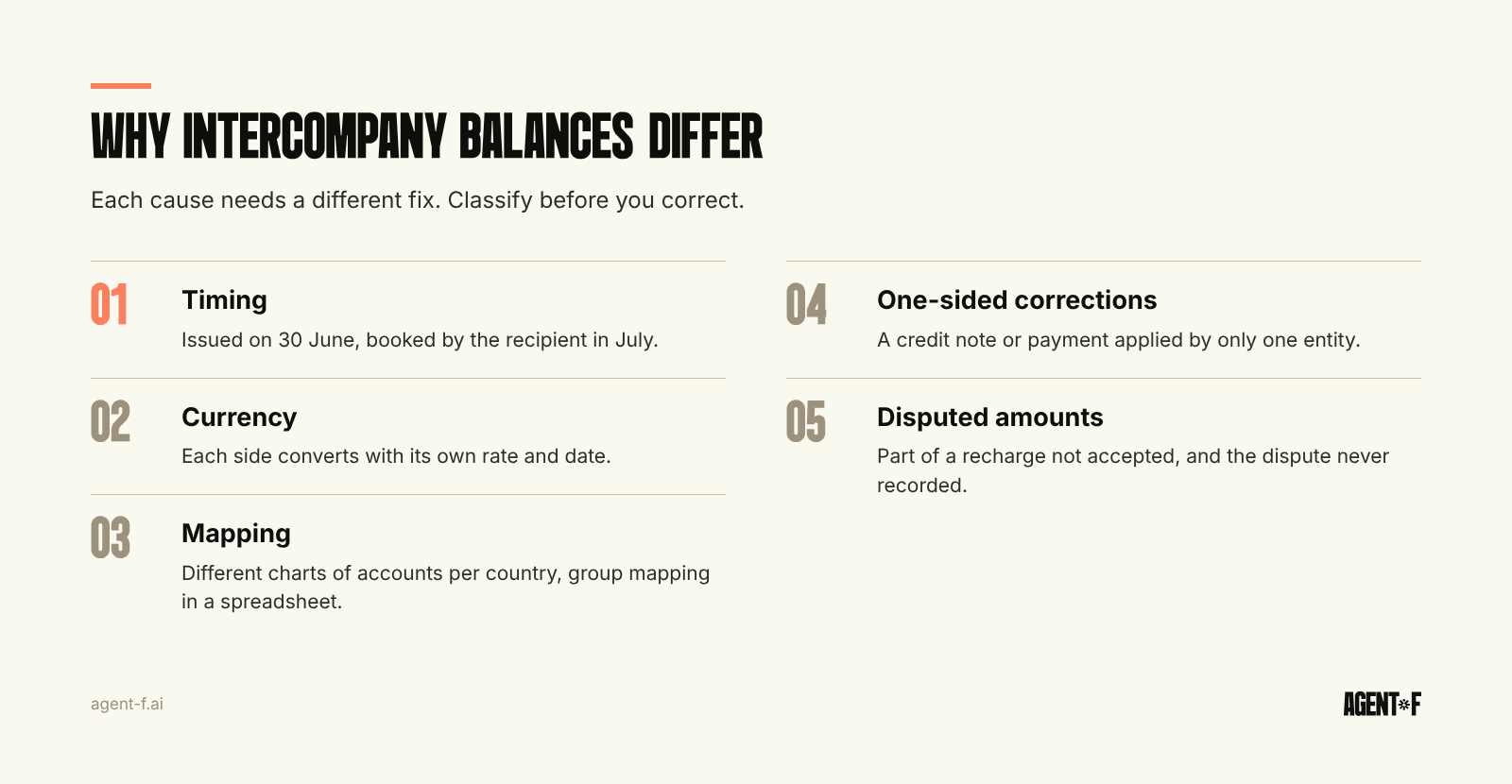
The causes repeat across almost every group.
Timing. The German parent issues a recharge on 30 June. The Dutch subsidiary receives it on 3 July and books it in July. At the June close, the parent has a receivable the subsidiary does not yet show.
Currency. The parent invoices in euros, the Polish subsidiary books in zloty. Each side uses its own exchange rate and date, so the converted balances differ even when the invoice is the same. Handling these differences is described in multi-currency accounting.
Mapping. The German entity books on SKR04, the Austrian one on its local chart, the Spanish one on another. Intercompany accounts are named and structured differently, and the group mapping is maintained in a spreadsheet.
One-sided corrections. A credit note is booked by the issuer but never reaches the recipient's tax advisor. A payment settles several invoices at once and is applied differently on each side.
Disputed amounts. The subsidiary does not accept part of a recharge, but nobody records the dispute, so the difference sits unexplained for months.
In a group where each foreign entity has its own local accountant or tax advisor, these causes multiply. Each advisor books on their own schedule and sees only their side. Nobody sees both sides until the group controller puts the trial balances next to each other, often weeks after month-end. By then, the person who issued the recharge may no longer remember what it was for.
How do you run intercompany reconciliation every month?
Treat it as a fixed step in the monthly close, not a year-end clean-up.
- Agree a cut-off. All intercompany invoices for a month are issued and sent by an agreed day, and recipients book them in the same period.
- Use fixed accounts per counterparty. Each entity books intercompany items on dedicated accounts per partner company, so balances can be compared pair by pair.
- Exchange balances. Each entity confirms its intercompany balances with each partner, in the transaction currency as well as in euros.
- Classify each difference. Timing, currency, missing document, error or dispute. Each type has a different fix.
- Correct at the source. The entity that made the error corrects it. Booking the difference to a clearing account in the consolidation hides the cause and brings it back next month.
- Sign off. Both entity owners confirm that their pair agrees before the group close starts.
Two practical rules keep the process short. Give every entity pair a named owner on each side, so a difference has someone to resolve it rather than sitting in a shared inbox. And agree a small tolerance for rounding and currency effects, so the team spends its time on differences that matter. Anything above the tolerance is explained before the close, not carried forward.
This belongs on the same list as bank and supplier reconciliations. The month-end close checklist shows where it fits.
What does the tax side add for a German group?
Intercompany transactions are also tax transactions, and the tax authorities look at them closely.
Transfer pricing. Prices between related companies must be at arm's length, and the reasoning must be documented. For tax audits ordered since 1 January 2025, a German company must hand over a transaction matrix and related transfer pricing records within 30 days of receiving the audit order. That is much easier when intercompany transactions are already identified and reconciled in the books.
VAT. Cross-border services between EU group companies usually fall under the reverse charge, so the recipient accounts for the VAT. Goods shipped between EU entities are intra-community supplies with their own reporting duties. Both require correct VAT IDs and consistent invoices on both sides. The details are in reverse charge and EU invoices.
Documentation. A recharge without a contract or a clear allocation key is hard to defend in an audit. Keep the agreement, the calculation and the invoice together with the booking.
How does Agent F help with intercompany reconciliation?
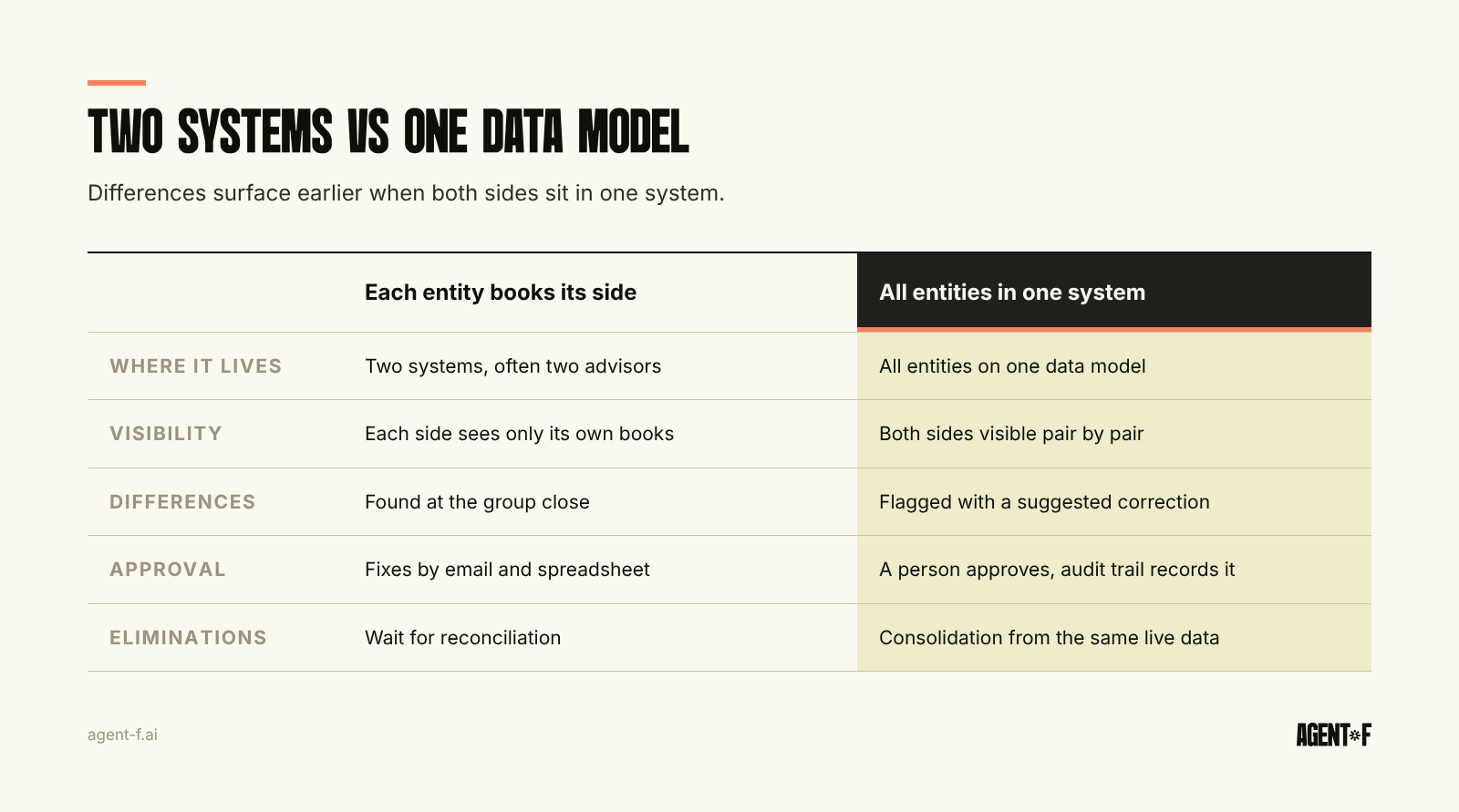
In most groups, intercompany reconciliation is matching two bookings that were made separately, in different systems, by different people. Agent F runs multi-entity accounting and consolidation on one data model, so the books of every group company sit in the same system and both sides of each entity pair can be compared while the month is still open, not weeks after it.
Each entity keeps its own books. Reconciliation is AI-assisted: when a balance differs, for example because a payment was applied differently, the AI layer flags it and suggests a match or correction, with a confidence score. A person approves, and the immutable audit trail records who changed what and why.
Consolidation then works from the same live data rather than from trial balances collected by email. With this setup, a multi-entity close can move from about 15 days to 3. German entities connect to their tax advisor through the DATEV integration. What to check before adding another entity is covered in multi-entity accounting.
To start, list every pair of entities that trade with each other and the accounts each side uses. Take last month's intercompany balances, compare them pair by pair and classify every difference by cause. If most differences are timing and currency, a fixed cut-off and one rate source will remove them. If they are mapping and one-sided corrections, the problem is that two systems are recording one transaction.
Learn how Agent F works, or see it on your own group structure at agent-f.ai/demo.
This article is for general information only and does not constitute tax or legal advice. Parts of it were generated with AI. Please consult your tax advisor or legal counsel before acting on it, and feel free to reach out at team@agent-f.com with any questions or for support.