Updated
Financial KPIs for a growing company: the twelve that matter and where they come from

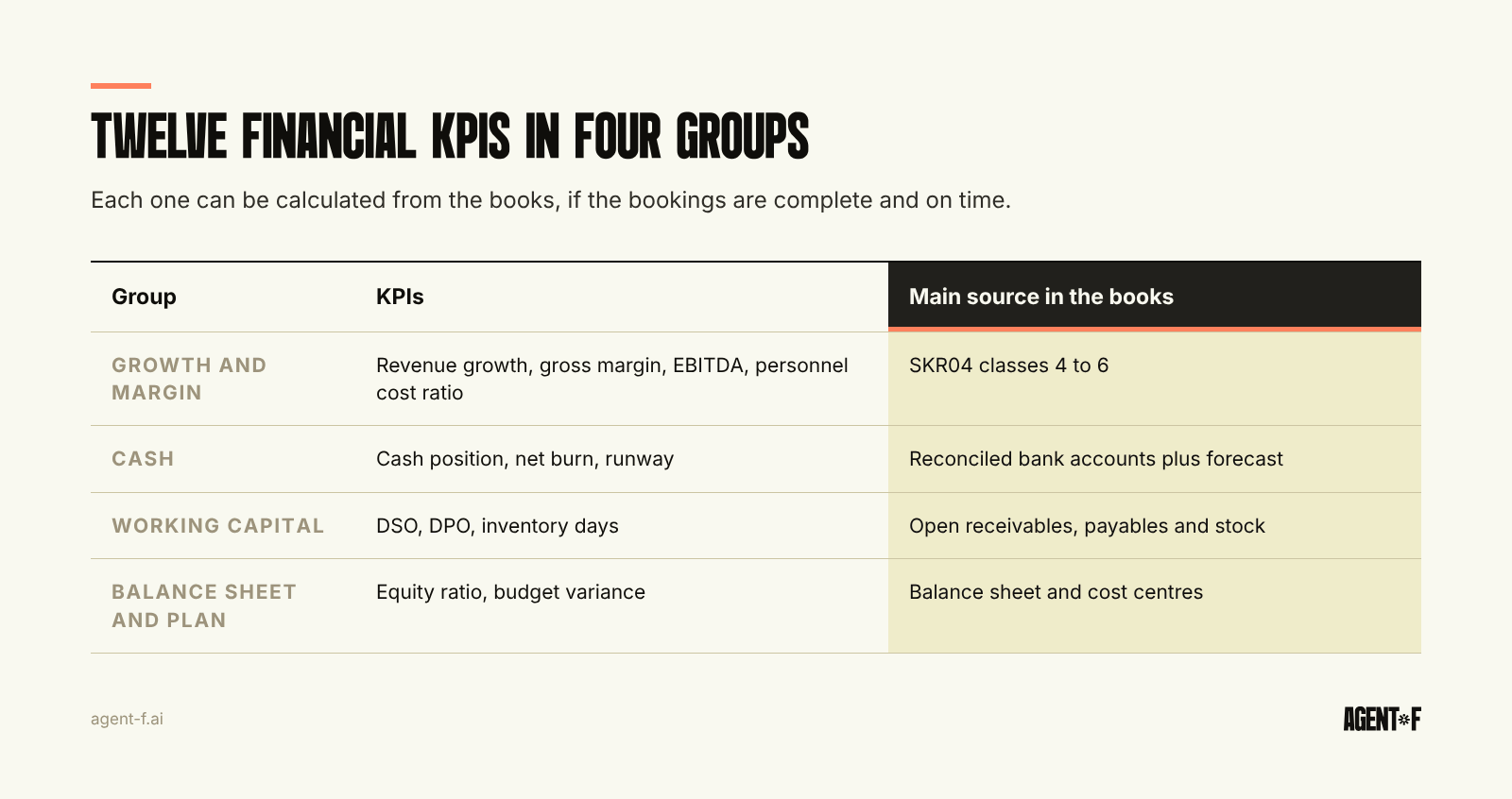
The financial KPIs that matter for a growing company fit into four groups: growth and margin, cash, working capital, and balance sheet strength. Twelve figures cover what management, a German bank and a venture investor will ask for: revenue growth, gross margin, EBITDA, personnel cost ratio, cash, burn, runway, DSO, DPO, inventory days, equity ratio and plan variance. All of them can be calculated from the books.
That last point is where most companies struggle. The KPIs are well known. The problem is that the bookings behind them arrive late, sit in different tools, or are booked in a way that makes the number technically correct and practically useless.
Which financial KPIs does a growing company actually need?
A company with 20 to 150 people does not need a dashboard with forty tiles. It needs a short list that the management team understands, that is calculated the same way every month, and that answers three questions: are we growing profitably, how long does the cash last, and is the balance sheet strong enough for the next step.
Growth and margin
- Revenue growth: month on month and year on year, ideally split by product or customer group.
- Gross margin: revenue minus direct costs (materials, purchased services, hosting), as a percentage of revenue. In German reporting, the closest figure is the Rohertrag.
- EBITDA: operating result before depreciation, interest and taxes. Banks and investors both use it as the starting point.
- Personnel cost ratio: salaries and social security as a share of revenue. In most service and software companies, it is the largest cost line.
Cash
- Cash position: across all bank accounts and entities, on one date.
- Net burn: how much cash the business consumes per month after revenue.
- Runway: cash divided by burn, in months.
Working capital
- DSO (days sales outstanding, also called accounts receivable days): how long customers take to pay.
- DPO (days payable outstanding): how long you take to pay suppliers.
- Inventory days: for companies with physical goods, how long stock sits before it is sold.
Balance sheet and plan
- Equity ratio (Eigenkapitalquote): equity as a share of total assets.
- Budget variance: actual against plan, per cost centre, explained.
Software companies add recurring revenue metrics on top, which we cover in SaaS metrics from the books. The twelve above still apply.
What matters more than the list is the definition behind each item. If gross margin includes hosting in one quarter and excludes it in the next, the trend is meaningless. Each KPI needs one written definition, one owner and one source in the books, agreed before the first report goes out.
Why do a bank and an investor ask for different numbers?
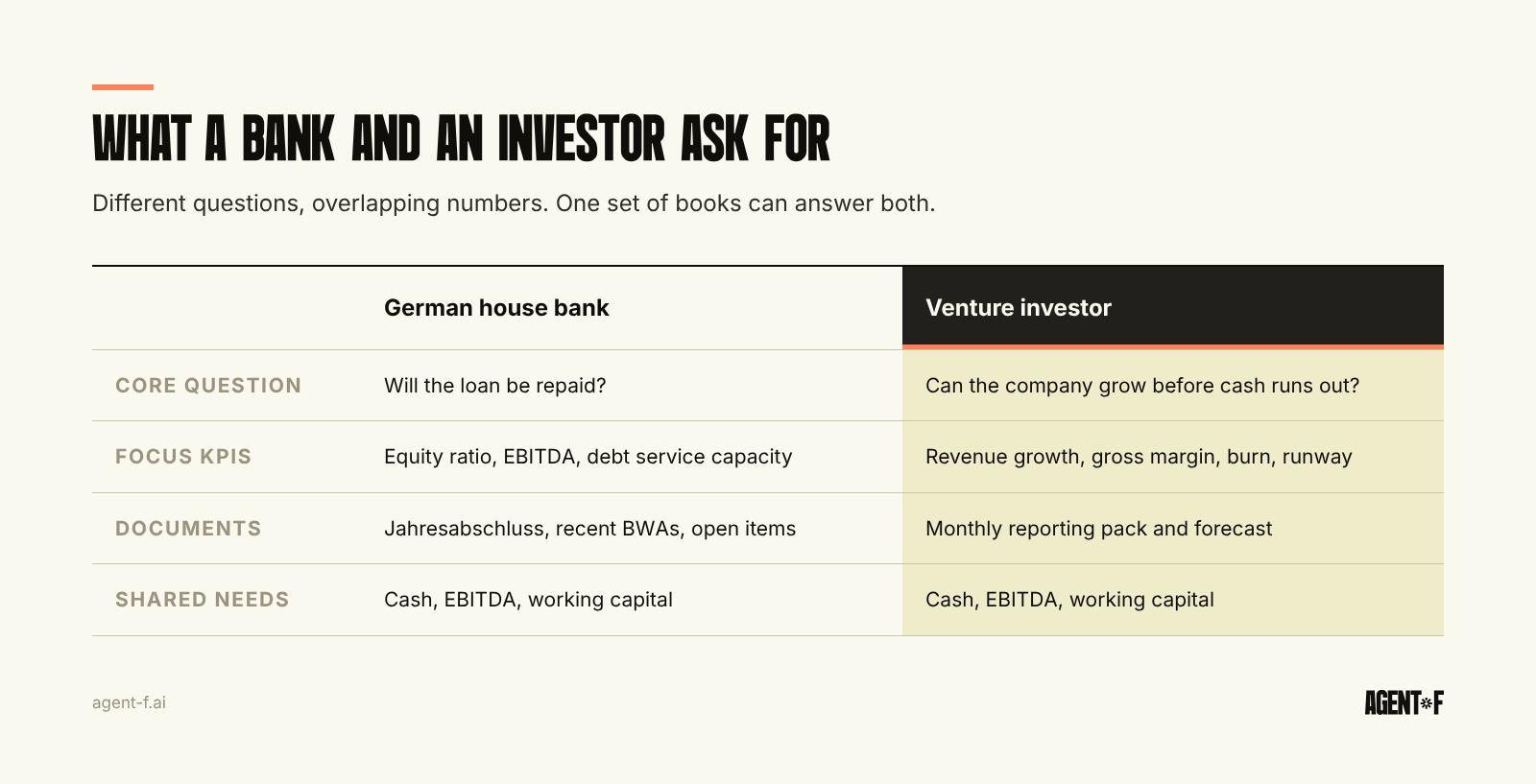
A German house bank (Hausbank) and a venture investor look at the same company with different questions. The bank asks whether the loan will be repaid. The investor asks whether the company can grow into a much larger one before the money runs out.
Banks therefore focus on stability. They ask for the equity ratio, EBITDA, debt levels and the ability to service debt from operating cash flow (Kapitaldienstfähigkeit). They usually want the annual financial statements (Jahresabschluss), recent BWAs (the monthly management report from your tax advisor) and a balance of open items. Loan agreements often contain covenants tied to some of these figures.
Investors focus on growth and efficiency. They ask for revenue growth, gross margin, burn and runway, and for software companies the recurring revenue metrics. They care less about the format and more about the trend and the explanation.
Both need cash, EBITDA and working capital figures. A company that can produce these from the same books, with the same definitions, answers both audiences without building two reporting packs. The board reporting article shows how to structure such a pack.
Where does each KPI come from in the books?
Most German SMEs book on a standard chart of accounts from DATEV, usually SKR04 (a chart of accounts organised by balance sheet structure). In SKR04, account class 4 holds operating income, classes 5 and 6 hold operating expenses such as materials, personnel and depreciation, and the balance sheet sits in classes 0 to 3. Trade receivables are typically on account 1200, trade payables on 3300.
That gives each KPI a clear source.
- Revenue, gross margin, EBITDA and personnel cost ratio come from classes 4 to 6, provided direct costs are booked to separate accounts from overheads.
- Cash comes from the bank accounts in class 1, which only works if every account and entity is reconciled to the same date.
- Burn and runway combine cash movements with the forecast.
- DSO and DPO combine the receivables and payables balances with revenue and purchases.
- The equity ratio comes from the balance sheet.
- Budget variance needs cost centres on every relevant booking.
The weak points are visible here. If direct costs and overheads share accounts, gross margin cannot be calculated. If bookings carry no cost centre, there is no meaningful variance analysis. Those are design choices in the chart of accounts, and they are easier to make early than to repair later.
Why do KPIs from the BWA often look wrong?
The BWA is the monthly report most German companies already have, and it is a reasonable starting point. But KPIs calculated from it often mislead, for reasons that have nothing to do with the formula.
Timing. If supplier invoices are booked when they arrive rather than in the month the service was received, margins swing from month to month. Booking accrued expenses at month-end fixes most of this.
Lag. When the tax advisor books the month two or three weeks after it ends, every KPI is a look back, not a basis for decisions. We describe the consequences in real-time financial reporting.
VAT in DSO. Receivables include VAT, revenue does not. Dividing gross receivables by net revenue overstates DSO by the VAT share, which is 19 percent for most German sales at the standard rate. Use net receivables or gross revenue, and stick to one.
One-off items. A large annual licence, a grant payment or a year-end correction distorts a single month. A rolling three-month view smooths this out without hiding it.
None of these are reporting problems. They are bookkeeping problems that show up in the reporting.
How often should you look at which KPI?
Not every figure deserves the same rhythm. Cash position belongs in a weekly view, and in a tight phase a daily one. DSO, DPO and overdue receivables are worth a weekly glance, because they move with individual customers and suppliers. Margins, EBITDA, personnel ratio and budget variance belong in the monthly close. Equity ratio and runway matter monthly in a growth phase and quarterly once the business is stable.
The rhythm also tells you how quickly the books must be closed. A monthly KPI that arrives on the 25th of the following month is already late for most decisions. The working capital side is covered in more detail in working capital.
How does Agent F help keep KPIs current?
In an AI-native ERP like Agent F, KPIs are calculated directly from the bookings on one data model, not exported into a spreadsheet. Each figure links to the transactions behind it, so a question like "why did gross margin drop in October" leads to the invoices and cost bookings that caused it. Accrual suggestions, cost centre categorisation and bank matching come with confidence scores and need a person's approval, which keeps the underlying data clean enough for the KPIs to mean something. BWA and DATEV export come from the same books.
For a first step, write down the definition of each of the twelve KPIs in one sentence, including which accounts feed it. Check whether your chart of accounts separates direct costs from overheads and whether bookings carry cost centres. Then calculate DSO once with net receivables and compare it with what you reported last quarter.
Learn how Agent F works, or see it on your own financial data at agent-f.ai/demo.
This article is for general information only and does not constitute tax or legal advice. Parts of it were generated with AI. Please consult your tax advisor or legal counsel before acting on it, and feel free to reach out at team@agent-f.com with any questions or for support.