Updated
Mandatory invoice details in Germany (Rechnung Pflichtangaben)
A German B2B invoice must contain ten mandatory details (Pflichtangaben) under § 14 Abs. 4 of the German VAT Act (UStG): both parties' names and addresses, the supplier's tax number or VAT ID, the issue date, a unique invoice number, quantity and description of what was supplied, the date of supply, the net amount per VAT rate, the rate and VAT amount, and two notes for special cases.
Most of these look obvious. They still cause trouble, because the details are checked by the recipient's tax office, not the sender's. A missing service date on a supplier's invoice is the supplier's mistake and your input VAT problem.
What must a German B2B invoice contain?
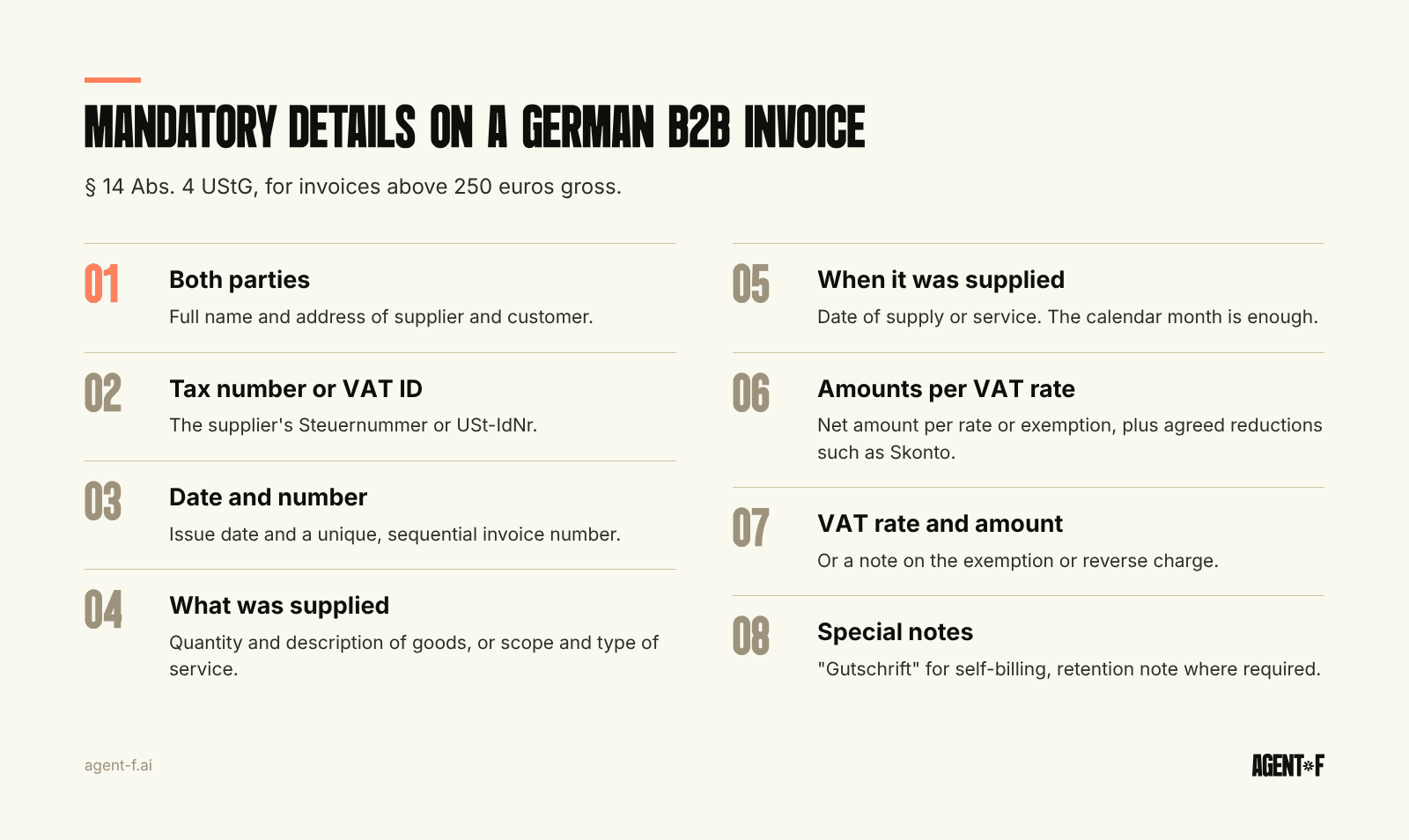
The list in § 14 Abs. 4 Satz 1 UStG applies to every invoice above 250 euros gross. In plain English:
- Full name and address of the supplier and of the customer.
- Tax number or VAT ID of the supplier. The tax number (Steuernummer) comes from the local tax office, the VAT ID (USt-IdNr.) from the Federal Central Tax Office. One of the two is enough.
- Issue date of the invoice.
- Invoice number: sequential and unique, so that each number is issued only once. It does not need to be gapless across the year, but it must never repeat.
- Quantity and description of the goods, or the scope and type of the service.
- Date of supply or service, even if it is the same as the invoice date. For advance payments, the date the payment was received, if known.
- Net amount broken down by VAT rate and by any exemption, plus any agreed reduction such as a Skonto that is not already included.
- VAT rate and VAT amount, or a note stating why the supply is exempt.
- A note on the retention duty for certain property-related services to private customers. This rarely applies between businesses.
- The word "Gutschrift" if the customer issues the invoice on behalf of the supplier (self-billing).
For businesses, the invoice must also be issued within six months of the supply (§ 14 Abs. 2 UStG). That is a deadline for the sender, but late invoices are one reason why costs land in the wrong period on the receiving side.
Which details cause the most problems in practice?
In practice, the invoices that fail a check rarely miss the name or the amount. They fail on details that seem minor.
The service date. Many invoices show only the issue date. The law requires the date of supply as well, and "date of supply equals invoice date" is acceptable only if the invoice says so. Under § 31 Abs. 4 UStDV, the calendar month is enough, for example "service period October 2026".
The description. "Consulting" may be acceptable for a clearly defined engagement. "Goods as discussed" or "services rendered" is not, because the tax office cannot see what was supplied.
The amounts per rate. Mixed invoices with 7 and 19 percent need a separate net amount and VAT amount for each rate. A single total with "including VAT" does not meet the requirement for larger invoices.
The recipient. The customer named on the invoice must be the company that received the service and claims the input VAT. An invoice addressed to the founder personally, or to a sister company in the group, belongs to someone else.
The supplier's tax number. It must be the supplier's own number, not the customer's, and not a personal tax ID.
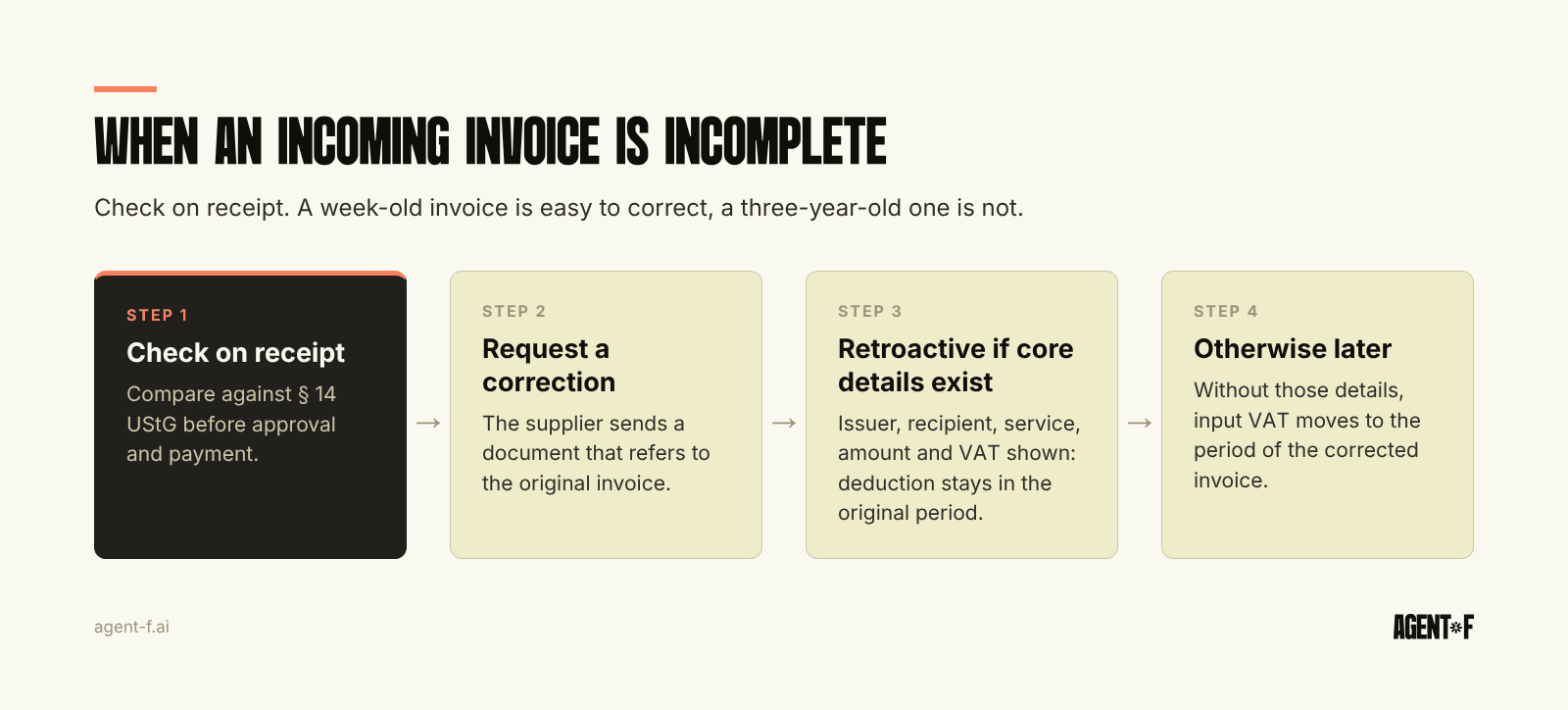
Corrections. A corrected invoice is not a fresh invoice with a new number and no history. Under § 31 Abs. 5 UStDV, the correcting document must refer specifically and unambiguously to the original invoice, usually by quoting its number and date. Suppliers who simply send a new invoice for the same delivery create a duplicate in your payables, and the risk of paying twice.
What changes for small invoices, reverse charge and EU customers?
Small invoices (Kleinbetragsrechnungen). Up to 250 euros gross, § 33 UStDV (the VAT implementing regulation) requires only four details: the supplier's name and address, the issue date, quantity and description, and the gross amount with the VAT rate or exemption note. Taxi receipts, small office supplies and most restaurant bills fall here.
Reverse charge. When the customer owes the VAT, for example for services from another EU country or certain construction services in Germany, the invoice shows no German VAT. Instead, it must carry the wording "Steuerschuldnerschaft des Leistungsempfängers" (reverse charge) under § 14a UStG.
Intra-community supplies. For goods shipped to a business customer in another EU country, the invoice must show both parties' VAT IDs and be issued by the fifteenth day of the month after the supply. Checking the customer's VAT ID is part of the process, which we cover in reverse charge and EU invoices.
What happens if an incoming invoice is missing something?
You can deduct input VAT only if you hold an invoice that meets §§ 14 and 14a UStG. If a detail is missing or wrong, the tax office can deny the deduction, typically during an audit years later, with interest on top. The rules and the practical traps are explained in input VAT deduction.
The good news is that most errors can be repaired. The supplier issues a corrected invoice, and in many cases the correction works back to the original date, so the deduction stays in the original period. According to the Federal Ministry of Finance (BMF) letter of 18 September 2020, that works only if the original invoice already contained the core details: the issuer, the recipient, a description of the service, the amount and the VAT shown. If those were missing or so vague that they amount to nothing, the deduction moves to the period in which the corrected invoice arrives.
The practical conclusion is simple. Check invoices when they arrive, not at year-end. A supplier answers a correction request within days when the invoice is a week old. Three years later, the contact person has left and the supplier may no longer exist.
Does the e-invoice mandate change the requirements?
The content stays the same. Since January 2025, every German business must be able to receive structured e-invoices, and sending them becomes mandatory in 2027 and 2028 depending on turnover. An e-invoice carries the same mandatory details as a paper invoice, in fixed data fields instead of free text.
That has one useful side effect. Because the fields are structured, a system can check them automatically on receipt. A missing service date or VAT ID shows up as an empty field, not as something a person has to notice on page two of a PDF. The dates, formats and exemptions are in e-invoicing in Germany.
How does Agent F help check invoices on receipt?
In Agent F, incoming invoices, both PDFs and e-invoices, are read into the payables workflow and checked against the § 14 UStG details. Missing or inconsistent fields, such as no service date, a recipient name that does not match the entity or a VAT amount that does not add up, are flagged before the invoice goes into approval. The suggested booking comes with a confidence score, and a person decides. That check sits inside the same flow described in accounts payable automation and the invoice approval workflow.
To start, take ten supplier invoices from last month and check them against the list above. Note which details were missing and from which suppliers. Then send those suppliers a short note with the correct company name, address and VAT ID, and ask for the service date on every invoice.
Learn how Agent F works, or see it on your own supplier invoices at agent-f.ai/demo.
This article is for general information only and does not constitute tax or legal advice. Parts of it were generated with AI. Please consult your tax advisor or legal counsel before acting on it, and feel free to reach out at team@agent-f.com with any questions or for support.