Updated
Reverse charge on EU invoices: VAT ID checks, EC sales list (ZM) and errors
Reverse charge means the customer, not the supplier, pays the VAT. When a German company sells services to a business customer in another EU country, the invoice carries no German VAT, states both VAT IDs and the note "Steuerschuldnerschaft des Leistungsempfängers" (reverse charge), and is reported in the recapitulative statement (Zusammenfassende Meldung, ZM). Goods delivered to EU businesses follow similar rules as tax-free intra-community supplies.
The rules themselves fit on one page. What goes wrong is the data behind them: an unchecked VAT ID, a ZM that does not match the advance VAT return, an invoice issued too late. Reverse charge is mostly a master data question.
When does reverse charge apply to a German company's EU business?
There are three situations, and they are often mixed up.
Services to EU business customers. Under § 3a (2) of the German VAT Act (UStG), most B2B services are taxed where the customer is established. A German software company invoicing a French customer charges no German VAT. The French customer accounts for the VAT in France under reverse charge.
Goods delivered to EU business customers. These are intra-community supplies under § 6a UStG. They are tax-free in Germany, and the customer declares an intra-community acquisition in its own country. Strictly speaking this is not reverse charge, but the practical steps are almost the same: VAT ID, invoice notes and ZM.
Services bought from EU suppliers. Here the roles swap. Under § 13b (1) UStG, your company owes the German VAT on services from suppliers in other EU countries, such as software subscriptions, consulting or advertising. You calculate the VAT yourself, declare it in the advance VAT return and, if you are entitled to deduct input VAT, deduct it in the same return.
There is also a domestic reverse charge under § 13b (2) UStG, for example for construction services or certain goods such as scrap metal. It follows its own rules and is not covered here.
How do you check a customer's VAT ID, and when?
A valid VAT ID from another member state is a legal condition for a tax-free intra-community supply (§ 6a (1) no. 4 UStG). For services, it is the main evidence that your customer is a business. If the number is wrong, you may owe the German VAT yourself.
The Federal Central Tax Office (Bundeszentralamt für Steuern, BZSt) offers two checks under § 18e UStG. A simple confirmation tells you whether the foreign VAT ID is valid at the time of the query. A qualified confirmation also checks whether the company name, place, postcode and street you entered match the register in the other country. For new customers and for larger deliveries, the qualified check is the one worth keeping.
In practice, three habits prevent most problems:
- Check the VAT ID when the customer record is created, before the first invoice.
- Repeat the check at regular intervals, because VAT IDs can be withdrawn, and keep the result with the date.
- Make sure the name and address on the invoice match the name and address you checked.
§ 6a (4) UStG protects suppliers who were misled by a customer, provided they acted with the care of a prudent merchant. A documented qualified check is the simplest way to show that care.
What must be on the invoice?
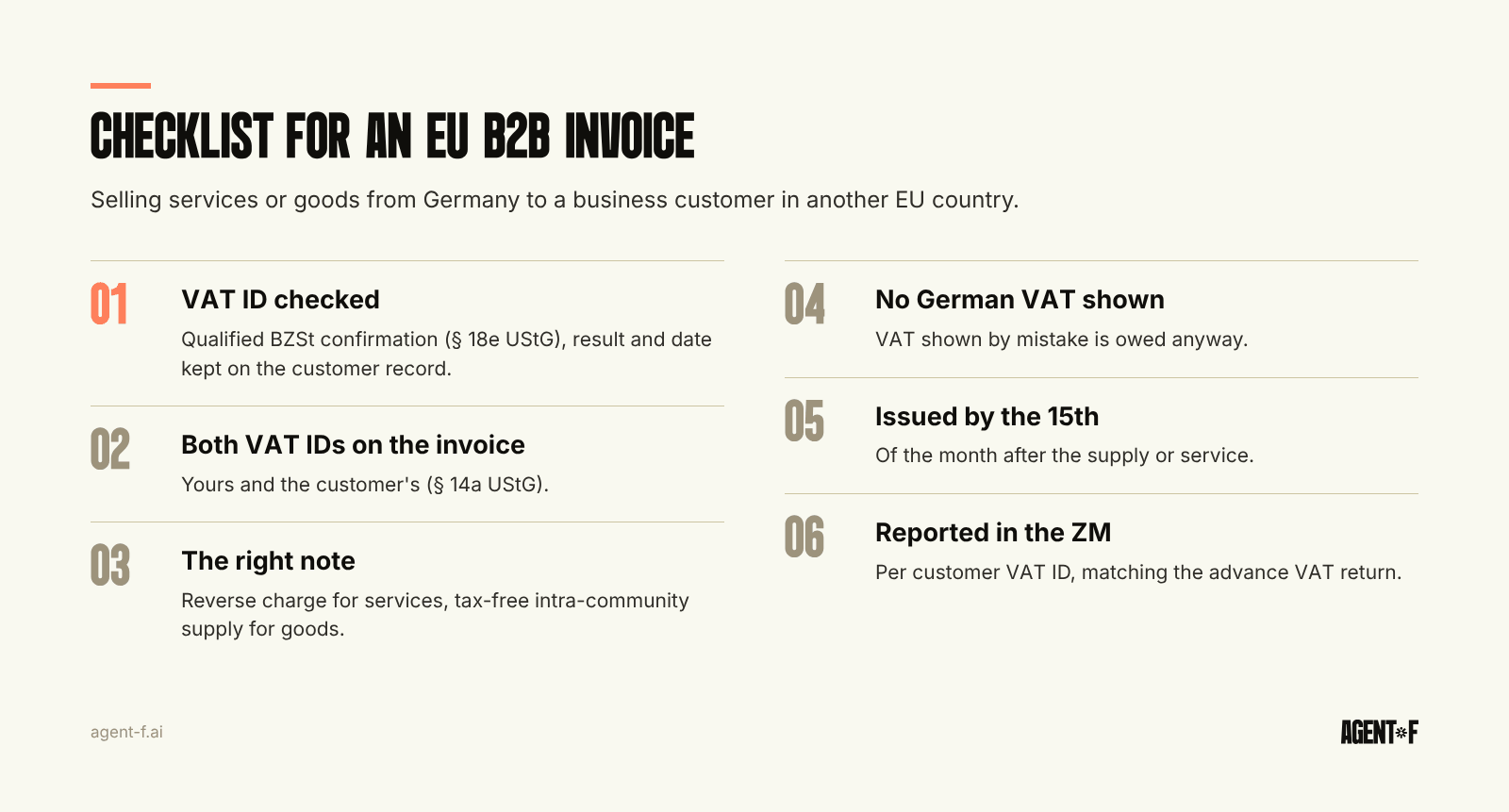
On top of the normal invoice requirements, which we cover in invoice requirements in Germany, § 14a UStG adds several points for EU business:
- Both VAT IDs: yours and the customer's.
- The right note: "Steuerschuldnerschaft des Leistungsempfängers" (or the English "reverse charge") for services, and a note that the supply is a tax-free intra-community supply for goods.
- No German VAT amount. If you show German VAT by mistake, you owe it anyway.
- A deadline: the invoice must be issued by the 15th day of the month after the supply or service.
The deadline is the item most often missed. Projects invoiced at the end of a quarter, or services billed in arrears months later, break it routinely. Cross-border invoices are not yet part of the German e-invoicing mandate, so a PDF is still allowed, but the data on it has to be correct.
Why does the ZM decide whether your supply stays tax-free?
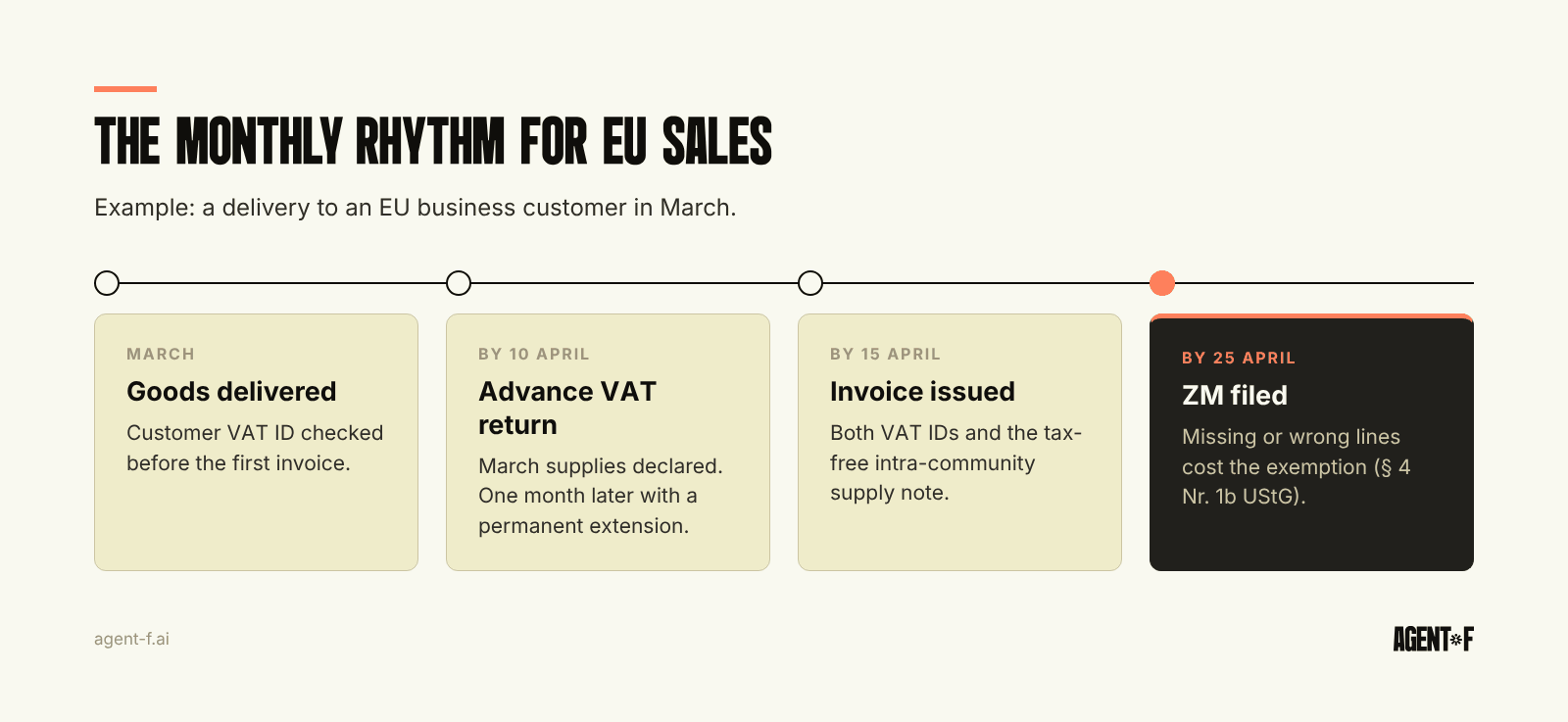
The ZM is a report to the BZSt listing, per customer VAT ID, the total value of your intra-community supplies and EU services. It is how the other country learns that its business should declare the VAT. Under § 18a UStG it is due by the 25th day after the end of the reporting period:
- Goods: monthly. Quarterly reporting is possible only if intra-community supplies stayed at or below 50,000 euros in the current quarter and in each of the four previous quarters.
- Services: quarterly, or monthly together with the goods report if you choose and notify the BZSt.
Since 2020, the ZM is no longer a formality. § 4 no. 1 (b) UStG states that the tax exemption for an intra-community supply does not apply if the ZM was not filed, or if it shows that supply incorrectly or incompletely. A missing or wrong ZM line can turn a tax-free delivery into a taxable one. Errors must be corrected within one month of being discovered.
The tax authorities also compare the ZM with the advance VAT return. When the two are prepared from different data, for example the ZM from the invoicing tool and the VAT return from the tax advisor's bookings, they drift apart. Credit notes and corrections are the usual reason.
What goes wrong with incoming reverse charge invoices?
The incoming side is quieter, which is why it fails. A team member buys a subscription from an Irish or Dutch software provider with a company card. The invoice shows no VAT and is booked as a plain expense. The reverse charge is never declared.
If you have full input VAT deduction, the error is usually neutral in amount, because the VAT owed and the input VAT cancel out. It is still an error in the return, and it becomes a real cost for companies with partial or no deduction rights. The conditions are explained in input VAT deduction. Typical sources are card payments for software, online advertising and freelancers in other EU countries.
How does Agent F help with reverse charge and EU invoices?
In Agent F, invoicing, expenses, bookings and the advance VAT return (UStVA) sit on one data model. That matters for reverse charge, because most errors come from the same transaction living in two systems with two different answers.
On the incoming side, supplier invoices and card receipts are captured and categorised. The self-learning categorisation suggests the booking for each one with a confidence score, and a person approves it before it counts. Every decision is in the immutable audit trail, so you can show later why an invoice was treated the way it was. The person approving should still look twice at a foreign supplier invoice without VAT: it is often a § 13b case.
UStVA preparation runs on the same bookings, and the figures reach your tax advisor (Steuerberater) through the DATEV connection. The VAT ID check and the ZM stay on your own checklist: keep each qualified confirmation with its date, and compare the ZM with the matching VAT return before you file.
To get started, export your EU customers and check every VAT ID with a qualified confirmation, compare last quarter's ZM with the matching VAT returns line by line, and list all foreign suppliers paid by card. Each of these usually finds something.
Learn how Agent F works, or see it on your own EU invoices at agent-f.ai/demo.
This article is for general information only and does not constitute tax or legal advice. Parts of it were generated with AI. Please consult your tax advisor or legal counsel before acting on it, and feel free to reach out at team@agent-f.com with any questions or for support.