Updated
Receipt management under GoBD: photos, substitute receipts, missing receipts
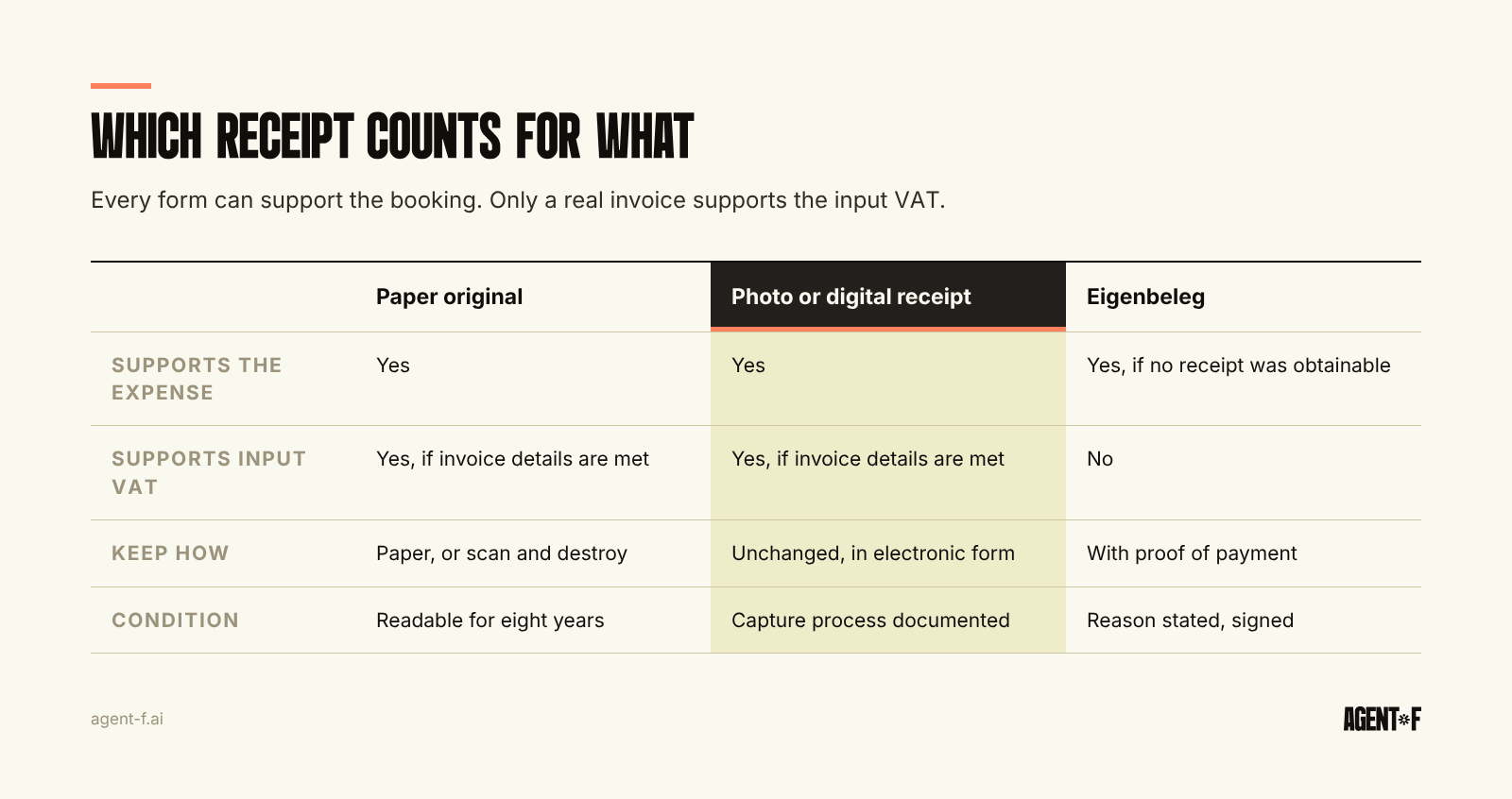
Receipt management in Germany means getting a valid record for every business payment, in a form the GoBD (German digital bookkeeping rules) accept, and storing it unchanged. A photo of a paper receipt counts if the capture process is documented. A PDF receipt sent by email is itself the original. A substitute receipt you write yourself (Eigenbeleg) supports the expense in exceptional cases, but never the input VAT.
Most companies treat missing receipts as a discipline problem and answer with reminders from finance. The more useful view is that receipts go missing for structural reasons, at predictable moments, and that the person who can fix it is almost never in the finance team.
What does the GoBD accept as a receipt?
The GoBD do not ask for paper. They ask for a record that is complete, readable, unchanged and findable for as long as the retention period runs. Three forms are common.
The paper original. Till receipts, restaurant bills, parking tickets. Since 2020, businesses with an electronic cash register must issue a receipt for every sale (Belegausgabepflicht, § 146a AO), on paper or electronically, so most card payments now come with one.
The photo or scan. Paper receipts may be captured with a phone or scanner and then destroyed, as long as no other rule requires the paper and the process is described in your procedure documentation (Verfahrensdokumentation). The GoBD also allow capture abroad when the receipt was issued or received there, which matters for every hotel and taxi on a business trip.
The digital original. A PDF invoice from a software supplier or an e-receipt from a cash register is an electronic document from the start. It has to be kept electronically. Printing it and filing the paper does not meet the rules. How long and in what form is set out in archiving invoices under GoBD.
Since January 2025, booking records such as receipts and invoices must be kept for eight years instead of ten. The clock does not change what counts as a receipt, only how long you need it. What it does change is the quality bar for photos: an image that is readable today but blurred at the amount or the VAT line will not help an auditor in year six. A quick check at capture, by the person who took the photo, is cheaper than any repair later.
Why do card receipts go missing in the first place?
Card payments are the main source of gaps, and they fail in a few typical ways.
- The receipt fades. Thermal paper loses its print within months. A receipt kept in a wallet until month-end may be unreadable by the time it is photographed.
- The confirmation lands in the wrong inbox. Online purchases send their receipt to whoever entered an email address, often a personal one.
- The invoice lives in a portal. Subscriptions charge the card every month while the invoice waits behind a login that one person holds.
- The receipt names the wrong party. Above 250 euros, an invoice made out to the employee instead of the company creates questions for the input VAT.
- The statement looks like proof. The card statement shows that money left the account. It says nothing about what was bought.
Card limits, policies and the link to budgets are the subject of corporate cards and spend control. This article stays with the document itself.
When is an Eigenbeleg allowed, and what must it contain?
An Eigenbeleg (a substitute receipt you write yourself) is the fallback when a third-party receipt cannot be obtained: a parking machine that printed nothing, a tip, a receipt that was lost or became unreadable. It is not a replacement for asking the supplier. Tax auditors accept it when a receipt was unavailable, and question it when a duplicate could simply have been requested.
To hold up, an Eigenbeleg should state:
- The payee's name and address, as far as known.
- What was bought or which service was used.
- The date of the purchase and the amount, including currency.
- Why no original receipt exists.
- Proof of payment where possible, such as the card transaction.
- The date and signature of the person who made the payment, and approval by a manager if your policy requires it.
Many companies cap Eigenbelege per person or per amount, because frequent use is itself a signal an auditor notices. There is no statutory limit, so the cap is a policy decision.
What does a missing receipt actually cost?
Three things, in increasing order of trouble.
The input VAT. Without a proper invoice there is no input VAT deduction under § 15 UStG, and an Eigenbeleg never replaces one. For amounts up to 250 euros gross, a simplified small invoice (Kleinbetragsrechnung) under § 33 UStDV is enough, which is why most till receipts qualify. The full rules are in input VAT deduction.
The expense itself. For most costs, an Eigenbeleg keeps the expense deductible for income tax. Entertainment expenses are stricter: § 4 (5) No. 2 EStG requires written details of place, date, participants, occasion and amount, and a missing restaurant bill is hard to repair afterwards.
The close. An unmatched card payment sits on a suspense account until someone resolves it. A handful is noise. Fifty make the month-end late and the BWA (the monthly management report from your tax advisor) less reliable, because costs land on the wrong account or in the wrong month.
Who should chase a missing receipt?
The cardholder, not finance. Finance can see that a receipt is missing, but only the person who paid has the receipt, the email or the login. Every reminder that goes from finance to the cardholder and back is a handover that adds a day.
A process that works has five parts:
- Ask at the moment of payment. The best time to capture a receipt is within minutes of paying, when it is still in hand.
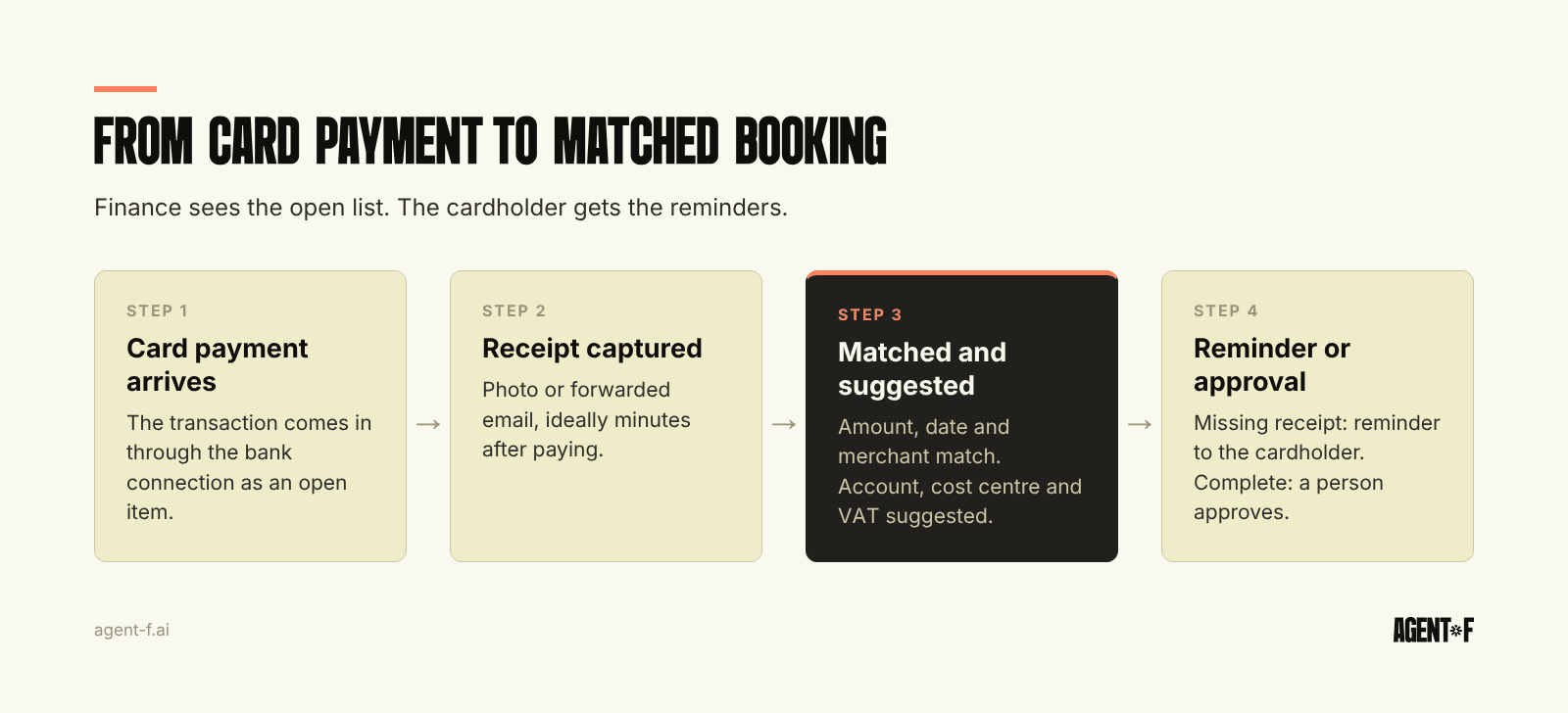
- Match automatically. A photo or forwarded email should attach itself to the right card transaction by amount, date and merchant, without anyone pairing them by hand.
- Remind the cardholder directly. After a day or two, then again, with the transaction shown, so they do not have to search for it. Finance sees the open list but does not send the reminders.
- Give every subscription an owner. Recurring charges get a named person who downloads the invoice from the portal each month, and a replacement when that person leaves.
- Escalate by rule. After a set period, the manager is informed, an Eigenbeleg is requested, or the card limit is reduced. The rule is written down, so nobody negotiates it each month.
With that in place, the receipt step on your month-end close checklist becomes a review of a short exception list.
How does Agent F match receipts to card payments?
In Agent F, card transactions arrive through the bank connection and appear as open items before any receipt exists. When the cardholder uploads a photo or forwards an email receipt, Agent F reads it, matches it to the payment by amount, date and merchant, and suggests the account, cost centre and VAT treatment from your booking history, each with a confidence score.
Missing receipts trigger reminders to the cardholder, not to the finance inbox. A person approves the booking, and the receipt, the match and the approval are kept together in the immutable audit trail described in audit trails under GoBD. Data is hosted in Germany, and the booked expenses flow into the DATEV export, so your tax advisor (Steuerberater) receives each booking with its receipt attached.
For a practical start, pull last month's unmatched card payments and sort them by the reasons above. Write down your rule for Eigenbelege and escalation. Update the capture section of your procedure documentation so photos and digital receipts are covered. Then move the reminders from finance to the cardholders.
Learn how Agent F works, or see it on your own card payments at agent-f.ai/demo.
This article is for general information only and does not constitute tax or legal advice. Parts of it were generated with AI. Please consult your tax advisor or legal counsel before acting on it, and feel free to reach out at team@agent-f.com with any questions or for support.