Updated
Skonto and payment terms: when paying early pays, and how to collect faster
Skonto is a discount for paying an invoice early, typically 2 or 3 percent if you pay within 10 or 14 days instead of 30. It is standard on German B2B invoices. Taking it is usually worth it: 2 percent for paying 20 days early equals an annual return of about 37 percent. The discount reduces the price, so the VAT changes with it.
Most companies agree with that arithmetic and still miss a large share of the Skonto they are offered. The reason is a process in which invoices wait for approval longer than the discount window lasts. On the receivables side, the same terms can bring cash in faster, if you set them deliberately.
What is Skonto, and how is it written on an invoice?
Skonto is an agreed reduction of the price on condition of early payment. A typical German payment term reads "zahlbar innerhalb von 14 Tagen mit 2 % Skonto, innerhalb von 30 Tagen netto": pay within 14 days and deduct 2 percent, or pay the full amount within 30 days. The window usually runs from the invoice date, unless the terms say otherwise.
Most English-language guidance treats early payment discounts as an occasional negotiation. In Germany they are a default, printed on many supplier invoices as a matter of course. For VAT purposes, an invoice must state any price reduction agreed in advance (§ 14 (4) No. 7 of the VAT Act, UStG). Since structured e-invoices are now becoming mandatory, there is also a fixed format: in an XRechnung, Skonto goes into the payment terms field as a coded line with the number of days and the percentage, so a system can read it without a person interpreting the text.
When is taking Skonto worth it?
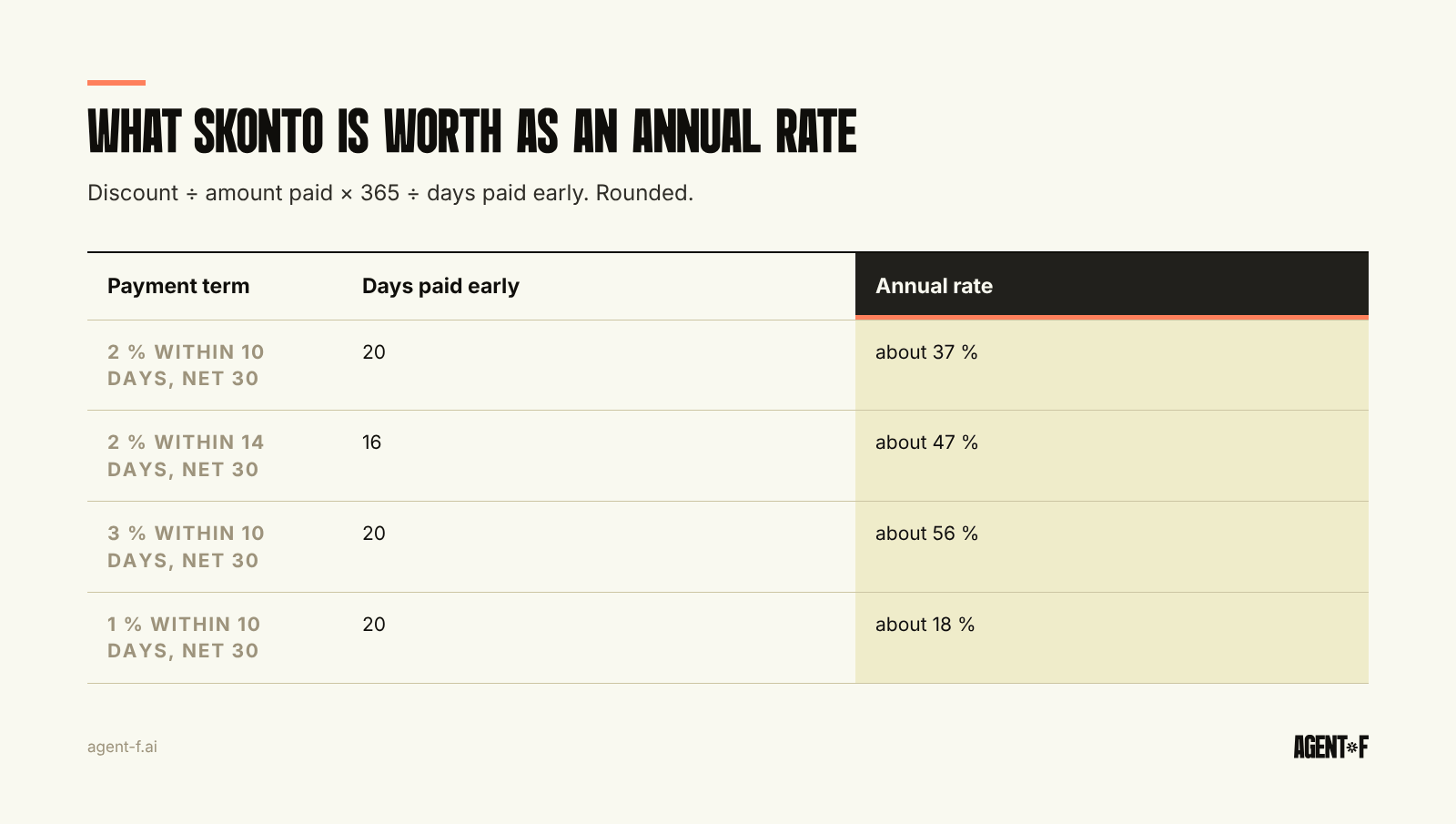
Treat Skonto as a return on cash. You give up credit for the days between the discount deadline and the net due date, and you earn the discount for doing so. The annual rate is roughly the discount divided by the amount you pay, multiplied by 365 and divided by the days you give up.
Two common terms:
- 2 percent within 10 days, net 30. You pay 20 days early. 2 / 98 × 365 / 20 is about 37 percent a year.
- 2 percent within 14 days, net 30. You pay 16 days early. That is about 47 percent a year.
Very few uses of cash in a growing company earn that much, and even an overdraft facility usually costs far less. The rule is simple: if you have the liquidity, take the Skonto. The exception is a company where cash is the binding constraint. Then a 13-week view of incoming and outgoing payments decides which discounts to take and which to let go, a trade-off we look at in working capital.
How is Skonto booked, and what happens to VAT?
Skonto reduces the price of the purchase, not a separate financial income. Because the price changes, VAT changes with it: the supplier corrects their output VAT and the buyer corrects their input VAT (§ 17 (1) UStG).
An example. An invoice for 10,000 euros net plus 1,900 euros VAT totals 11,900 euros. With 2 percent Skonto, you pay 11,662 euros. The 238 euros deducted consist of 200 euros net and 38 euros VAT. Your input VAT falls from 1,900 to 1,862 euros. The German standard charts of accounts (SKR03 and SKR04) have dedicated discount accounts, and accounting systems typically split the VAT automatically when the payment is matched to the invoice. Booking the payment by hand against the full invoice leaves a 238 euro difference that someone has to explain at month-end.
For purchases that are capitalised, such as a machine, the discount reduces the acquisition cost and therefore the depreciation. That is a detail your tax advisor (Steuerberater) will check, but the system should get it right in the first place.
Why do companies miss Skonto they meant to take?
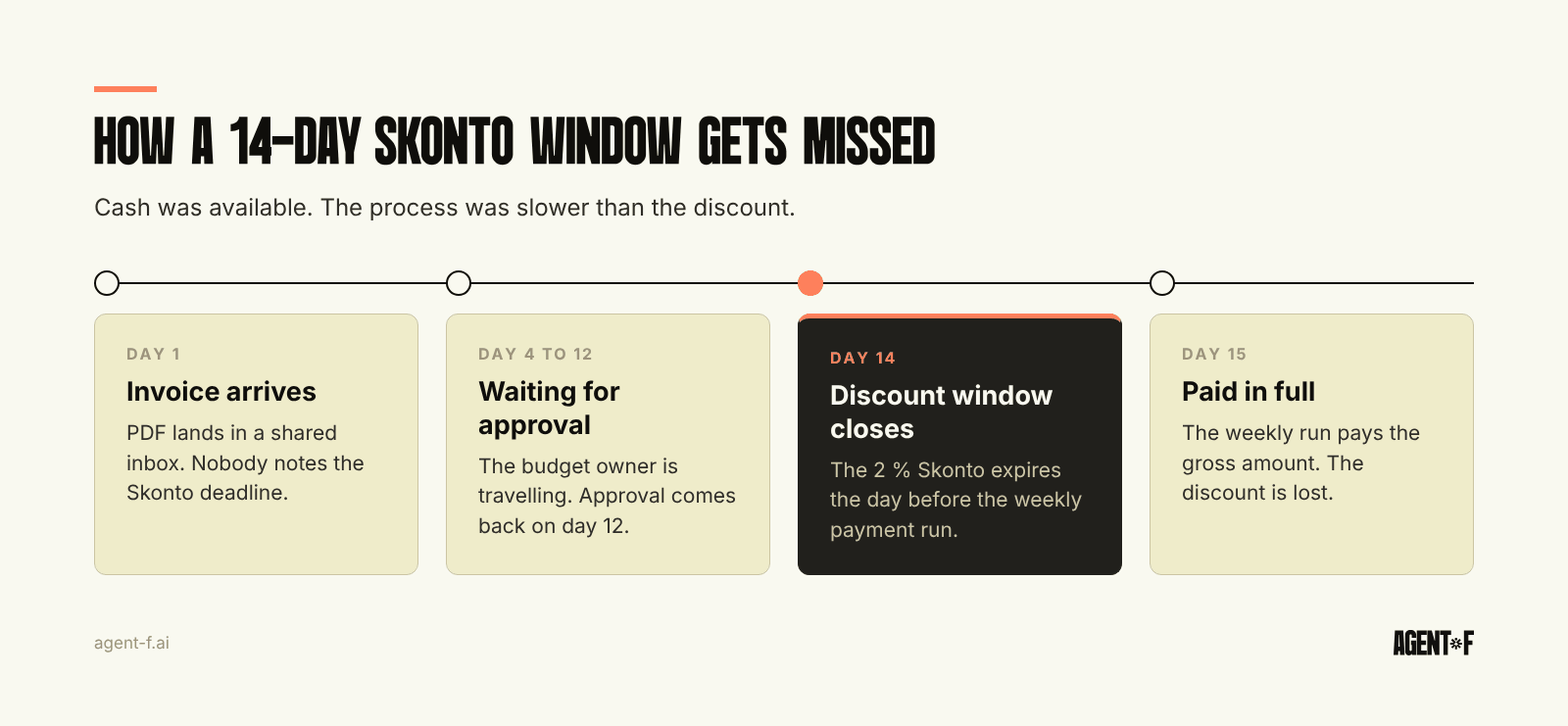
The discount window is short and the internal process is long. A typical path: the invoice arrives by email on day 1, sits in a shared inbox until day 4, goes to the budget owner, who is travelling, and comes back approved on day 12. The weekly payment run is on Thursday, day 15. The 14-day window closed the day before.
Three changes fix most of this:
- Capture the Skonto date on arrival. The discount deadline, not the net due date, becomes the date that drives the process.
- Approve against the deadline. Invoices with Skonto move to the top of the approver's list, with the deadline visible. The broader approval flow is covered in accounts payable automation.
- Schedule the payment run around discount dates. A run that picks invoices by Skonto deadline, as described in batch payment runs, stops a weekly rhythm from eating the window.
Then measure it: the share of offered Skonto actually taken, per month. It is one of the few finance KPIs that translates directly into euros.
Should you offer Skonto to your own customers?
On the receivables side, Skonto is a price for faster cash. Offering 2 percent for payment within 10 days costs the same 37 percent a year from your perspective, so it only makes sense when early cash is worth that much to you, for example in a tight growth phase or with customers who otherwise pay at day 60.
If you offer it, three things matter. First, customers deduct Skonto after the deadline more often than you might expect, and the difference of a few euros stays open unless someone checks every payment against the terms. Clean payment reconciliation catches these. Second, decide in advance whether you chase late deductions, and say so consistently. Third, keep the terms short and clear on every invoice.
Without Skonto, German law gives you a default framework. A business customer is in default at the latest 30 days after the due date and receipt of the invoice (§ 286 (3) BGB). Payment terms of more than 60 days in B2B contracts are only valid if expressly agreed and not grossly unfair to the creditor (§ 271a BGB). Once a business customer is in default, you can claim interest of nine percentage points above the base rate and a flat fee of 40 euros (§ 288 BGB). Reminders that follow these rules are part of dunning and receivables.
How does Agent F calculate and catch Skonto?
In Agent F, accounts payable, bank and ledger work on one data model. When a supplier invoice arrives, as a PDF or as an XRechnung or ZUGFeRD file, the AI reads the payment terms, calculates the Skonto amount and the deadline for that invoice, and suggests account, cost centre and VAT treatment with a confidence score. The invoice goes to the approver with the discount deadline shown.
Approved invoices are scheduled into the payment run on the last safe day for the discount, and the run is proposed for a person to release. When the payment leaves the bank, the system matches it to the invoice, books the discount with the VAT correction, and records every step in the audit trail. On the receivables side, incoming payments are checked against your terms, and late or excessive Skonto deductions are flagged for follow-up instead of disappearing as small differences. The bookings flow into the DATEV export for your tax advisor.
To start, pull last quarter's supplier invoices with Skonto terms and check how many you actually took. Add up the euros you missed, look at how many days approval took on those invoices, and move your payment run to follow discount deadlines rather than the calendar. For your own invoices, decide whether early cash is worth the discount before you print it on every invoice.
Learn how Agent F works, or see it on your own invoices at agent-f.ai/demo.
This article is for general information only and does not constitute tax or legal advice. Parts of it were generated with AI. Please consult your tax advisor or legal counsel before acting on it, and feel free to reach out at team@agent-f.com with any questions or for support.