Updated
Strategic finance: how the finance team moves from reporting to decisions

Strategic finance means the finance team helps decide what the company does next, rather than reporting afterwards what it did. In practice that comes down to timing and questions: margin by product or customer, cash impact of a hire or a contract, and scenarios for the next two quarters, delivered while the decision is still open. Most finance teams want this role. What stops them is the time the close and reconciliation still take.
The usual advice is to build new skills, earn a seat at the table and communicate better. All of that helps. But in many German companies the real constraint is structural: the people who should be analysing are still busy producing numbers that arrive too late to matter.
What does strategic finance mean in a German company?
In German companies the idea has a long tradition under another name: Controlling. The word comes from the English "to control" but means steering, not checking. The Controller (the internal management accountant) is meant to give the managing directors the numbers they need to steer: plan versus actual, cost by cost centre, contribution margin, liquidity.
Alongside sits external accounting, often done or reviewed by the tax advisor (Steuerberater). Its output, the BWA (the monthly management report from your tax advisor), is built on tax bookkeeping and the standard chart of accounts. It is reliable for what it is designed for, but it does not know your products, projects or customers.
Strategic finance is what happens when the controlling side is fully staffed and fed with current data. In many Mittelstand companies, the Controller exists on the organisation chart, but spends most of the month reconciling the BWA with spreadsheets instead of steering.
Why does finance get stuck in reporting?
Three patterns explain most of it.
The numbers arrive late. If the books for October are final in the middle of November, every analysis is about a month that cannot be changed any more. Our article on real-time financial reporting explains where the delay comes from.
The data lives in too many places. Orders in one system, invoices in another, bank data in a third, the ledger with the tax advisor. A simple question about margin per customer needs three exports and an afternoon of matching. By the time the answer is ready, the meeting has passed.
Routine work fills the calendar. Invoice checking, bank matching, chasing receipts and accrual lists repeat every month. They are necessary, and they are the work that gets done first, because the VAT return and the tax advisor are waiting. Analysis is what gets postponed.
None of these is a skills problem: a good Controller with late, scattered data produces late, scattered analysis.
What does a finance business partner actually do differently?
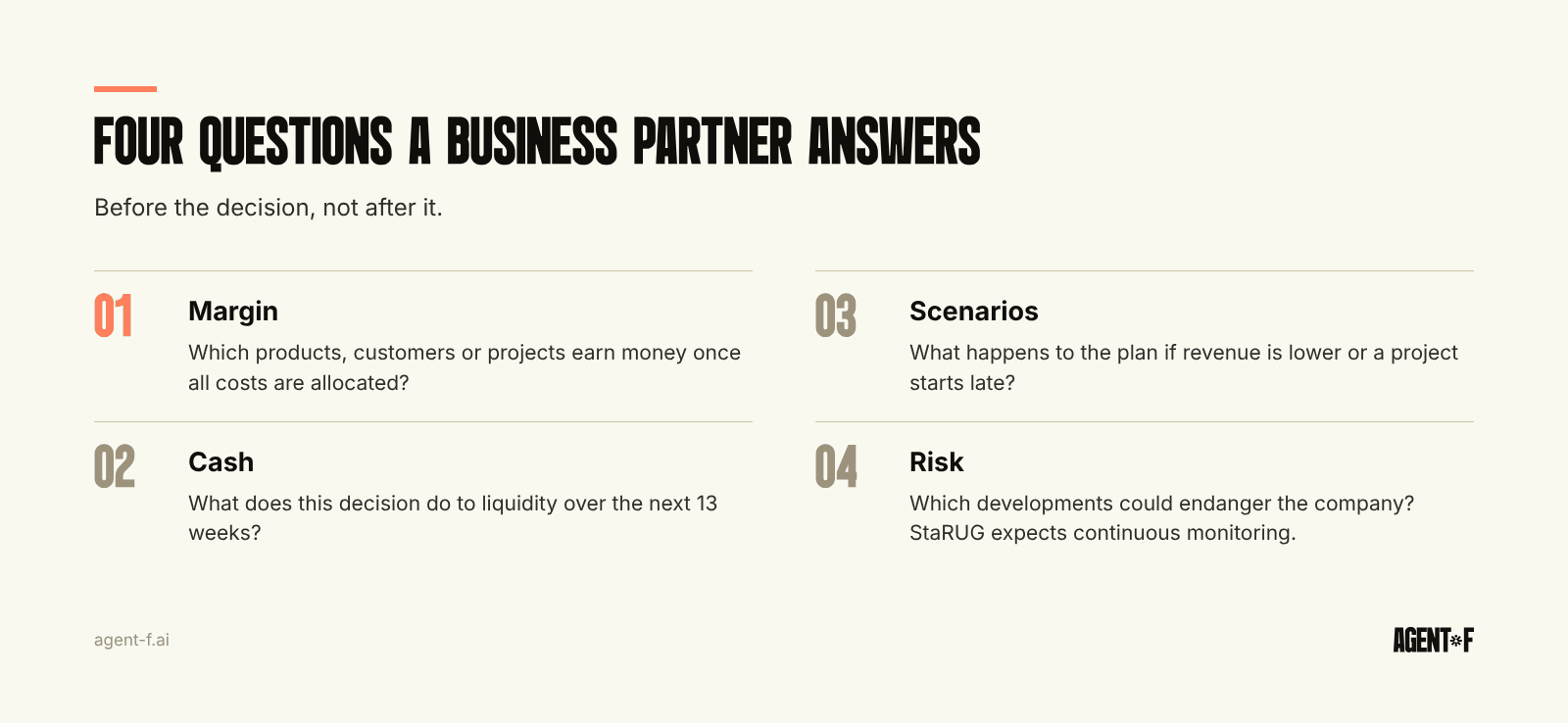
The difference is in the questions finance answers, and when. A reporting function explains last month. A business partner answers four kinds of questions before the decision.
- Margin. Which products, customers or projects earn money once all costs are allocated? Contribution margin by dimension is often the first analysis a growing company lacks, as described in contribution margin by product, customer or project.
- Cash. What does this decision do to liquidity over the next 13 weeks? A new hire, a large order with long payment terms or an inventory build-up all look different in cash than in profit.
- Scenarios. What happens to the plan if revenue comes in 15 percent lower, or the new facility starts three months late? A rolling forecast makes this a monthly routine instead of an annual exercise.
- Risk. Which developments could threaten the company, and how early would we see them?
The fourth question is not optional in Germany. Under § 1 of the Corporate Stabilisation and Restructuring Act (StaRUG), the managing directors of a legal entity must continuously monitor developments that could endanger its continued existence and take countermeasures. In practice, that monitoring depends on finance: a liquidity plan, a forecast and early warning on receivables and margins.
How does the Controller role change when the close takes days, not weeks?
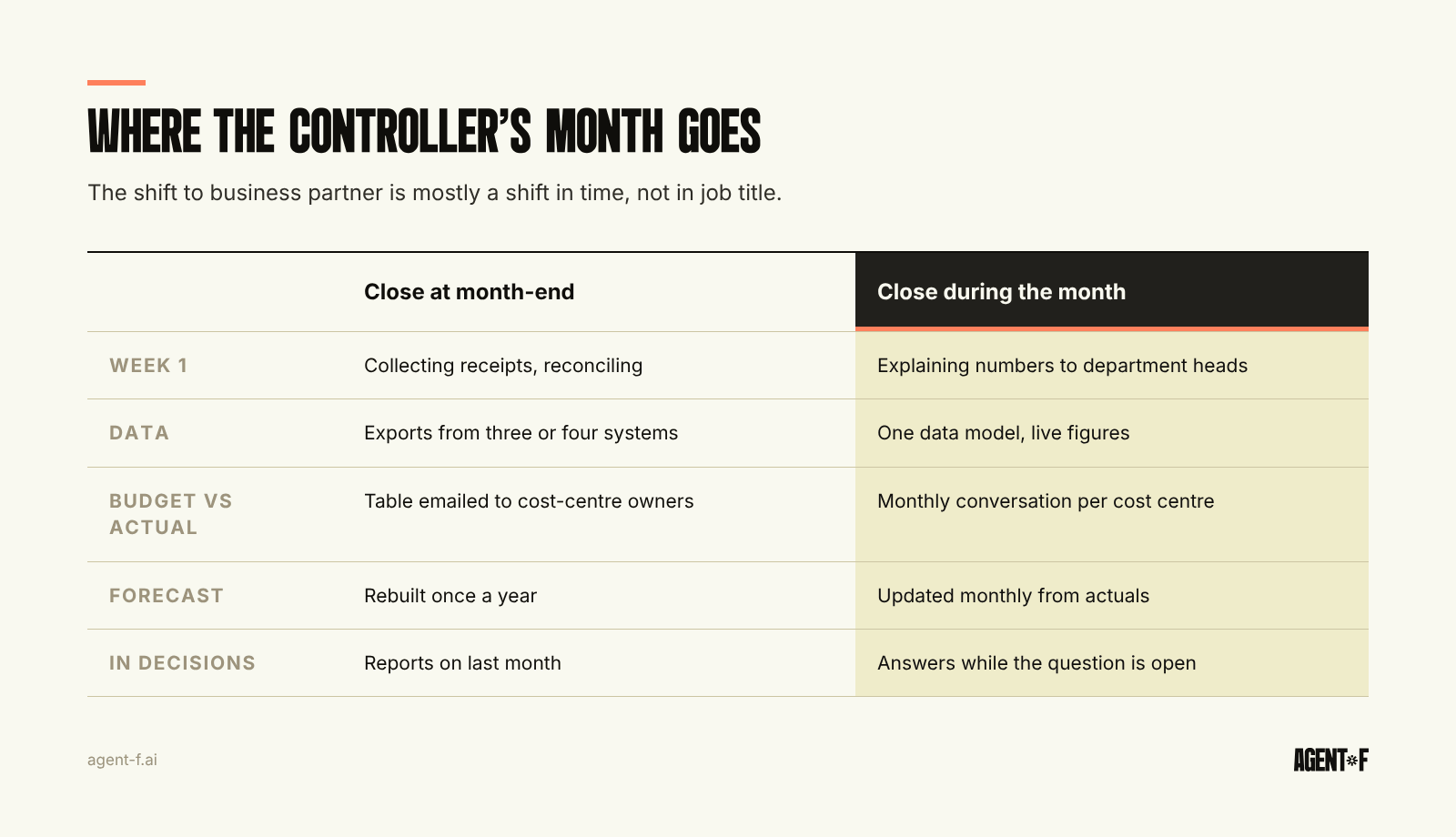
When the close runs during the month and finishes within one or two days, the Controller's calendar changes. The first week of the month is no longer spent producing the numbers. It is spent explaining them and discussing them with department heads.
Three things tend to follow. Budget versus actual becomes a conversation with cost-centre owners, not a table emailed to them; the method is in budget vs actual reporting per cost centre. Forecasts are updated monthly from actuals instead of rebuilt once a year. And the Controller is in the room when decisions are made, because the answer is available while the question is still being asked.
The team structure changes too. A company of 50 people often has one or two people in finance doing everything. As routine work shrinks, the next hire can be an analyst rather than another bookkeeper, a shift we discuss in finance team structure at 20, 50 and 100 people.
What should finance stop doing to make room?
Becoming a business partner is as much about subtraction as addition. Most finance teams can name work that persists only because nobody has questioned it.
Reports nobody reads. Monthly packs often grow by one tab per request and never shrink. Ask each recipient which page they used last month. The rest can usually go, or become a question they can ask when they need it.
Reconciling the same number twice. If the ledger, the BWA and the management spreadsheet each show revenue, someone spends time making them agree. One source for all three removes the reconciliation rather than speeding it up.
Manual handovers to the tax advisor. Collecting receipts by email, answering the same questions each month and correcting entries after the advisor's review all take Controller time. A clear split of tasks and a clean monthly export reduce this to a routine.
Building the budget from scratch. An annual budget rebuilt in a fresh spreadsheet each autumn takes weeks. Starting from actuals and updating monthly is a much smaller job each time.
Each item removed returns time every month. Together they make up the time that analysis needs.
Where does AI fit in strategic finance?
AI does not make the decisions. What it can do is prepare the ground, in two places.
First, it takes over much of the routine work: reading invoices, matching payments, suggesting bookings and drafting accruals, each checked by a person. The hours saved there are the hours that analysis needs.
Second, it prepares analysis. Plain-language questions on live data, such as "why did gross margin fall in September?", can return a first answer with the transactions behind it. Anomaly detection flags a cost centre that is drifting from plan before the month ends. The Controller still checks, interprets and explains, but starts from a draft instead of an empty spreadsheet.
How does Agent F help finance move to decisions?
Take margin by customer. In Agent F, orders, invoices, bank data and the ledger share one data model, so margin by customer comes from the same records the close uses, every month and without an export. Cash and plan versus actual work the same way. The AI suggests bookings and accruals with confidence scores for a person to approve, and teams typically move from a 5 to 10 day close to 1 to 2 days. The time that frees is the time strategic finance needs.
For a finance team that wants to make this shift, three steps help. List the decisions coming up in the next quarter and the numbers each one needs. Measure how many days after month-end your numbers are final. And pick one recurring question, such as margin by customer, and make it available every month without an export.
Learn how Agent F works, or see it on your own numbers at agent-f.ai/demo.
This article is for general information only and does not constitute tax or legal advice. Parts of it were generated with AI. Please consult your tax advisor or legal counsel before acting on it, and feel free to reach out at team@agent-f.com with any questions or for support.