Updated
Finance team structure at 20, 50 and 100 people in a German company

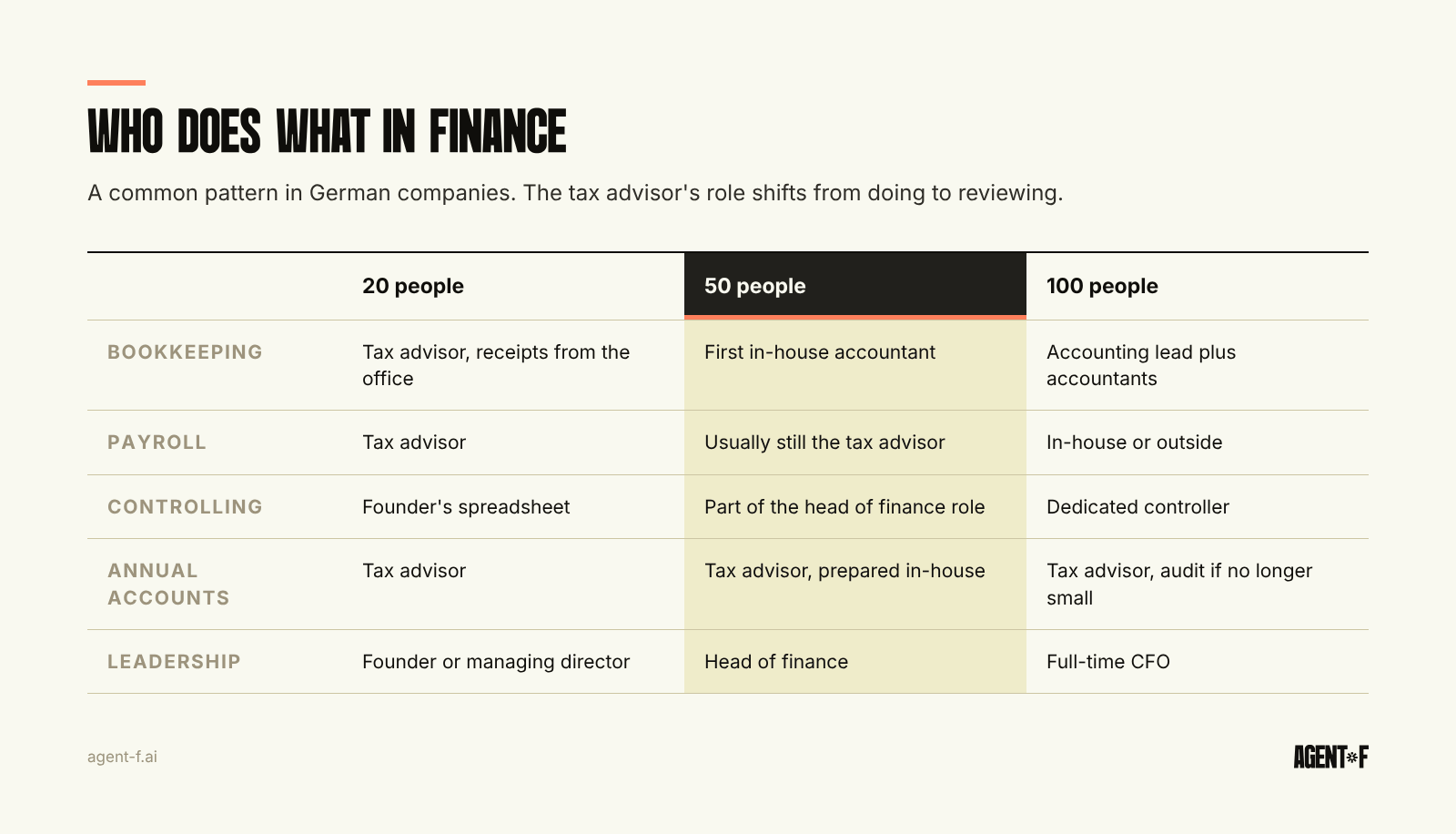
At 20 people, finance in a German company is usually the founder, a part-time bookkeeper and the tax advisor (Steuerberater), who does the books, payroll and the annual accounts. At around 50, bookkeeping moves in-house with a first full-time accountant and a head of finance. At 100, the team splits into accounting and controlling, and a statutory audit may apply. The right structure depends less on headcount than on how much transaction work the system leaves to people.
Most guides to finance team structure assume a US model, with a controller, a staff of accountants and no outside firm. German companies grow differently, because the tax advisor carries a large part of the work for years. The real design question is which work moves in-house, when, and whether it moves to people or to the system.
What does the finance team look like at 20 people?
At this size, finance is a part-time job spread across several people. A typical setup:
- The founder or managing director (Geschäftsführer) owns the numbers, approves payments and talks to investors and the bank. Under § 41 GmbHG, the managing directors are responsible for proper bookkeeping, even when they delegate the work.
- An office manager or part-time bookkeeper collects receipts, chases missing invoices, prepares payments and answers supplier questions.
- The tax advisor books the transactions, runs payroll, files the advance VAT returns and prepares the annual accounts, usually in DATEV.
This works as long as the company needs little more than compliance. The weak point is timing. The BWA (the monthly management report from your tax advisor) arrives weeks after month end, and any question deeper than the profit and loss statement ends in a spreadsheet the founder builds at night. Some companies add a fractional CFO for fundraising and planning, which fills the strategic gap but not the data gap.
What changes at 50 people?
Somewhere between 30 and 60 people, three things usually happen at once: invoice volume grows, investors ask for monthly reporting, and cost centre owners want to know where they stand against budget. The tax advisor's monthly rhythm can no longer keep up.
The typical response is the first full-time finance hire, often an accountant (Buchhalter) or a certified accountant with the IHK qualification (Bilanzbuchhalter). Bookkeeping moves in-house: invoices, bank matching, accounts payable and receivable, and the monthly close. The tax advisor keeps payroll in many cases, plus the annual accounts and tax returns, and shifts from doing the books to reviewing them.
Above that sits a head of finance, sometimes titled finance manager or CFO, who builds the budget, owns the investor and board reporting and acts as the counterpart to the managing directors. Controlling, meaning budget versus actual, forecasts and cost centre reports, is often a part of this role at first rather than a separate person.
This is the stage where the split with the tax advisor needs to be explicit. Who books what, who closes the month, who sends what by when. We go through that split in working with your tax advisor.
What does the finance team look like at 100 people?
At around 100 people, finance usually splits into two functions with different skills.
Accounting owns the books. An accounting lead, often a Bilanzbuchhalter, runs the close and the relationship with the tax advisor and auditors. One or more accountants handle payables, receivables and bank matching. Payroll may come in-house or stay outside, depending on complexity.
Controlling owns the view forward. A controller (in German companies a distinct role, focused on planning, cost centres and management reporting rather than on the books) builds forecasts, explains variances and prepares the numbers for management and investors.
Leadership is now a full-time CFO or head of finance who spends most of the time on funding, banks, pricing and planning, and less on the ledger.
Two legal points tend to arrive at this stage. Under § 267 HGB, a corporation is small if it stays within two of three limits: 7.5 million euros balance sheet total, 15 million euros revenue and an average of 50 employees. A company that exceeds two of them on two consecutive balance sheet dates is no longer small, and under § 316 HGB its annual accounts must then be audited. With 100 employees, one criterion is already exceeded, so revenue or balance sheet growth can trigger the audit. Many groups also add a second entity around this size, which brings intercompany bookings and consolidation into the team's work.
Which work should stay with the tax advisor?
Even at 100 people, most German companies keep a tax advisor. The question is which work to buy and which to own.
Work that usually stays outside: the corporate tax returns, the annual accounts or at least their review, tax planning, and specialist questions such as reverse charge cases, transfer pricing or tax audits. Payroll often stays outside too, because the rules change frequently and errors are visible to every employee.
Work that usually comes in-house: everything that needs context from inside the company. Which cost centre an invoice belongs to, whether a delivery arrived, whether a customer has agreed a payment plan. Those are the questions that slow the tax advisor down, and they are the ones your own team answers in seconds.
A useful test for every task: does it need tax expertise, or does it need knowledge of the business? The first belongs with the advisor. The second belongs inside the company, ideally in a system where the person with the knowledge can answer once and the answer is reused next month. Whatever the split, write it down, including deadlines, so that nobody assumes the other side has done it.
Why does the finance team grow faster than the company?
In many companies, finance headcount follows transaction volume. Twice the supplier invoices means more time spent typing, matching and chasing. Twice the customers means more open items to reconcile. If every new process adds a tool and every tool adds an export, the team grows with the number of interfaces as well.
This is the pattern behind most premature finance hires. The new accountant does not add judgement, they add hands for work the system could do. The more useful hire at 50 people is someone who designs the process and checks the results, not someone who keys in data. The longer view of how roles change is in will AI replace accountants.
How does Agent F help a finance team grow slower than the company?
Agent F is built to take over the transaction work, so that each finance hire adds judgement rather than capacity. Supplier invoices are captured and matched to orders, bank transactions are matched to open items, and bookings, accruals and depreciation are suggested from your own history. Each suggestion comes with a confidence score, a person approves it, and every step is recorded in an immutable audit trail. Reconciliation accuracy typically reaches 90 percent or more by month three.
Because finance, operations and payroll sit on one data model, the controller works from the same live data as the accountant, and budget versus actual per cost centre or board reporting no longer needs a separate spreadsheet. The tax advisor receives a clean DATEV export and keeps the work that needs their expertise. Teams in this position often go from a monthly close of 5 to 10 days to 1 to 2 days, which is what frees a head of finance to act as a business partner rather than a report builder.
Before your next finance hire, list what the team did last month and mark each task as typing, checking or deciding. If more than half is typing, fix the system before you add a person. Then agree the split of work with your tax advisor in writing and set a close calendar the whole team follows, such as our month-end close checklist.
Learn how Agent F works, or see it on your own finance processes at agent-f.ai/demo.
This article is for general information only and does not constitute tax or legal advice. Parts of it were generated with AI. Please consult your tax advisor or legal counsel before acting on it, and feel free to reach out at team@agent-f.com with any questions or for support.