Updated
In-house bookkeeping: what to keep and what to hand to your tax advisor
In-house bookkeeping means your own team records the daily transactions, matches payments and prepares the month, while the tax advisor (Steuerberater) reviews, closes the year and files the taxes. Most German companies start by handing receipts to the advisor and move bookkeeping in-house once they need numbers faster than the advisor's monthly rhythm allows. The legal responsibility for the books stays with management either way.
The question is rarely "advisor or no advisor". It is where the line between the company and the advisor should sit, and when to move it. This guide explains the usual models, the signals that the line should move, and what a clean handover looks like each month.
Who is responsible for the books when the tax advisor does them?
Management is. Under § 238 HGB (German commercial code), every merchant must keep books. For a GmbH, § 41 GmbHG makes the managing directors responsible for proper bookkeeping. Handing the work to a tax advisor moves the work, not the responsibility.
That matters in two situations. In a tax audit, the tax office asks the company, not the advisor, for complete and traceable records under the GoBD (German digital bookkeeping rules). And when investors or banks ask for numbers, they expect management to understand them. A company that sees its own books only through the BWA (the monthly management report from your tax advisor) can meet the legal minimum and still not know where its cash went last month.
What does the usual split with a tax advisor look like?
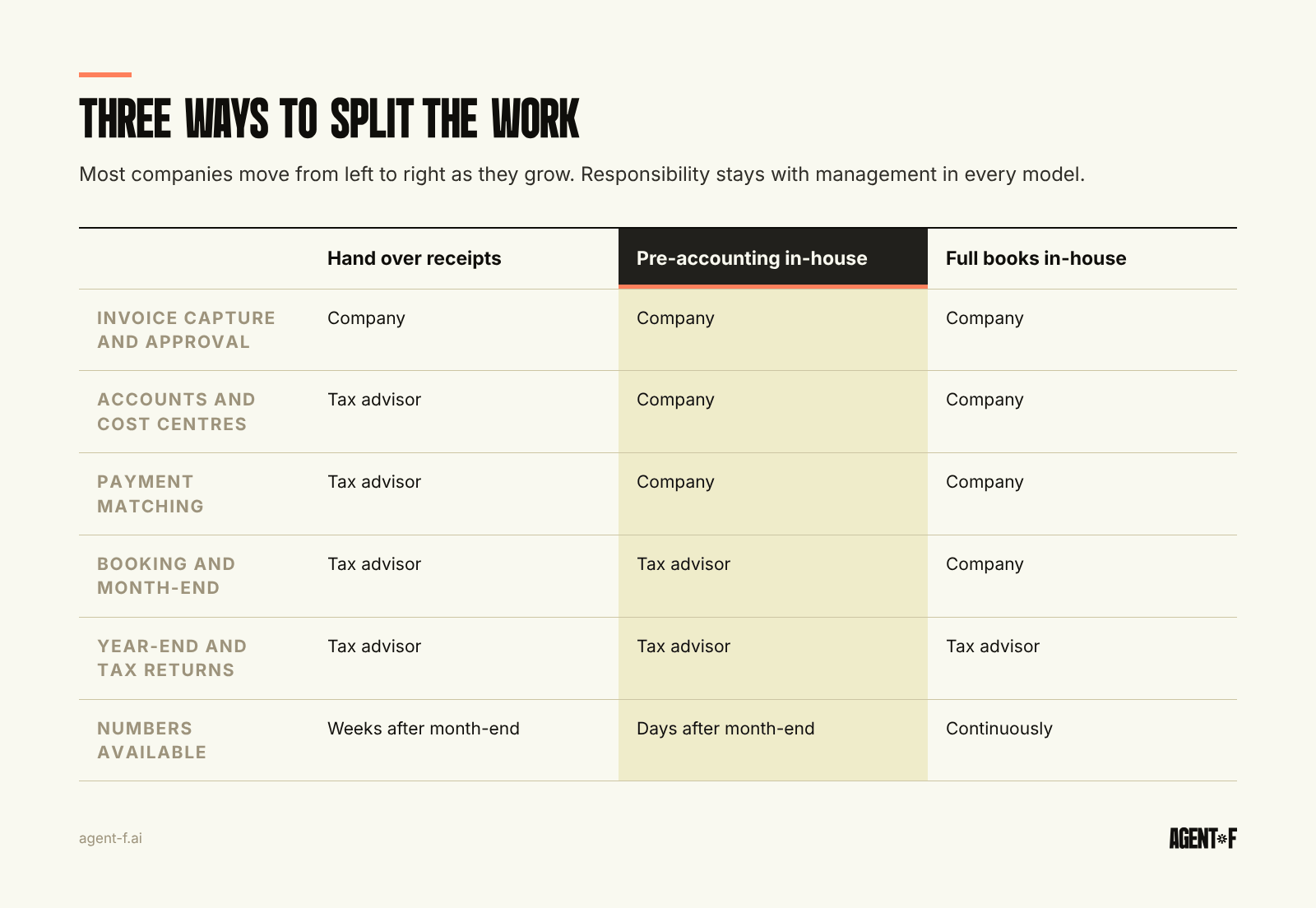
In practice, German companies use one of three models, often moving from the first to the third as they grow.
Model 1: hand over receipts. The company collects invoices and bank statements and sends them to the advisor, today usually through a DATEV upload. The advisor codes each receipt, books it, prepares the advance VAT return (UStVA), payroll and the BWA, and at year-end the annual accounts and tax returns. Simple, but the numbers arrive several weeks after month-end, and every question goes through the advisor.
Model 2: pre-accounting in-house. The company does the pre-accounting (vorbereitende Buchhaltung): it captures invoices, approves them, assigns accounts and cost centres, and matches payments. The advisor receives prepared data, checks it, books it into the ledger and handles taxes and year-end. This is the most common model in growing companies.
Model 3: full bookkeeping in-house. The company books everything itself, runs its own month-end close and sends the finished ledger to the advisor through the DATEV export. The advisor reviews, posts year-end adjustments, prepares the annual accounts and files the returns.
The fee structure reflects this split. The German fee regulation for tax advisors (StBVV) sets lower fee ranges in § 33 when the client codes receipts or enters data itself than when the advisor keeps the full books. Whether that lowers the total cost depends on your internal effort, so compare both sides honestly.
When should you move bookkeeping in-house?
There is no turnover threshold. The signals are operational, and they usually appear together:
- Numbers arrive too late to act on. If you learn in late March what happened in January, your budget reviews are about history.
- Questions pile up. You ask the advisor what a booking means, and the answer takes a week.
- Controlling needs dimensions. Cost centres, projects, product lines or several entities are hard to maintain from the outside, because the advisor does not know which project an invoice belongs to.
- Investors want monthly reporting. A board report built on a six-week-old BWA invites questions you cannot answer.
- Volume is high enough for a process. When the team spends hours every month collecting and explaining receipts, it is already doing half the bookkeeping, just not in the books.
If two or three of these apply, move one step, not two. Going from model 1 to model 2 is a manageable change. Going straight to model 3 means hiring or training someone who can run a close, as described in our guide to finance team structure.
Which tasks should stay with the tax advisor?
Moving bookkeeping in-house does not make the advisor less important. It changes what you pay them for: review and judgement instead of typing.
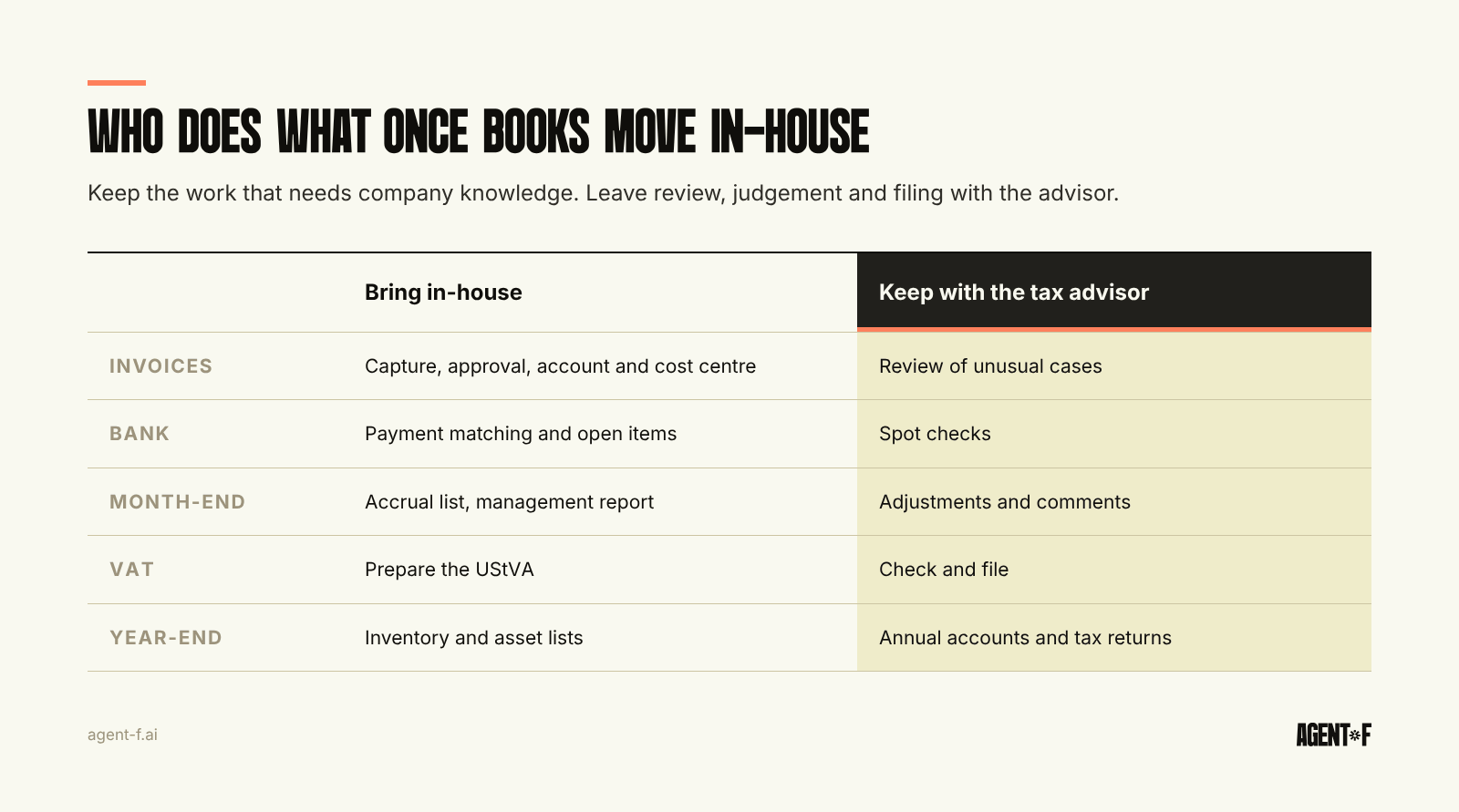
Keep with the advisor: annual tax returns for corporate, trade and VAT, the annual accounts (Jahresabschluss) and their tax adjustments, tax planning, questions on new structures, and representation in a tax audit. Many companies also leave payroll with the advisor, at least until headcount and complexity justify a payroll system. The steps of the year-end are in year-end close in Germany.
Bring in-house first: invoice capture and approval, account and cost centre assignment, payment matching, open item management, accrual lists and the monthly management report. These need knowledge that sits in your company: who ordered what, which project it belongs to, whether the customer has already paid.
The advance VAT return sits in between. Many companies prepare it in-house and let the advisor check and file it. The deadlines are in advance VAT return in Germany.
How should the monthly handover work?
Whichever model you use, agree the handover in writing: what the advisor receives, by which day, in which format, and what they check. A practical version looks like this:
- By the fifth working day, all invoices for the month are captured, approved and coded, and bank accounts are matched.
- Open questions are listed in one place, not spread across emails.
- The data goes to the advisor as a DATEV export with the receipts attached, so nothing is typed twice. What it should contain is covered in the DATEV export.
- The advisor reviews, books adjustments and returns comments. Their corrections flow back into your system, so next month starts from the same numbers.
The order of the month-end steps is in our month-end close checklist. Also agree who documents the process. The GoBD expect a procedural documentation (Verfahrensdokumentation), and it is easiest to write when the split is fresh.
How does Agent F help you share the work with your tax advisor?
Agent F is built for model 2 and model 3, and for the move between them. Pre-accounting is done by the system, and your advisor reviews and files instead of typing.
Incoming invoices are read, checked and matched to orders. Agent F suggests the account, cost centre and VAT treatment from your booking history, each with a confidence score, and bank payments are matched to open items the same way. A person approves; nothing is booked without that approval, and every step is recorded in the immutable audit trail. Accruals, depreciation schedules and the UStVA are prepared as suggestions for the close, and the period is locked once it is done.
The ledger follows HGB and GoBD on the SKR04 chart of accounts, so the DATEV export arrives at your advisor's office in the structure they already use, with the receipts attached. Data is hosted in Germany. Because your team sees the same live ledger, the BWA becomes a check rather than your first look at the month. Companies that move their close into the system typically go from 5 to 10 days to 1 to 2 days. The onboarding period, typically three months, runs in parallel with your current setup, so your advisor can compare both before anything changes.
To decide where your line should sit, list every task your advisor does today and mark which ones need knowledge only your team has. Then ask your advisor which data they would like to receive instead of receipts, and agree a handover day. Start with one month in parallel before you change the engagement.
Learn how Agent F works, or see it on your own bookings at agent-f.ai/demo.
This article is for general information only and does not constitute tax or legal advice. Parts of it were generated with AI. Please consult your tax advisor or legal counsel before acting on it, and feel free to reach out at team@agent-f.com with any questions or for support.