Updated
Will AI replace accountants? What is really changing in the finance team

AI is taking over a large part of what accountants spend their day on: typing invoices, matching payments, preparing standard entries. The judgement and the responsibility under German bookkeeping law stay with people, and Germany is short of those people: the German Economic Institute (IW) counted 2,671 open positions for tax advisory experts in 2025.
The work moves from producing bookings to reviewing them, and the companies that plan for that shift will find it easier to hire, keep and use the accountants they have.
Why is the question different in Germany?
The English-language debate tends to assume a surplus of accountants that automation might make redundant. German finance teams describe the opposite. Tax advisors (Steuerberater) turn away new clients, in-house accounting roles stay open for months, and people who know DATEV, HGB and the German VAT rules inside out are hard to find at any salary.
The data supports what finance leaders hear. In its 2025 annual review, the competence centre for skilled labour at the German Economic Institute (IW, KOFA) counted 2,671 open positions for tax advisory experts and a gap of 2,318 positions that could not be filled with suitably qualified jobseekers. That gap grew by 26.7 percent compared with 2024, while the labour market as a whole cooled.
In that context, automation is less a threat to existing jobs than a condition for getting the work done at all. A 50-person company that cannot hire a second accountant has two options: push more work to an overloaded tax advisor, or let software take over the repetitive part.
Which accounting tasks is AI actually taking over?
The tasks that move first share three properties: they are frequent, rule-based and checkable after the fact.
- Capturing documents. Reading supplier, date, amounts and VAT from an invoice or receipt, and increasingly receiving them as structured e-invoices.
- Suggesting bookings. Proposing account, cost centre and tax code based on how similar documents were booked before.
- Matching. Pairing bank transactions with open invoices, including partial payments and payments that combine several invoices.
- Preparing recurring entries. Accruals, prepayments and depreciation that follow a known schedule.
- Spotting anomalies. Duplicates, unusual amounts, a supplier whose bank details changed.
None of these is new as an idea. What changed is the accuracy and the ability to handle the messy cases that rule-based tools used to throw back to a person. How reliable current models are, and what error rates mean for approval, is covered in how accurate AI is on accounting work. A wider map of where AI belongs and where it does not is in AI in accounting.
Why has earlier automation not removed the work already?
Accounting has been automated for decades. Bank feeds, OCR, booking rules and recurring entries all exist, and yet most small finance teams feel busier than ten years ago. There are three reasons for that.
First, the volume grew. More transactions, more payment providers, more entities, more reporting for investors and banks. Second, the automation sat inside single tools. The invoice tool read the invoice, the bank tool matched the payment, the spreadsheet built the report, and a person carried the data from one to the next. That work between tools never went away. Third, rule-based automation breaks on exceptions. A rule that books every invoice from a supplier to one account fails the first time that supplier sends something different, and the exception lands back on someone's desk without context.
What is different now is that AI can handle variation rather than only fixed rules, and that it can work across a single data model instead of one tool at a time. Both are needed. A capable model on top of five disconnected tools still leaves the carrying to people.
What stays with people?
German law gives part of the answer. Bookings must be complete, correct, timely and orderly (§ 146 of the Fiscal Code, AO), and the GoBD (German digital bookkeeping rules) require every figure to be traceable. A company cannot hand that responsibility to a model. Someone has to decide, sign off and be able to explain the result to a tax auditor.
The other part is judgement that does not follow from past data:
- Whether a new contract is a lease, a service or a purchase, and how it is recognised.
- How to treat a one-off event that has no precedent in the booking history.
- Which risks need a provision at year-end, and how large.
- What the numbers mean for the business: why margin fell, whether cash will last, which cost centre needs a conversation.
These tasks were always the valuable part of the job. In most small finance teams, they get the time that is left after the typing is done, which is usually not much.
How does the work move from typing to reviewing?
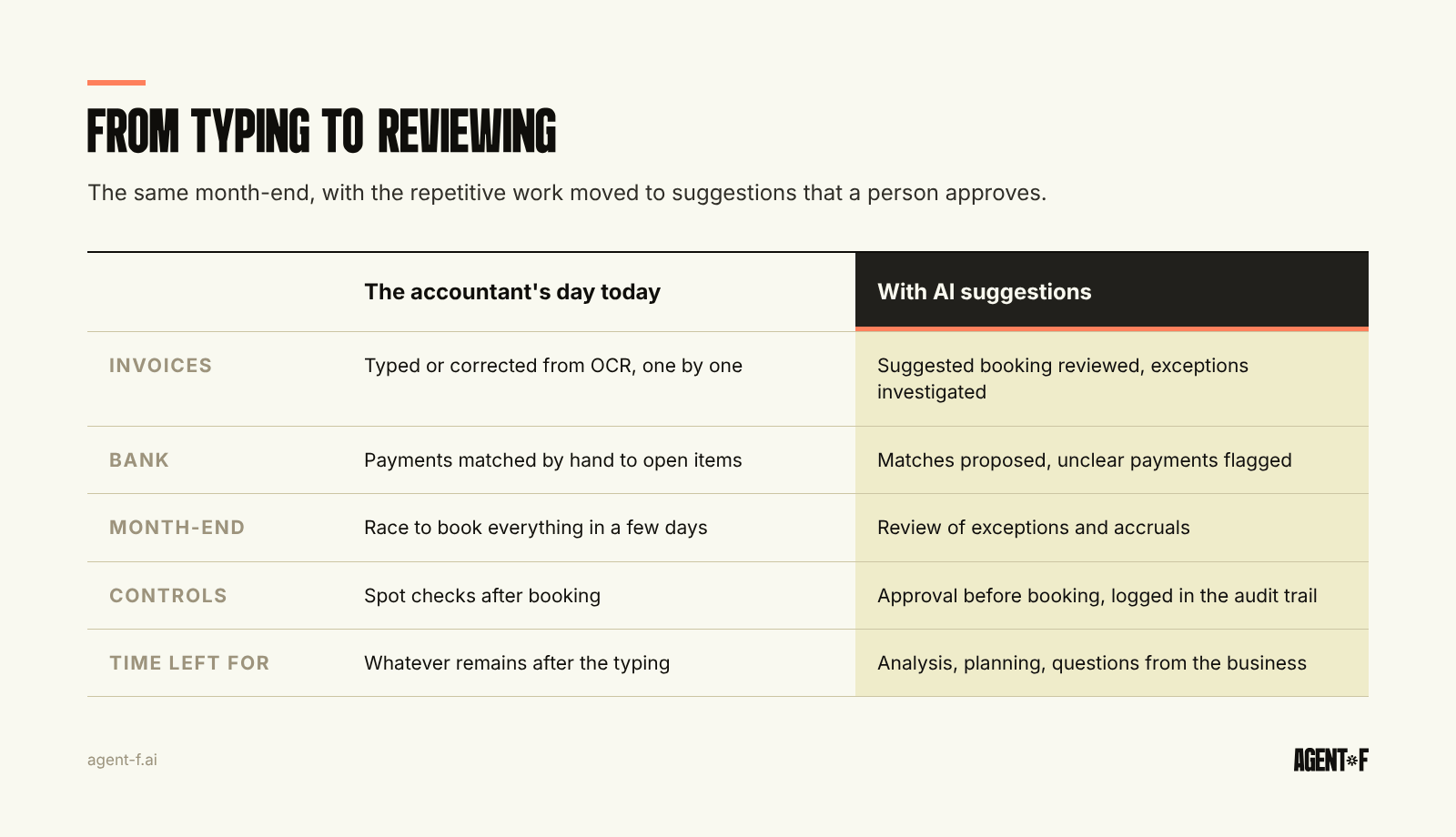
The practical change is a different kind of working day. Instead of entering 300 invoices, an accountant reviews 300 suggestions, approves the 270 that are clearly right, corrects the 25 that are close, and investigates the five that are odd. The corrections feed back into the next month's suggestions.
That shift sounds simple and is not. Reviewing well is a skill: knowing which suggestions to trust, recognising when a high-confidence suggestion is still wrong, and keeping the controls that make approval meaningful rather than a click-through. Teams that treat approval as a formality end up with the same errors as before, only faster.
It also changes the month. When documents are captured and matched as they arrive, the month-end close becomes a review of exceptions rather than a race to book everything in four days. Our month-end close checklist looks very different when step one is already done on the first working day. The limits of letting agents act without a person are described in AI agents for finance.
What does this mean for hiring and team structure?
For a growing company, the effect shows up in the shape of the team rather than its size. Fewer hours go into data entry, so the first finance hire can be someone who builds reporting and planning rather than someone who types. The relationship with the tax advisor shifts as well: they receive cleaner data and spend their time on tax questions and the annual accounts instead of sorting receipts.
The profile of the accountant changes with it. Process knowledge, comfort with systems and the ability to explain numbers to non-finance colleagues matter more than speed at data entry. How a team typically develops at 20, 50 and 100 people is the subject of finance team structure.
Where does Agent F fit into this?
Agent F is built around the review model described above. The AI suggests bookings, matches and accruals, each with a confidence score. A person approves or corrects, and every decision is stored in an immutable audit trail, with bookings flowing to the tax advisor through DATEV. The intent is that accountants spend their time on the work that needs them.
For finance leaders thinking about this now, three steps are useful. List the tasks your team repeats every month and estimate the hours each takes. Mark which ones are rule-based and checkable, because those are where AI helps first. Then talk with your team about what they would do with the time, since the answer decides whether automation feels like a threat or a relief.
Learn how Agent F works, or see it on your own bookings at agent-f.ai/demo.
This article is for general information only and does not constitute tax or legal advice. Parts of it were generated with AI. Please consult your tax advisor or legal counsel before acting on it, and feel free to reach out at team@agent-f.com with any questions or for support.