Updated
Cash management in scale-ups: one cash position across banks, entities and currencies

Cash management in a scale-up means knowing, every morning, how much cash the group holds, where it sits, in which currency and which entity, and what is committed against it. Once a company runs five or more bank accounts across two or three entities, that answer stops coming from one banking app. It has to be built from bank feeds, matched to the books and explained.
Most growing companies treat cash management as a forecasting problem. The forecast matters, but it rests on something more basic that often fails first: a cash position that is complete, current and trusted by everyone who reads it.
What does cash management mean once you have more than one bank?
At ten people, cash management is a glance at the business account. At fifty, the picture looks different. There is a main account at a German house bank, a second account at a digital bank for cards and subscriptions, a payment provider balance from online sales, a US dollar account for a few customers, and perhaps a new subsidiary in another EU country with its own bank.
Each account is correct on its own, but nobody sees them together. The founder checks one app, the finance lead logs into three portals, and the investor update quotes last Tuesday's number.
In practice, cash management at this stage covers four tasks:
- Visibility: one daily cash position across all banks, entities and currencies.
- Control: who can move money, with which limits and which approvals.
- Allocation: how much cash sits where, and how much is held as a buffer.
- Planning: what comes in and goes out over the next weeks, built on the position above.
Planning gets most of the attention. Visibility is where most scale-ups struggle, because without a reliable starting balance every forecast rests on an estimate.
Why does the cash position take a day to build?
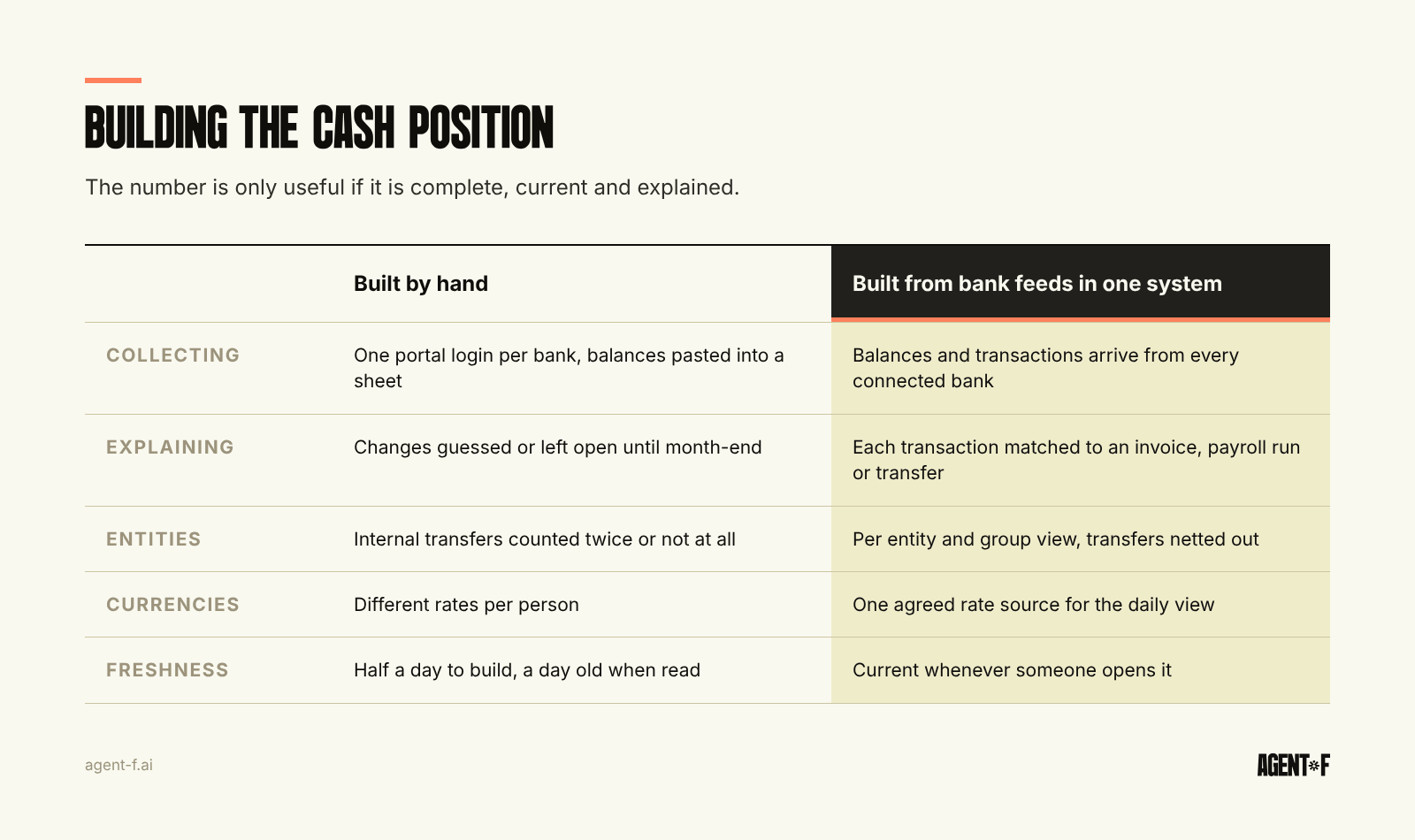
Ask a finance team how they produce the weekly cash report and you hear the same routine. Someone logs into each bank portal, downloads balances or statements, pastes them into a spreadsheet, converts foreign currency at whatever rate they find, and adds a column for the payment provider. Then the questions start. Why is this account lower than last week? Was the supplier run already paid? Is that incoming amount a customer payment or a transfer between our own entities?
Three things make the routine slow and fragile.
The balances are not explained. A bank balance tells you how much is there, not why it changed. Explaining the change means matching transactions to invoices, payroll and transfers, which is the work described in our article on payment reconciliation. If that matching happens only at month-end, the weekly cash report has no explanation behind it.
Internal transfers count twice or not at all. When money moves from the parent company to a subsidiary, it leaves one account and arrives in another, sometimes a day later. In a spreadsheet, it is easy to see the cash in both places, or in neither.
Currencies are converted inconsistently. One person uses the bank's rate, another a rate from the web, a third last month's closing rate. The totals do not agree. The accounting side of this is covered in multi-currency accounting.
The result takes half a day to build and is a day old when it is read.
How do bank feeds change the picture?
The European payment services directive (PSD2) requires banks to give licensed account information services access to payment accounts, with the account holder's consent. That is the legal basis for most bank feeds in the EU. Software can read balances and transactions from many banks through one connection instead of one portal login per account.
There are practical limits worth knowing. Consent is not permanent: under the amended EU technical standards, access must be confirmed with strong customer authentication every 180 days, up from 90 days originally. Someone in the company needs to own those renewals, or a feed quietly stops. Coverage also varies: current accounts are usually reachable, some deposit or credit accounts are not. Larger German companies often also use EBICS, the German corporate banking standard, to retrieve statements and send payment files.
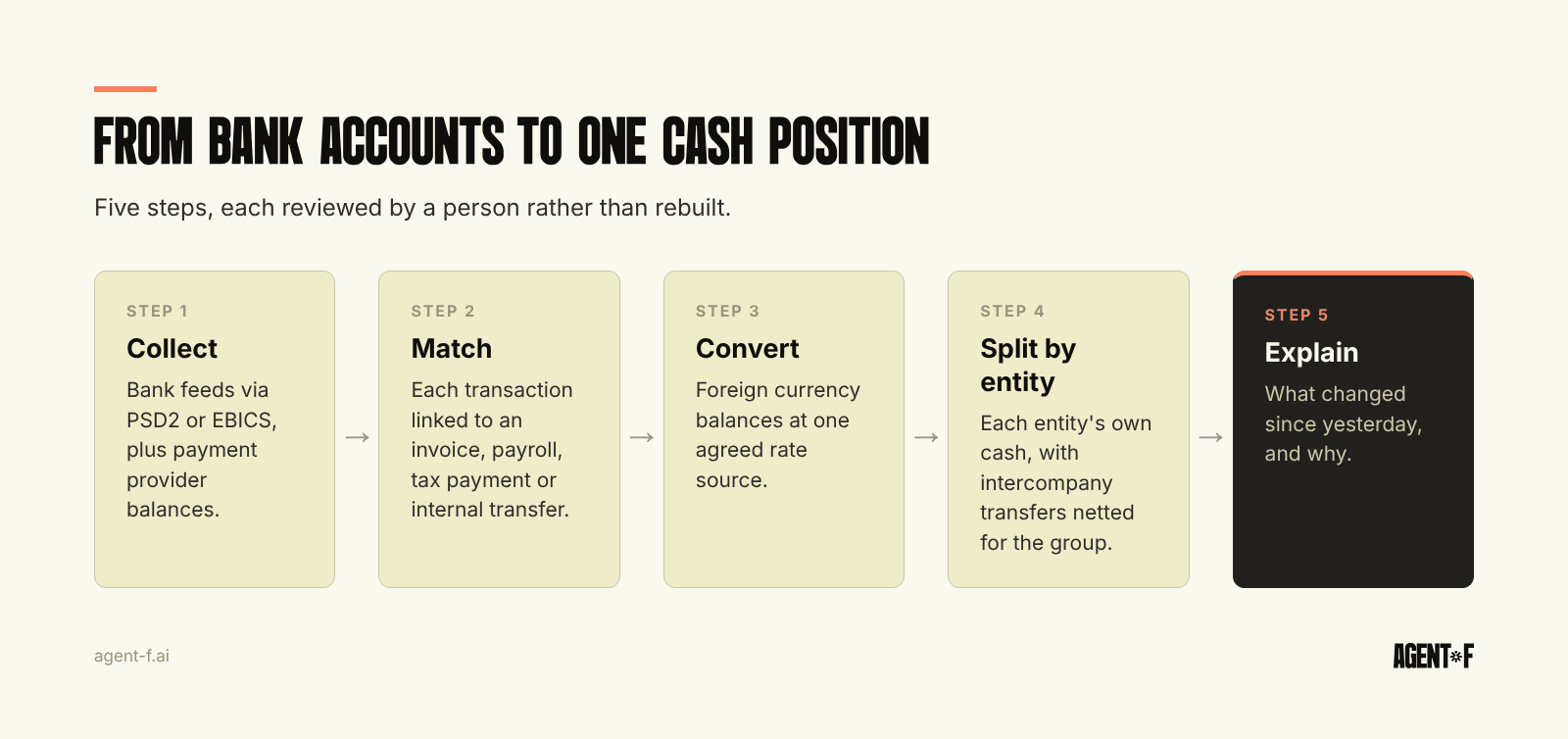
Once the feeds run, the work changes. Instead of collecting balances, the team reviews a position that has already been assembled:
- Balances and transactions arrive from every connected bank and payment provider.
- Each transaction is matched to an invoice, a payroll run, a tax payment or an internal transfer.
- Foreign currency balances are converted at one agreed rate source.
- Balances are shown per entity and for the group, with internal transfers netted out.
- Changes since the last position are explained, not just shown.
Step five is the one most tools skip. A cash position that falls by 180,000 euros overnight is not useful until someone knows it was the monthly VAT payment plus a supplier run.
How do you keep entities and currencies apart in one view?
A group cash position has two readers with different needs. The CFO or founder wants the total: how much cash the group has, and how long it lasts. Each managing director (Geschäftsführer) wants their own entity, because they are legally responsible for its ability to pay. A German GmbH cannot simply count on cash sitting in a sister company.
That means the cash view should always be able to answer three questions without rebuilding anything. How much does each entity hold in its own accounts? How much does each entity owe to or expect from the others? How much is held in each currency, before and after conversion?
For intercompany flows, the rule is simple: every transfer between entities needs a matching booking on both sides, ideally on the same day. If it is booked only on one side, the group total looks right while the entities do not. We cover the structural side in multi-entity accounting.
For currencies, pick one rate source for the daily view and keep it. The books follow the rates your accounting policy prescribes. Mixing the two is where reconciliation differences start.
Which rules keep cash safe as the company grows?
Visibility shows you the cash. A few written rules decide what happens to it. For most scale-ups, a page of agreed rules is enough, and our article on treasury for mid-sized companies covers when that stops being true.
Spread the balances deliberately. The German statutory deposit protection covers up to 100,000 euros per depositor and bank. For an operating company with several million euros in the bank, that is a small share of its balances. Many finance teams therefore hold operating cash at more than one bank and agree with the board how much may sit at any single one.
Set a minimum buffer. Agree a cash level, per entity and for the group, below which someone must act: delay discretionary spending, draw on a credit line or speak to investors. Write the number down and review it each quarter.
Separate who prepares and who releases payments. Every payment above a limit should need a second person. Bank portals support this, but limits often stay at their opening defaults.
Plan the known outflows. Payroll, rent, VAT and social security contributions follow a calendar. They belong in the forecast, which we describe in our guide to a 13-week cash flow forecast.
How does Agent F help you see one cash position?
In Agent F, the cash position is built from the same data as the books. Bank accounts are connected directly, and transactions from every connected bank and payment provider arrive in one place, per entity and in their original currency.
As transactions arrive, Agent F suggests a match for each one: the customer invoice, the supplier payment, the payroll run, the transfer to a sister entity. Each suggestion carries a confidence score, and a person confirms or corrects it. The system learns from those corrections, which is how reconciliation accuracy typically reaches 90 percent or more by the third month.
Because matching happens continuously, the cash view can explain itself. You can ask in plain language why cash at one entity fell since yesterday and get the transactions behind the change, not a number. Anomaly detection flags payments that look unusual for a supplier or an account. Every confirmation sits in the audit trail, and the same bookings flow into the DATEV export for your tax advisor (Steuerberater) without being typed again.
To start, list every bank account and payment provider balance the group holds, including the ones nobody checks. Note which entity owns each one, who can release payments and with which limit. Then agree one rate source and one minimum buffer per entity. If that list takes more than an hour, the cash position is not yet one number.
Learn how Agent F works, or see it on your own bank accounts at agent-f.ai/demo.
This article is for general information only and does not constitute tax or legal advice. Parts of it were generated with AI. Please consult your tax advisor or legal counsel before acting on it, and feel free to reach out at team@agent-f.com with any questions or for support.