Updated
Treasury management for mid-sized companies: what you need before a treasury system
Treasury management is the work of making sure a company has the cash it needs, where and when it needs it, at an acceptable cost and risk. It covers cash visibility, payments, liquidity planning, funding and financial risks such as currency and interest rates. Most mid-sized companies need the first three done well long before they need a dedicated treasury system.
The treasury software market tends to describe the problem from the top: risk management, hedging, in-house banks. Mid-sized companies usually struggle at the bottom: nobody knows the cash position across all accounts before noon, and the forecast lives in a spreadsheet that disagrees with the books. A treasury system built on that foundation inherits its gaps.
What does treasury management actually cover?
In a large group, treasury is a department. In a company with 50 to 500 people, it is usually a set of tasks spread across the CFO, the finance team and sometimes the tax advisor (Steuerberater). The tasks are the same either way:
- Cash visibility. Balances and transactions across all banks, accounts, entities and currencies, ideally daily.
- Payments. Outgoing payments approved, batched and released, incoming payments matched to invoices.
- Liquidity planning. A forecast of cash in and out over the next weeks and months, compared with actuals.
- Funding. Credit lines, loans, leasing and their covenants, plus where surplus cash is held.
- Financial risk. Currency exposure, interest rate exposure and counterparty risk with banks.
- Bank relationships. Accounts, mandates, signatories and fees.
The first three are daily or weekly. The last three are monthly or quarterly decisions that depend on the first three being right.
In a typical mid-sized company, the finance team runs payments and reconciliation, the CFO owns the forecast and the bank relationships, and funding and risk come up when a credit line is renewed or a large foreign-currency contract is signed. Treasury, in other words, already exists. The question is whether it runs on reliable data.
What do most mid-sized companies need first?
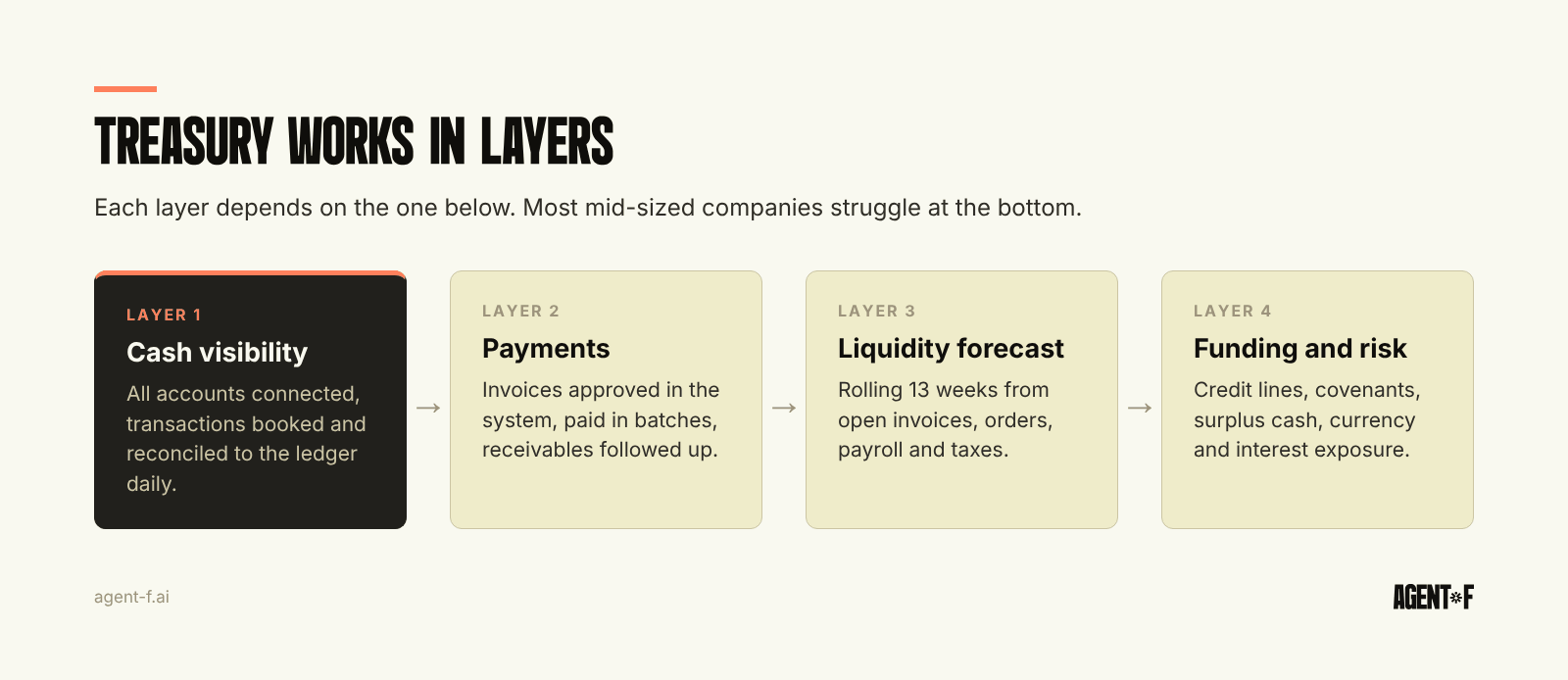
Treasury works in layers, and each one depends on the one below.
The base is cash visibility: every account connected, every transaction booked, and the bank balance reconciled to the ledger. If the reconciliation is a week behind, the cash position is a week old. We describe why matching still takes so long in our article on payment reconciliation.
The second layer is payments: supplier invoices approved in the system, paid in batches with the right terms and early-payment discounts, and receivables followed up. That is where most of the cash is actually moved, and where working capital gets stuck or released.
The third layer is the liquidity forecast: a rolling view, often 13 weeks, built from open invoices, orders, payroll, taxes and planned investments. It is only as reliable as the data underneath. The method is in cash flow forecasting.
Only then does the fourth layer, funding and risk, have a solid base. A decision to draw a credit line or hedge a currency is a decision about the forecast. If the forecast is wrong, the hedge is the wrong size.
The same applies to surplus cash. Spreading deposits across banks to limit counterparty risk, or moving cash into a fixed-term deposit, only makes sense when you know how much of the balance is free over the next three months. A company that cannot answer that question tends to keep everything in one current account, just in case, and earns nothing on it.
When does a company need a dedicated treasury system?
A treasury management system (TMS) is built for the top layers: bank connectivity across many countries, cash pooling, intercompany loans, hedging with derivatives, debt management and risk reporting. That is real work, and at some size it justifies its own tool.
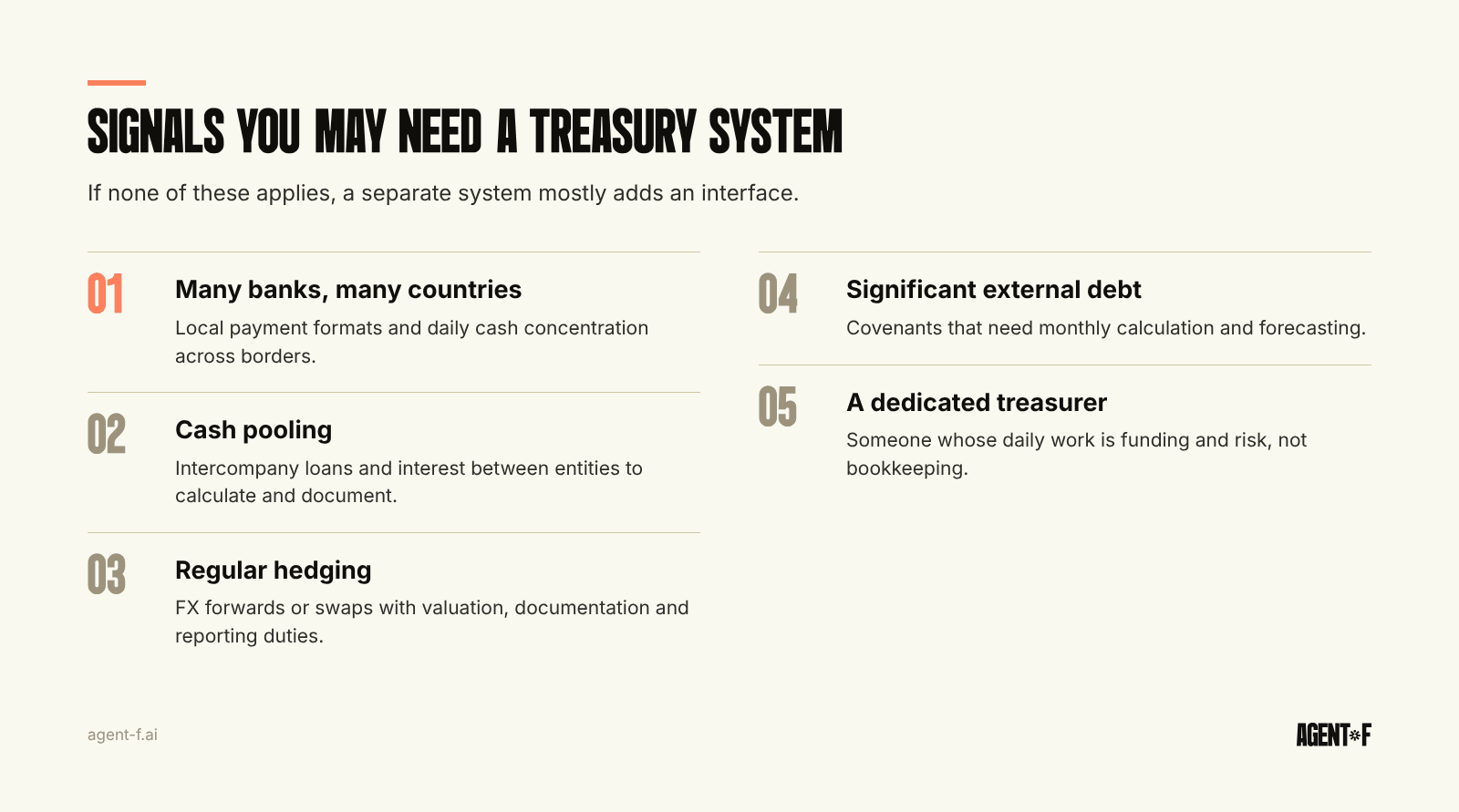
Signals that a company is getting there:
- Many banks in many countries, with local payment formats and daily cash concentration.
- Cash pooling between entities, with intercompany interest to calculate and document.
- Regular hedging with derivatives such as FX forwards or interest rate swaps, which bring valuation, documentation and reporting duties.
- Significant external debt with covenants that need monthly calculation and forecasting.
- A dedicated treasurer or treasury team whose daily work is funding and risk, not bookkeeping.
If none of these applies, a separate system mostly adds an interface. Cash data has to flow from the banks and the ledger into the TMS and back, and every mismatch has to be explained twice. For many companies below roughly 50 million euros of revenue, the cash, payment and forecast functions inside the finance system cover most of what treasury needs.
What has to be in place before a treasury system can work?
Whether or not a TMS comes later, the same basics decide whether treasury works:
- Clean bank connections. All accounts, including the smaller ones at a second bank or a payment provider, connected and booked daily.
- Reconciliation that keeps up. Bank transactions matched to invoices and bookings the same day or the next, not at month-end.
- One entity structure. Each legal entity with its own accounts, and intercompany balances that agree on both sides.
- Payment approvals in the system. A four-eyes rule for releases, not an email with a spreadsheet attached.
- A forecast linked to the books. Open payables and receivables feed the forecast directly, and actuals replace forecast values as they come in.
- Currency handled at booking. Foreign-currency invoices and accounts booked with the right rate, so exposure can be read off the ledger. See multi-currency accounting.
Companies that skip this step often find that the new treasury system shows the same unreliable numbers in a nicer layout.
What is different for a German Mittelstand company?
German companies bring a few specifics to treasury.
Bank communication. Corporate payment files and statements in Germany typically run over EBICS, a standard for secure data exchange between companies and banks that is also used in France and Switzerland. Many Mittelstand companies also have one or two long-standing house banks (Hausbanken) that provide credit lines and expect regular reporting.
The tax advisor. In many mid-sized companies, the tax advisor keeps the books in DATEV. Any treasury setup then has to agree with the bookings the tax advisor makes, or the cash position and the BWA (the monthly management report from your tax advisor) tell two different stories.
Cash pooling and capital maintenance. Cash pooling with a parent touches the capital maintenance rule in § 30 of the GmbH Act (GmbHG); involve your legal and tax advisors before setting one up.
Derivatives. FX forwards and swaps fall under the EU's EMIR rules. For smaller non-financial companies, the bank has generally reported the trade on their behalf since 2020, but the company still needs a Legal Entity Identifier and correct trade details. For a broader view across banks and entities, see cash management in scale-ups.
Where does Agent F fit?
Agent F covers the bottom three layers inside the ERP. Bank accounts are connected directly, transactions are matched to invoices with AI-assisted reconciliation and confidence scores, payments are approved and released in the system, and the liquidity forecast draws on open invoices, orders and payroll in the same data model. Every suggestion is approved by a person and recorded in the audit trail, and the bookings reach the tax advisor through the DATEV export.
Before evaluating treasury software, it is worth answering three questions: how old is your cash position when you look at it, how many accounts are not yet connected, and how far does your 13-week forecast differ from actuals. If the answers are "days", "some" and "a lot", the foundation comes first.
Learn how Agent F works, or see it on your own bank and invoice data at agent-f.ai/demo.
This article is for general information only and does not constitute tax or legal advice. Parts of it were generated with AI. Please consult your tax advisor or legal counsel before acting on it, and feel free to reach out at team@agent-f.com with any questions or for support.