Updated
Finance data warehouse: when you need one and when the ERP is enough
A finance data warehouse is a separate database that collects data from the ledger and other systems so it can be combined and analysed in one place. It earns its place when finance must join large volumes of non-financial data, such as product activity or web analytics, or bring together many systems that cannot be replaced. When the questions are about margin, cost, cash and plan versus actual, reporting directly on a complete ERP is usually enough.
In many German mid-sized companies, the "warehouse" is something else: a reporting tool or a set of spreadsheets fed by the monthly DATEV export from the tax advisor. It looks like a modern data stack, but it reports on last month's tax bookkeeping. Before building a warehouse, it is worth asking whether the real problem is the data source rather than the lack of a warehouse.
What does a typical Mittelstand reporting stack look like?
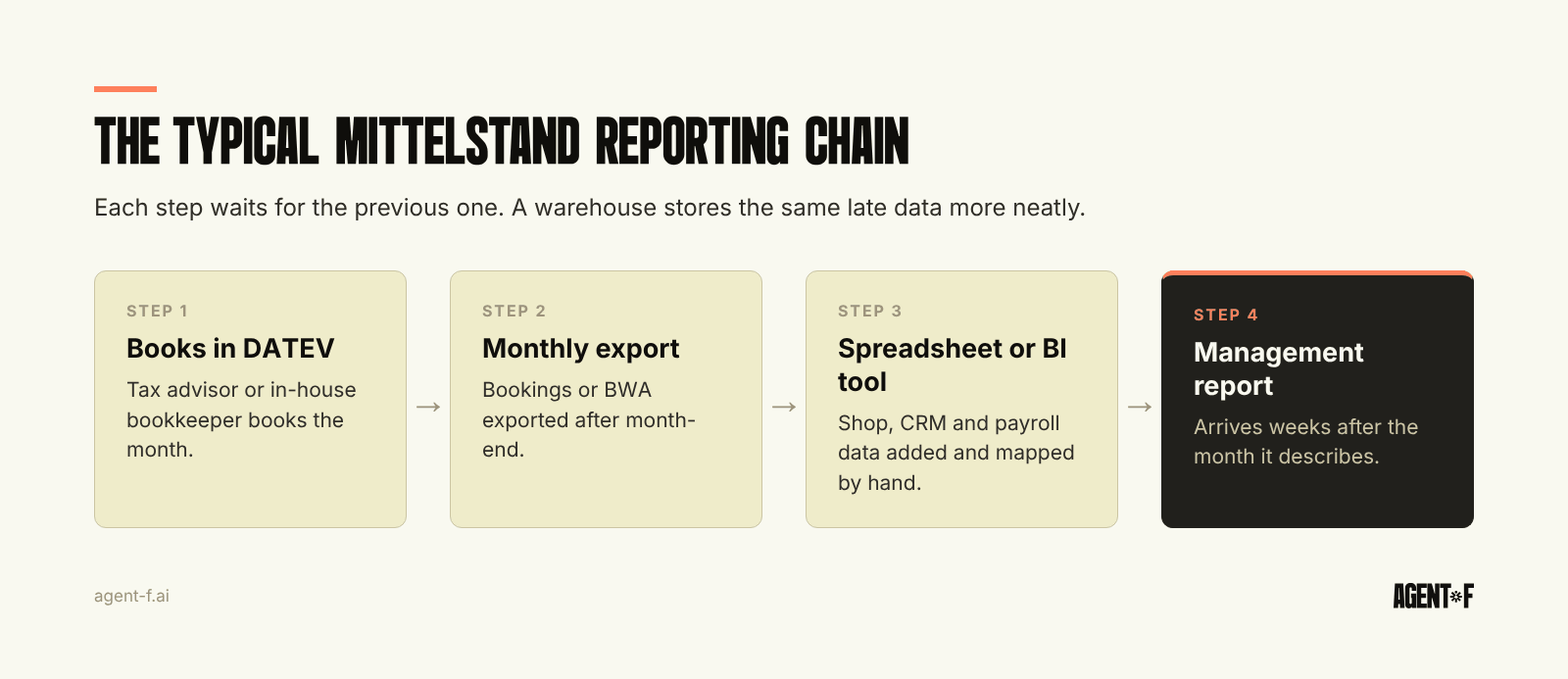
The pattern repeats across industries. The tax advisor (Steuerberater) or an in-house bookkeeper books in DATEV. Some time after month-end, the bookings or the BWA (the monthly management report from your tax advisor) are exported. Someone in finance loads the export into a spreadsheet or a BI tool, adds data from the online shop, the CRM and the payroll system, and maps it all to the company's own reporting structure.
That chain has three weak points. It is slow, because each step waits for the previous one, so the management report arrives weeks after the month it describes. Our article on real-time financial reporting traces where that delay comes from. It is fragile, because every mapping lives in a formula or a script that one person understands. And it is shallow, because a tax-oriented export carries accounts and perhaps two cost centres, but not products, projects or customers in the form management needs.
Adding a warehouse to this chain does not fix any of the three. It stores the same late, shallow data more neatly.
What is the difference between an ERP and a data warehouse?
An ERP is a system of record. Orders, invoices, payments, stock movements and payroll are created and changed there, under controls and with an audit trail. The ledger in the ERP is the original record that bookkeeping law refers to.
A data warehouse is a system of analysis. It receives copies of data from other systems, usually on a schedule, and makes them easy to query and combine. It does not create transactions, and it is not where corrections happen. If a number is wrong in the warehouse, the fix has to be made in the source and loaded again.
This difference matters in Germany for a practical reason. Books must be kept for ten years and booking vouchers for eight under § 147 of the Fiscal Code (AO), and in a tax audit the tax office has the right to access the bookkeeping data in the system itself. That access is aimed at the system of record. A warehouse is a useful view on top, but it never replaces the ledger and its documentation.
When do you actually need a data warehouse?
There are good reasons to build one. Four come up most often.
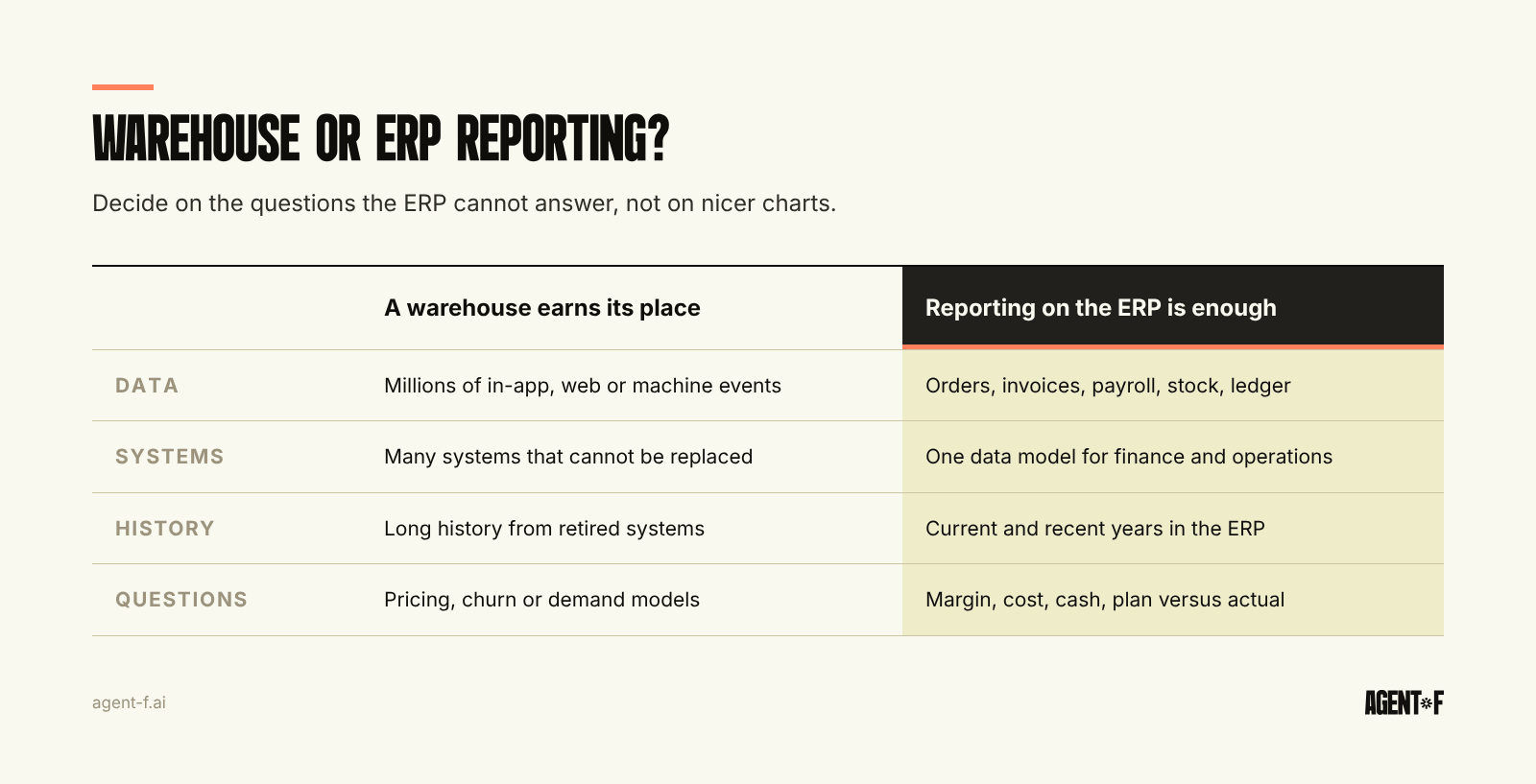
- Large volumes of non-financial data. In-app events, web analytics or sensor data from machines run into millions of rows. Combining them with revenue or cost data is a warehouse job.
- Many systems you cannot replace. A group with acquired subsidiaries on different ERPs, or a business with specialised industry systems, needs a common layer to compare them.
- Long history from retired systems. Ten years of sales data from a system that has been switched off can live in a warehouse for analysis, while the legally required archive stays in its own form.
- Data science and modelling. Pricing models, churn prediction or demand forecasts with external data are built on a warehouse, not in the ledger.
If none of these applies, a warehouse is mostly an expensive way to make spreadsheets look professional. Each new source needs a pipeline, each pipeline needs maintenance, and someone has to reconcile the warehouse to the ledger every month.
What does a warehouse cost beyond the licence?
The visible cost is the database and the BI licence. The larger cost is the work around them, and it tends to land in finance.
Pipelines. Every source system needs a connection that extracts data, transforms it and loads it on a schedule. When a source changes a field or an API, the pipeline breaks, often silently.
Mapping. The warehouse has to translate accounts, cost centres and entities into one reporting structure. If the chart of accounts changes, the mapping changes too, and historical comparisons need care.
Reconciliation. Each month, someone has to prove that revenue in the warehouse equals revenue in the ledger. Until that is done, nobody fully trusts the dashboard.
People. A warehouse usually needs a data engineer or an external partner. In a company of 50, that is a significant share of the finance and IT budget, and a dependency on one person.
None of this makes a warehouse wrong. It means the decision should rest on questions the ERP cannot answer, not on the wish for nicer charts.
When is reporting on the ERP enough?
For most companies with 20 to 200 people, the questions management asks are about the business itself: which products and customers earn money, where costs are running ahead of budget, how cash will develop over the next quarter, how each entity is performing. The financial KPIs a growing company needs come from the same transactions.
Those questions can be answered on the ERP if three conditions hold. The ERP covers the operational data, not only accounting: orders, purchasing, inventory, payroll and time tracking. Bookings carry dimensions such as cost centre, product and project, so the management view is built into each transaction. And reports run on live data, not on a monthly copy.
When those conditions hold, the reconciliation step disappears, because there is only one set of numbers. Investor packs and board reporting come from the same records as the tax advisor's export.
Where does AI change the picture?
Part of the case for warehouses has been self-service: business users wanted to explore data without waiting for finance. Plain-language questions on the ledger cover much of that need. A department head can ask why travel costs rose in Q3 and get an answer with the bookings behind it, without a dashboard being built first.
AI also helps with the work warehouses were often used for, such as spotting outliers. Anomaly detection on live bookings can flag a cost centre drifting from plan or an unusual supplier payment during the month, not after the next data load. The remaining warehouse use cases are the ones listed above: very large non-financial datasets, many systems and modelling.
How does Agent F fit in?
Agent F is an AI-native ERP in which finance, operations and people share one data model. Reports, BWA, board reports and custom reports run on live data, and the DATEV export for the tax advisor comes from the same records. Where a company does need a warehouse for product or web data, the ERP becomes a clean source for it rather than one more export to reconcile.
Before deciding on a warehouse, list the ten questions management asked most often last quarter and note which system each answer came from. Count how many of them needed data outside finance and operations. If it is only a few, the better investment is usually a more complete system of record, a topic we cover in the finance tech stack for a 50-person company.
Learn how Agent F works, or see it on your own reports at agent-f.ai/demo.
This article is for general information only and does not constitute tax or legal advice. Parts of it were generated with AI. Please consult your tax advisor or legal counsel before acting on it, and feel free to reach out at team@agent-f.com with any questions or for support.