Updated
First 100 days as CFO: what to fix first at a German scale-up
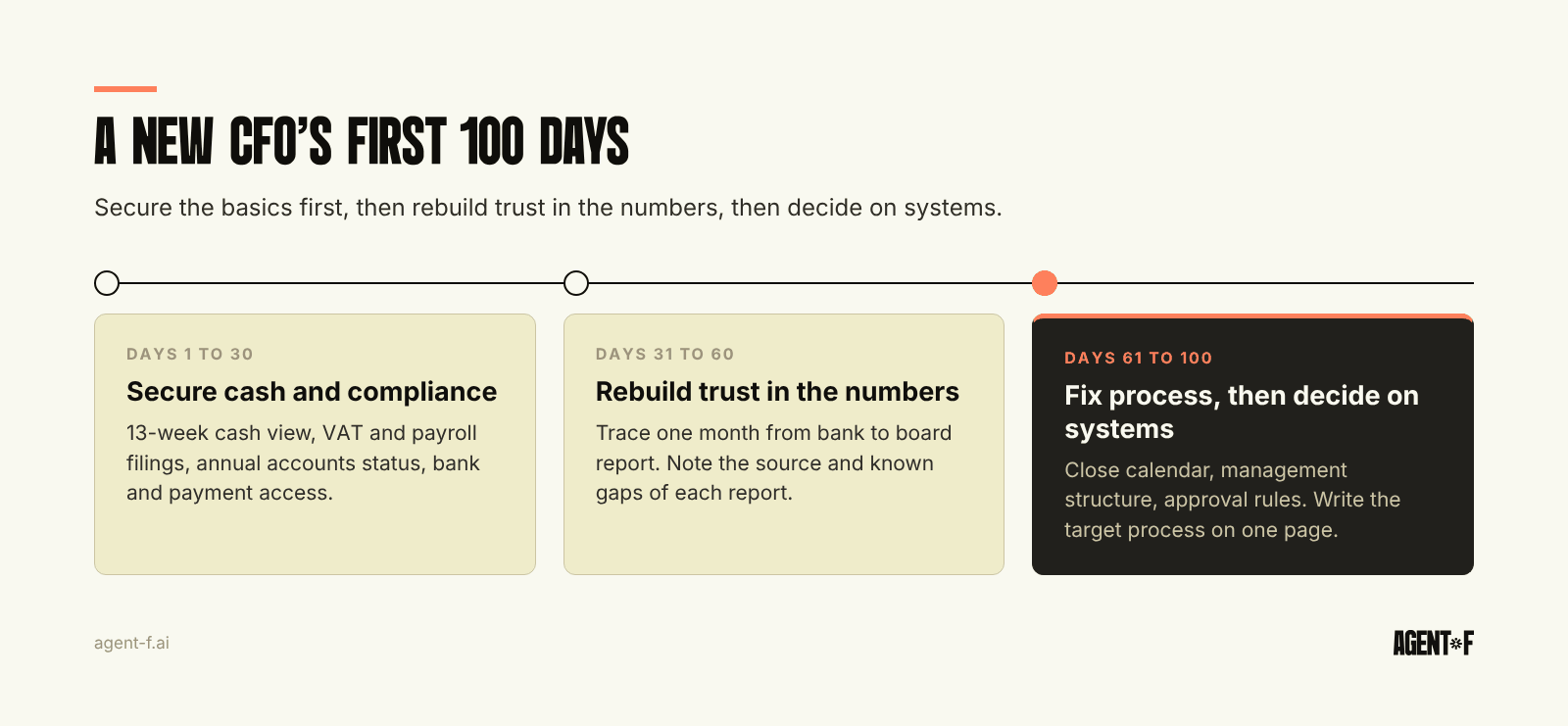
The first 100 days as CFO of a German scale-up are usually spent less on strategy than on finding out which numbers are true. The books often sit with the tax advisor (Steuerberater), reports are rebuilt in Excel each month, and nobody owns the close. A sensible order is: secure cash and compliance in the first month, rebuild trust in the numbers in the second, and only then decide what to change in the systems.
Most first-CFO plans are written for companies with an in-house accounting team and a mature ERP. German scale-ups between 20 and 100 people rarely look like that. The inherited setup has its own pattern, and recognising it early saves weeks of rebuilding reports that should not exist in the first place.
What does a new CFO usually inherit at a German scale-up?
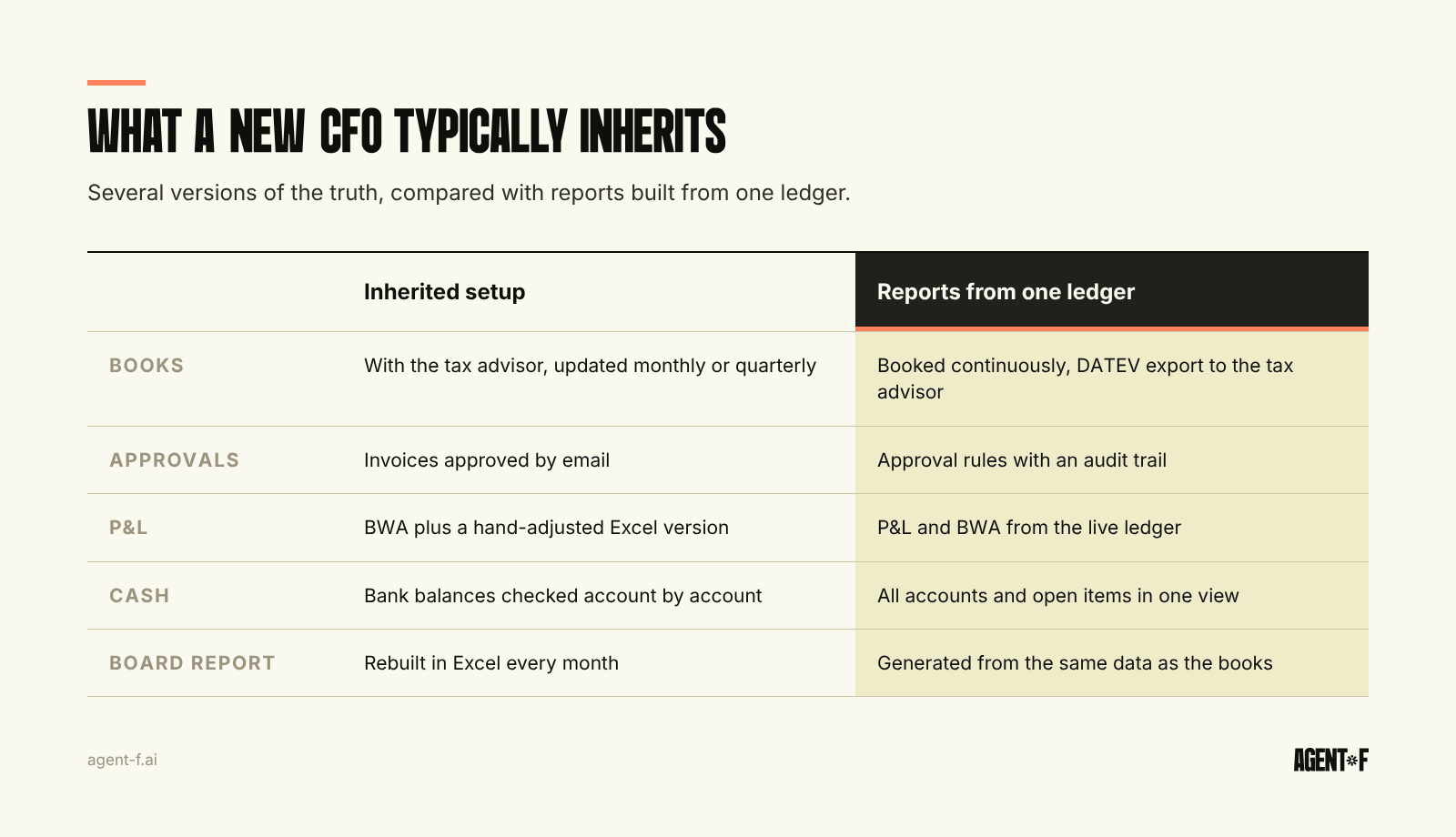
The pattern repeats across industries. Bookkeeping is done by the tax advisor in DATEV, based on documents uploaded once a month, sometimes once a quarter. The founders, or an office manager, approved invoices by email. Revenue comes from an invoicing tool or a payment provider that is not connected to the books. Two or three bank accounts are reconciled by the tax advisor weeks after the fact.
On top of that sits Excel. There is a liquidity sheet, a board report, a budget that was built once and never compared to actuals, and a "real" P&L that someone adjusts by hand because the BWA (the monthly management report from your tax advisor) does not show the right picture. We explain how that report is built and why it lags in reading the BWA.
None of this is negligence. It is what happens when a company grows faster than its finance function. But it means the new CFO starts with several versions of the truth, and a first task that is part archaeology: finding out which sheet feeds which decision, and who last touched it.
What should you secure in the first 30 days?
The first month is about risk, not improvement. Four areas come first.
- Cash. Build a simple weekly view of all bank balances, committed payments and expected receipts for the next 13 weeks. It does not need to be elegant. It needs to show whether there is a problem in the next quarter.
- Tax and statutory deadlines. Check that the advance VAT return (UStVA) is filed on time, normally by the tenth of the following month, that payroll taxes and social security are paid, and where the last annual accounts stand. A GmbH must prepare its annual accounts within three months of year end, or six months for a small company, and disclose them within twelve months. Overdue filings are the most common surprise.
- The tax advisor relationship. Meet the Steuerberater early. Ask what they do, what they receive, when, and in what quality. Ask for the current trial balance (Summen- und Saldenliste) and open items lists rather than the BWA alone.
- Access and authority. Get bank access, payment approval rights and logins to every finance tool. Write down who can pay what. In many scale-ups, more people can release payments than anyone realises.
This is also the time to understand responsibility. Under § 41 GmbHG, the managing directors of a GmbH are responsible for proper bookkeeping, even when it is outsourced. If the new CFO is not a managing director, the CEO still carries that duty, which is a useful conversation to have in week two.
Which numbers can you trust on day one?
Usually fewer than the board assumes. A practical test is to take one month and trace it from the bank statement to the board report. Does the cash in the board report match the bank? Does revenue in the P&L match what the invoicing tool says was billed? Are costs booked in the month they belong to, or in the month the invoice arrived?
Three gaps show up again and again. First, timing: without accruals, the P&L follows invoice dates, so one large annual licence makes March look terrible and April look excellent. Second, mapping: the chart of accounts was set up for the tax return, not for management, so marketing, product and sales costs end up in the same few accounts. Third, versioning: the Excel model has been adjusted so often that nobody can say which numbers came from the books and which were typed in.
The aim of month two is knowing exactly where each number comes from and how far you can trust it. A short written note per report, stating its source and known gaps, is often the most valuable document a new CFO produces. Why the monthly income statement arrives late in the first place is covered in real-time financial reporting.
What should you fix before you change any system?
It is tempting to start with software. A new tool on top of unclear processes usually reproduces the same problems faster. Before changing systems, three things are worth settling, because they will shape whatever comes next.
- A close calendar. Agree with the tax advisor which documents arrive by which working day, who books what, and when the month is final. Even a ten-working-day close that runs reliably is better than a variable one.
- A management structure. Decide which cost centres, departments and product lines the board actually needs to see, then check whether the current chart of accounts can carry them. Setting this up properly is described in chart of accounts for SKR03 or SKR04.
- Approval rules. Write down who approves which invoices, contracts and payments, up to which amount. Email approvals leave no audit trail, and they make every later automation harder.
These decisions also clarify the team question. Which work stays with the tax advisor, and which moves in-house, depends on company size and transaction volume, as laid out in finance team structure at 20, 50 and 100 people.
When is the right time to change the finance stack?
Usually in the third month, once the CFO can describe the target process in a page. By then, the inherited setup has shown where it breaks: the hours spent each month copying data between tools, the reports that cannot be produced without a weekend, the questions from investors that take a week to answer.
A good decision document at day 100 answers a few plain questions. What do we need to see each month, and how fast? Which processes must stay with the tax advisor, and in which format, usually DATEV? How many tools touch a single invoice today? What does it cost us in hours each month to keep the spreadsheets alive? Each workaround added in the meantime makes the later change harder, a dynamic described in ERP complexity debt.
The worst outcome of the first 100 days is a quarter spent rebuilding the same Excel board report every month, so that the system change keeps getting deprioritised until the next funding round forces it.
How does Agent F help a new CFO see the numbers?
Agent F is an AI-native ERP, configured per company, with finance, operations and people on one data model. For a new CFO, the relevant difference is where reports come from. P&L, balance sheet, cash flow and BWA are built from the live ledger, so the trace from bank statement to board report is one step instead of four tools.
The AI layer suggests bookings, accruals and reconciliations with a confidence score, and a person approves each one. Everything sits in an audit trail, and the tax advisor receives a DATEV export instead of a folder of documents.
For the first 100 days, a few concrete steps help regardless of which system you use: trace one month end to end before trusting any report, write down the source of every number the board sees, agree a close calendar with your tax advisor, and document the target process before you speak to any software vendor.
Learn how Agent F works, or see it on your own numbers at agent-f.ai/demo.
This article is for general information only and does not constitute tax or legal advice. Parts of it were generated with AI. Please consult your tax advisor or legal counsel before acting on it, and feel free to reach out at team@agent-f.com with any questions or for support.