Updated
Reading the BWA: what your monthly report shows and why it arrives so late
The BWA (betriebswirtschaftliche Auswertung) is the monthly management report most German companies receive from their tax advisor. It is a short income statement from the current bookkeeping: revenue, total output, gross profit, cost types, operating result and a preliminary result, usually with the year to date and the prior year next to it. It is useful, but it often arrives weeks after the month ends.
Almost every Mittelstand CFO knows the BWA, and many companies run on it without ever questioning its structure or its timing. Both are worth understanding. The structure tells you what the report can and cannot answer. The timing tells you whether you are steering with it or only looking back.
What is the BWA, and who makes it?
The BWA is produced from the bookkeeping, in most cases by the tax advisor (Steuerberater) in DATEV, the software most German tax firms use. It is not a statutory report. No law requires a company to produce one, and it is not the same as the annual financial statements (Jahresabschluss) under the HGB (German Commercial Code).
It matters anyway, for three reasons. Management uses it as the monthly view of results. Banks ask for it: under § 18 of the German Banking Act (KWG), banks must obtain disclosure of a borrower's financial circumstances for larger loans, and in practice they request the latest BWA together with the trial balance (Summen- und Saldenliste). And investors and advisory boards often receive it as the default monthly figures when nothing better exists.
There are several standard BWA forms. The most common is the standard short-term income statement, and there are variants for particular industries and for cash-basis bookkeeping. Most tax advisors use the standard form unless asked otherwise.
How do you read the standard BWA line by line?
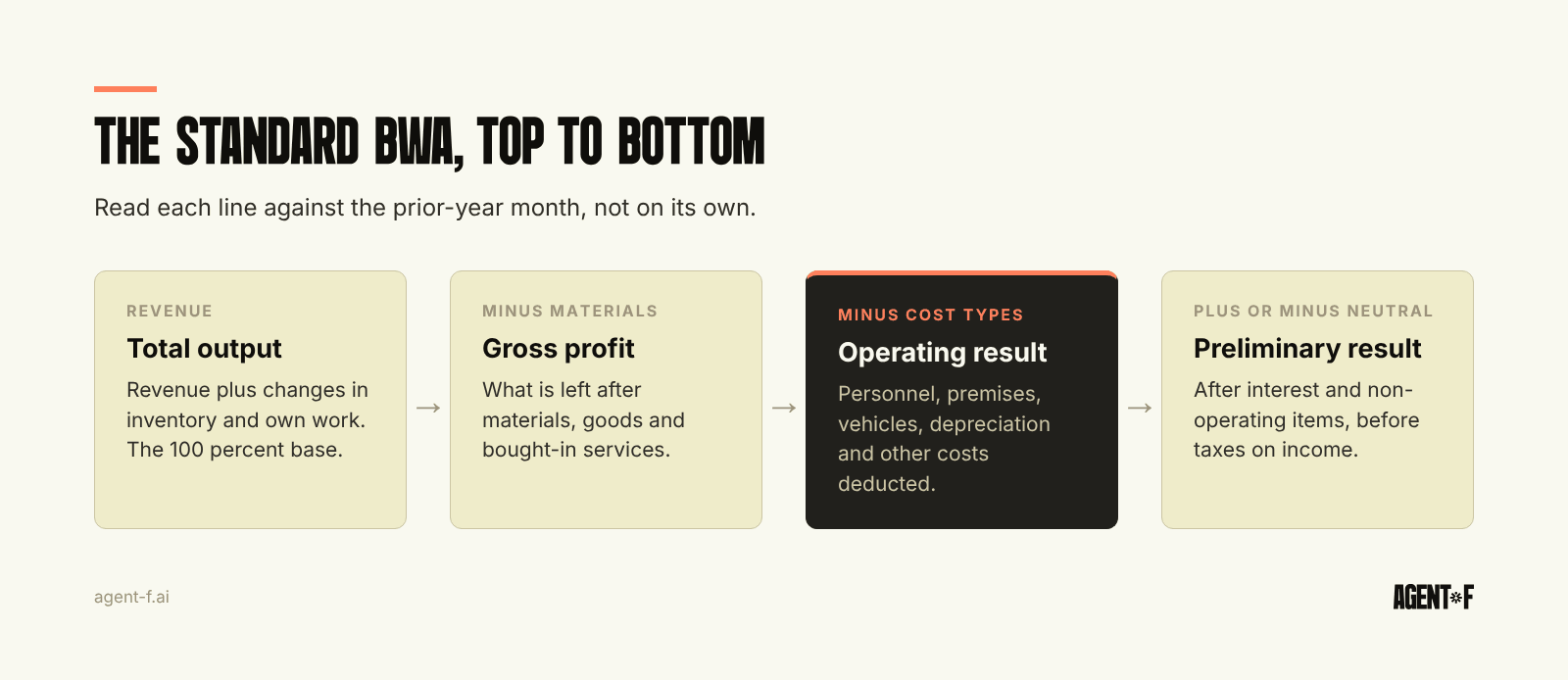
The standard BWA runs from top to bottom, from revenue to a preliminary result:
- Revenue (Umsatzerlöse): net sales for the month.
- Changes in inventory and own work capitalised: work in progress or finished goods built up or reduced.
- Total output (Gesamtleistung): revenue plus these changes. Many BWAs show every other line as a percentage of this figure.
- Cost of materials and goods (Material- und Wareneinsatz): what you bought in to produce or resell.
- Gross profit (Rohertrag): what is left to pay for the rest of the business.
- Cost types (Kostenarten): personnel, premises, vehicles, advertising, insurance, depreciation, repairs and other costs, each on its own line.
- Operating result (Betriebsergebnis): gross profit minus the cost types.
- Neutral items and interest: income and expenses unrelated to the core business, such as interest or gains on asset sales.
- Preliminary result (vorläufiges Ergebnis): the bottom line before taxes on income.
Next to each line you usually see the current month, the year to date, and the same periods of the prior year. Reading the BWA well mostly means reading the columns: a month alone says little, a month against its prior-year month says a lot.
The word "preliminary" deserves attention. The result is only as good as the bookings behind it. If supplier invoices for October services arrive in November, October looks better than it was and November worse. Year-end entries such as provisions and some depreciation are often only booked at the end of the year, which makes the monthly result look higher than the annual one will be. Booking accruals at month-end fixes most of the distortion.
What can the BWA not tell you?
The BWA is organised by cost type, because it follows the chart of accounts. It tells you how much was spent on personnel. It does not tell you which product, customer, project or location the personnel worked for. For a single-line business that is fine. For a company with two product lines, three entities or a mix of subscription and project revenue, the most important questions stay unanswered.
Typical blind spots:
- Margin per product or customer. The BWA shows one gross profit for the whole company.
- Cost centres. Some tax advisors can add a cost centre view, but only if the cost centres are booked consistently.
- Several entities side by side, with intercompany items removed.
- Cash. The BWA shows results, not liquidity. A profitable month can still drain the bank account.
- Your own KPIs, such as EBITDA as you define it or recurring revenue.
The BWA was designed as a standard report for the whole client base of a tax firm. For the view the business actually needs, see management reporting without Excel, and for the KPIs that go beyond it, financial KPIs for a growing company. How the chart of accounts shapes what any report can show is covered in setting up SKR03 or SKR04.
Why does the BWA arrive so late?
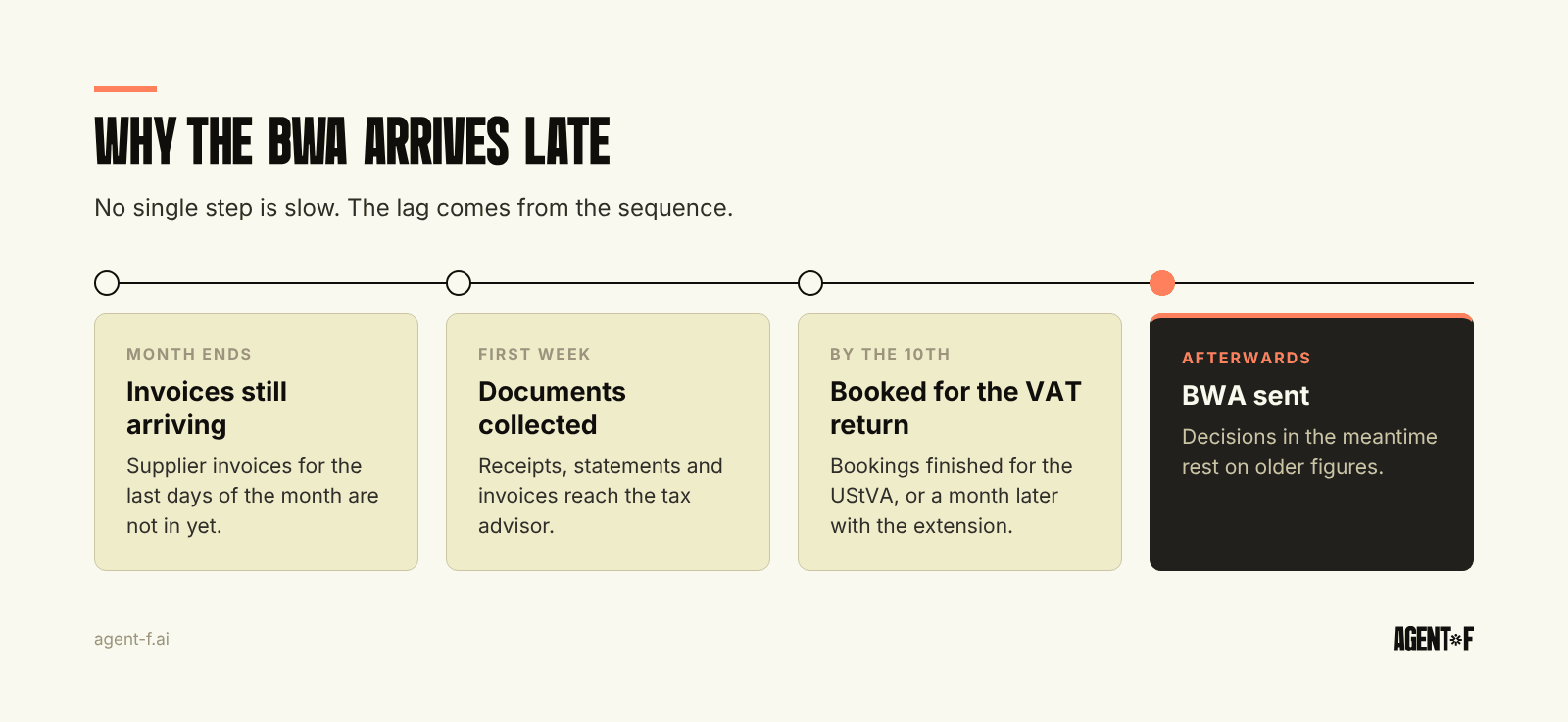
The lag is built into the process, and no single step is to blame:
- The month ends. Supplier invoices for the last days of the month are still arriving.
- Documents are collected. Receipts, bank statements and invoices reach the tax advisor, often in the first week of the next month, sometimes later.
- The tax advisor books. The work sits in a queue with other clients, and questions about unclear items go back and forth.
- The advance VAT return is filed. The UStVA is due on the tenth day after the period, or a month later with a permanent extension (Dauerfristverlängerung). Many tax firms finish the bookings for the VAT return first and send the BWA afterwards.
- The BWA is sent. For companies with the extension, that can be well into the second month.
The result is that decisions in November are made on September's figures, or on a gut feeling. We describe the business consequences of that lag in real-time financial reporting.
How can you get a useful BWA sooner?
Some improvements need no new software. Send documents continuously instead of once a month. Agree with your tax advisor on a fixed delivery date and a short list of open questions instead of a long email thread. Ask for the BWA with prior-year comparison and cumulative figures, and, if you book cost centres consistently, for a cost centre view.
It also helps to ask your tax advisor three questions once. Which BWA form do you use for us, and why? Are costs that belong to the month booked in that month, or when the invoice arrives? Which entries are only made at year-end, so that we know how far the monthly result will move? The answers explain most of the surprises people later find in the annual financial statements, and they cost one meeting.
The larger step is to stop treating the BWA as the only management report. If the bookkeeping is current in your own system, the same figures exist every day. The BWA then becomes what it should be: a standard report for the bank and the tax advisor, produced from books that are already up to date.
How does Agent F produce the BWA from the live ledger?
In Agent F, the BWA is one of the standard reports built from the general ledger, so it is available continuously rather than once a month. Alongside it, the same bookings feed reports per cost centre and entity that the BWA cannot show. When a figure moves, you can ask in plain language what changed and drill down to the bookings behind it. The DATEV export to the tax advisor comes from the same ledger, so their BWA and yours agree.
A practical first step: take your last three BWAs and note the date each one arrived. Then mark which lines you actually used for a decision, and write down the three questions the BWA could not answer.
Learn how Agent F works, or see it on your own books at agent-f.ai/demo.
This article is for general information only and does not constitute tax or legal advice. Parts of it were generated with AI. Please consult your tax advisor or legal counsel before acting on it, and feel free to reach out at team@agent-f.com with any questions or for support.