Updated
Flux analysis: explaining month-over-month variances without a week of Excel

Flux analysis compares each account's balance or activity with an earlier period and explains every change that is large enough to matter. It is a close control and a reporting tool at once: it catches bookings in the wrong account or month before the numbers leave finance, and it produces the commentary that tells management why costs or revenue moved. The arithmetic is trivial. The explanation is the work.
Most guides to flux analysis assume a US controller with a monthly close and fully accrued books. Many German mid-sized companies work differently: the tax advisor (Steuerberater) books or reviews the month, the BWA (the monthly management report from your tax advisor) is the report everyone reads, and some bookings only arrive at year-end. A useful flux process has to fit that setup, or it explains noise.
What is flux analysis, and how is it different from budget vs actual?
Both compare a number with a reference. The difference is the reference and the owner.
Flux analysis compares actuals with actuals: this month against last month, the same month last year, or the year to date against the prior year. It asks whether the books are right and what happened. It is owned by accounting and runs as part of the close.
Budget vs actual compares actuals with the plan. It asks whether the business is on track. It is owned by controlling or FP&A and runs after the close, on numbers that flux has already checked. We cover it in budget vs actual reporting per cost centre.
The order matters. A budget variance explained on top of a misbooked invoice is a wasted conversation. Flux comes first, so that the budget discussion is about the business and not about the bookkeeping.
Why are month-over-month changes so noisy in a German SME?
Because many movements in a typical BWA have nothing to do with the business. Four sources produce most of the noise.
- Costs booked when the invoice arrives. If an annual insurance premium or a software licence is booked in full in January, January looks expensive and February looks cheap. Without monthly accruals or prepayments, the month-over-month comparison measures invoice timing. The fix is covered in accruals at month-end.
- Year-end-only bookings. Depreciation, provisions and inventory changes are often booked once a year, at the annual accounts. December or the closing period then carries twelve months of cost, and every monthly comparison during the year is missing it.
- Corrections by the tax advisor. When the tax advisor reclassifies bookings after the month was reported, last month's figure changes. A flux that compares this month with a number nobody can reproduce explains a moving target.
- Late documents. Supplier invoices that arrive after the cut-off land in the next month, inflating it and flattering the one before.
None of these are errors in the strict sense. They are reasons why a raw month-over-month comparison in a German SME often produces twenty explanations, of which three are about the business.
Which comparison should you run: last month, last year or year to date?
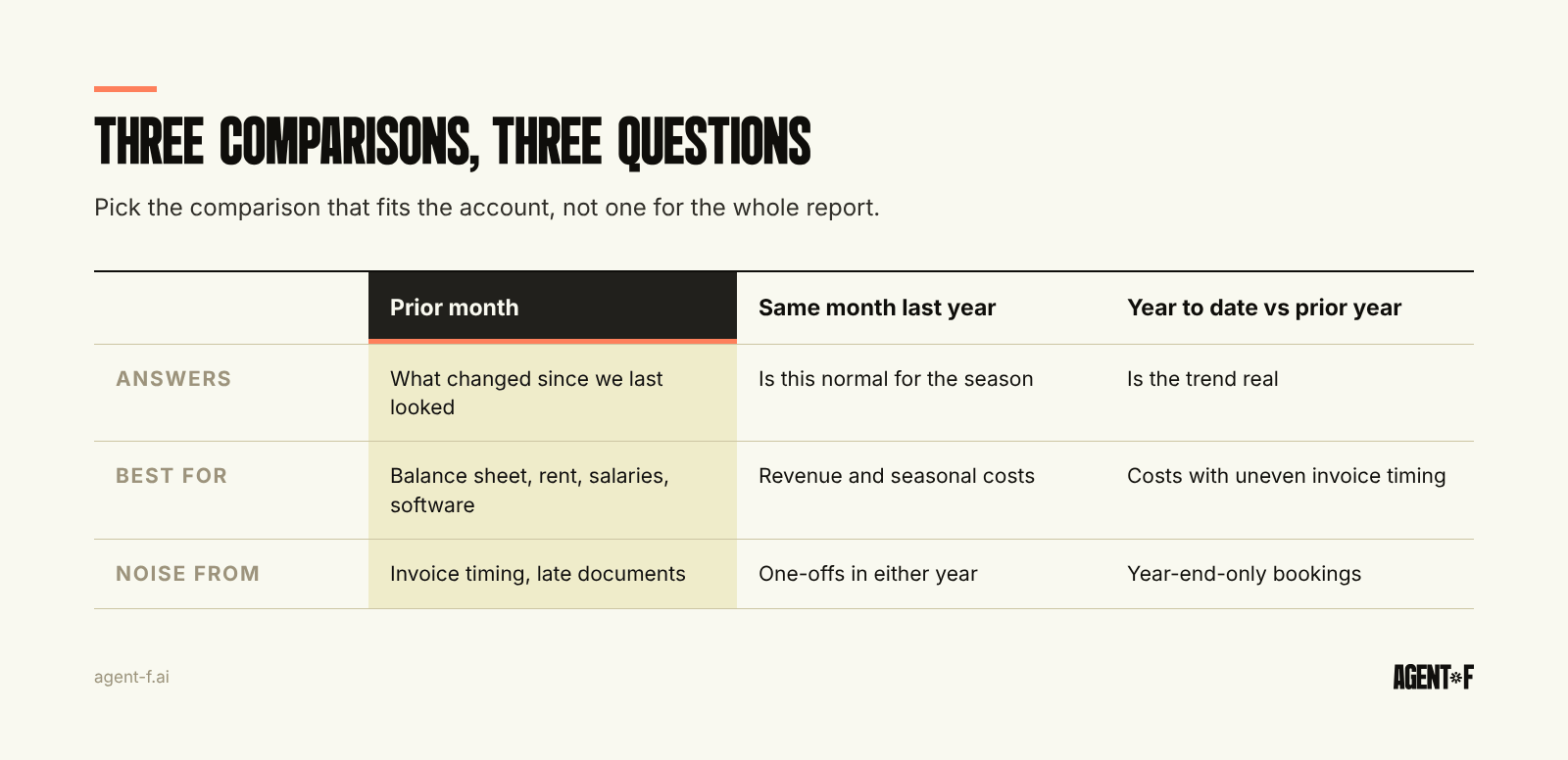
Each comparison answers a different question, and a good flux uses the one that fits the account.
Prior month is the main control for the close. It catches what changed since the last time someone looked: a new supplier, a missing invoice, a cost centre booked wrongly. It works best on accounts that should be stable month to month, such as rent, salaries and recurring software.
Same month last year removes seasonality. For a business with strong seasons, comparing December with November says little, while December against last December says a lot. Most tax advisors can add a prior-year comparison form to the BWA, and many German managers already read their numbers this way.
Year to date against prior year smooths out timing. An insurance premium booked in January looks like a spike month over month but disappears in the cumulative figure. Year to date is where the noise from invoice timing and late documents mostly cancels out. The standard BWA shows the month and the cumulative year side by side, so this view is usually already in front of management.
A practical rule: run prior month for balance sheet accounts and stable costs, same month last year for revenue and seasonal costs, and use year to date as the check before anyone escalates a variance.
How do you decide which variances need an explanation?
Set a threshold per line, not one for the whole P&L. A combination of a fixed amount and a percentage works for most companies: a change needs an explanation if it is above a set euro amount and above a set percentage of the prior figure. The amount stops tiny accounts from producing alarms. The percentage stops large accounts from hiding real changes.
Two additions make the threshold useful in practice. First, include the balance sheet. Receivables, payables, clearing accounts and the VAT accounts move every month, and an unexplained movement there is often the first sign of a booking problem. Second, flag lines that should have moved and did not. A month without a rent booking or without a payroll entry is a variance of zero that matters more than most of the others.
The margin side of the same exercise, splitting changes into price, volume and mix, is covered in P&L analysis.
What does good variance commentary look like?
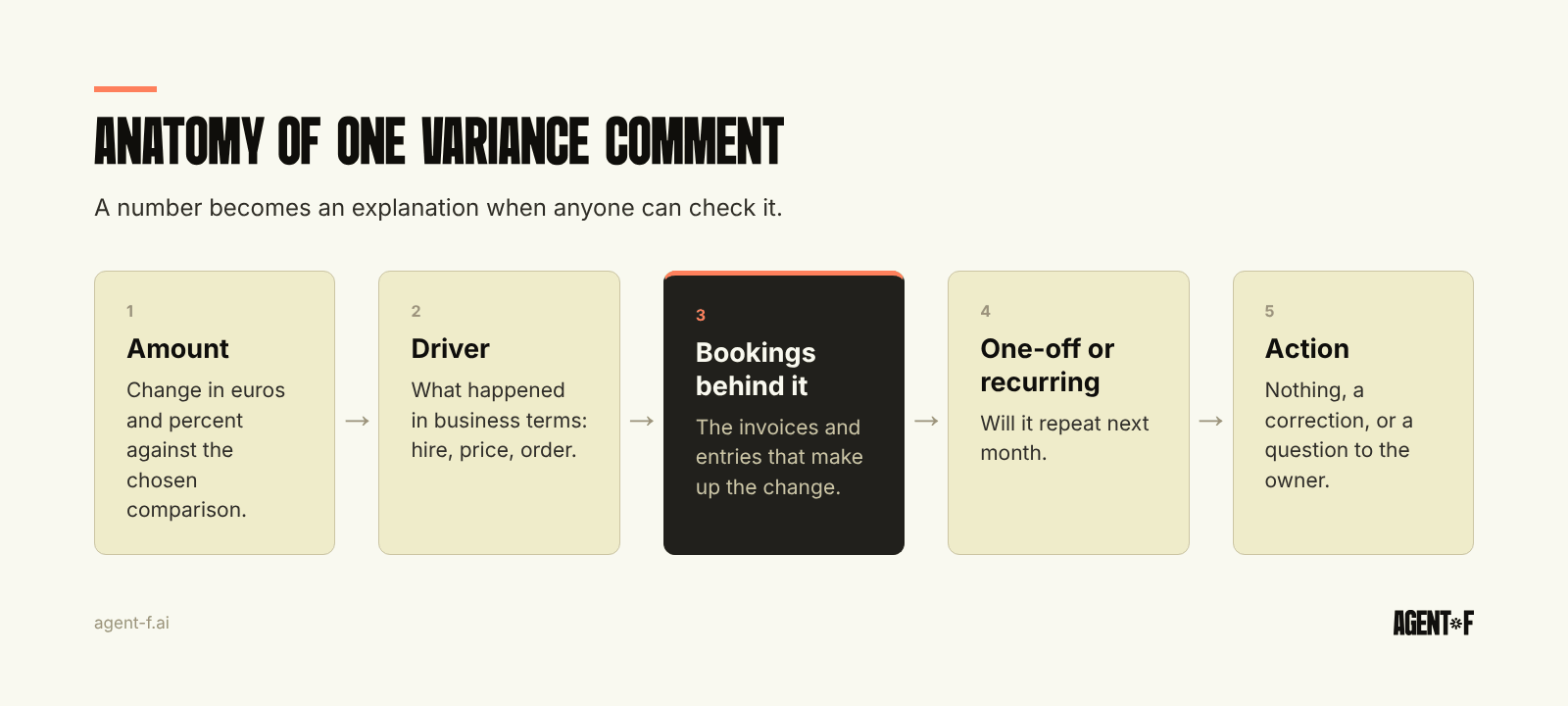
Commentary that holds up in a management meeting or with an auditor has five parts:
- The amount. The change in euros and percent against the comparison you chose.
- The driver. What happened, in business terms: a new hire, a price increase, a large order.
- The bookings behind it. The invoices or entries that make up the change, so anyone can check it.
- One-off or recurring. Whether the change will repeat next month, which is what management actually wants to know.
- The action. Nothing, a correction in the books, or a question for the cost centre owner.
"Other operating expenses up 18,000 euros" is a number. "Consulting costs up 18,000 euros, of which 15,000 is a one-off project invoice booked in full and to be spread over three months, 3,000 recurring" is an explanation. Writing the second version takes minutes if the bookings are at hand and an hour if someone has to rebuild them from an export. A comment that refers to a booking still to be corrected also belongs on the close list, so the fix happens before the report goes out, as in the month-end close checklist.
How does Agent F help with the variance commentary?
In Agent F, reports run on live ledger data, so there is no export and no workbook to rebuild. Custom reports can put this month next to last month, the same month last year or the year to date, and the bookings behind each change sit in the same system. Anomaly detection flags unusual entries for review, and you can ask in plain language what drove the change in an account instead of filtering an export.
The comment itself stays with the controller, who knows the business driver behind the number. Every AI suggestion comes with a confidence score, nothing is booked without approval, and everything is recorded in the immutable audit trail. If a variance turns out to be a missing accrual, the month-end close suggests accruals with a confidence score, and the correction is booked after approval rather than explained away. Because the BWA is built from the same ledger, the commentary refers to the same numbers your tax advisor sees, as explained in reading the BWA.
To start, choose one comparison per account group, set a threshold per line, and add the balance sheet accounts you currently skip. Agree with your tax advisor when corrections for a month are final, so last month's figures stop moving. Then write the commentary in the five-part form for one close and see how many lines were actually about the business.
Learn how Agent F works, or see it on your own monthly numbers at agent-f.ai/demo.
This article is for general information only and does not constitute tax or legal advice. Parts of it were generated with AI. Please consult your tax advisor or legal counsel before acting on it, and feel free to reach out at team@agent-f.com with any questions or for support.