Updated
Unannounced VAT inspections (Umsatzsteuer-Nachschau) and tax audits

The Umsatzsteuer-Nachschau is an unannounced VAT inspection under § 27b of the German VAT Act (UStG). A tax official may enter your business premises during working hours, ask for VAT-related records, invoices and data, and view them directly in your accounting system. If the findings give cause, the inspection can turn into a formal tax audit on the spot, without the usual written audit order.
Most companies prepare for a tax audit when the letter arrives. For a Nachschau there is no letter, so the only preparation that works is books that are in order every month, not just at year-end.
What is an Umsatzsteuer-Nachschau, and how is it different from a tax audit?
German tax authorities have several ways to check a company. The three that matter for VAT are easy to mix up.
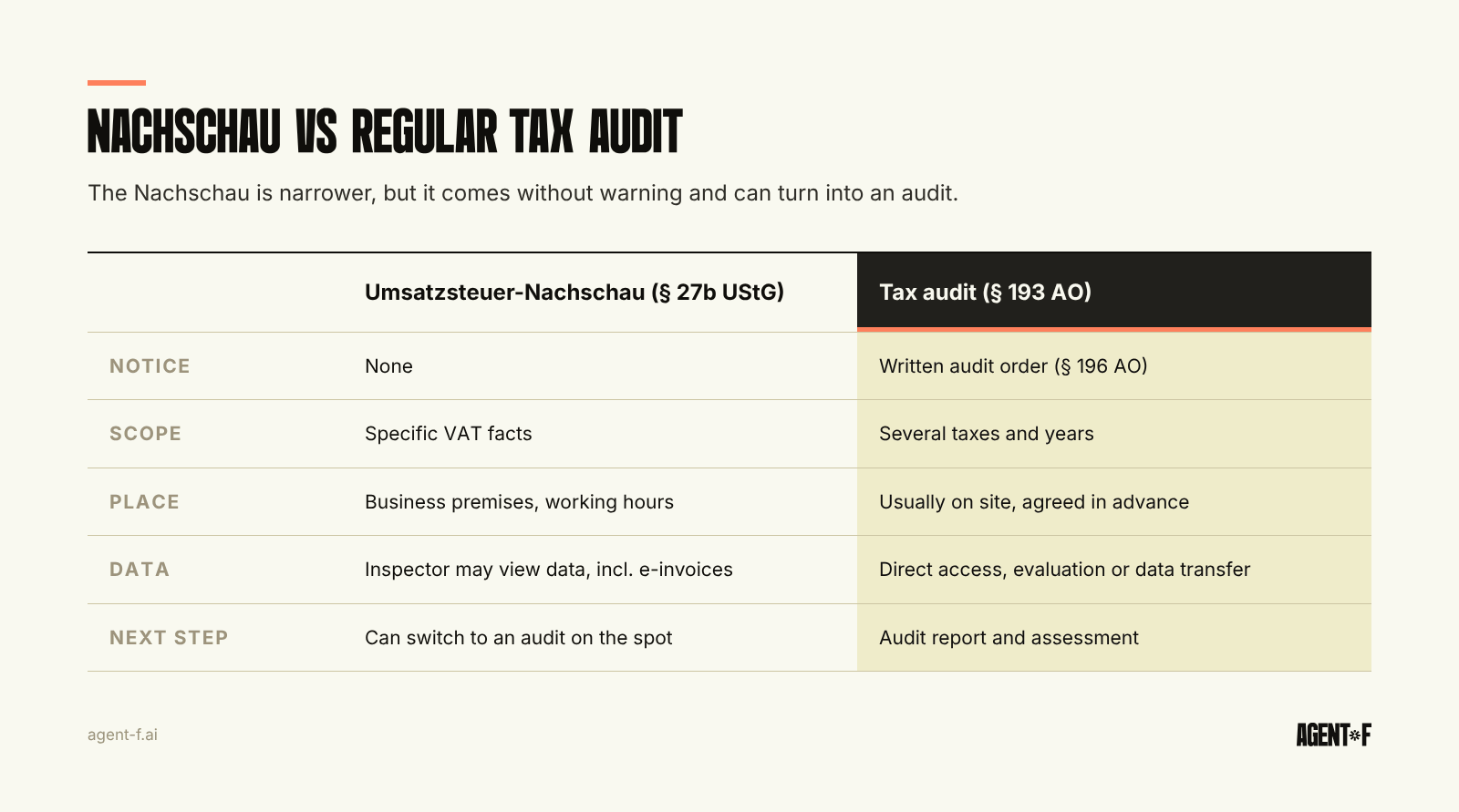
The regular tax audit (Außenprüfung, Betriebsprüfung). It is announced in writing with an audit order (Prüfungsanordnung) under § 196 of the Fiscal Code (AO). The order names the taxes, the years and the start date. It usually covers several taxes and several years.
The VAT special audit (Umsatzsteuer-Sonderprüfung). A formal audit limited to VAT, often for a few months or a specific issue such as a large refund. It is also announced with an audit order.
The Umsatzsteuer-Nachschau. No announcement and no audit order. The inspector comes to establish specific VAT facts: does the business exist, are the goods there, does the invoice match what was delivered. It is shorter and narrower than an audit, but it has two consequences that make it serious. First, under § 27b Abs. 3 UStG, the inspector can move straight to a formal audit, announced in writing at that moment. Second, facts found during the Nachschau that matter for other taxes may be used for those taxes too.
What may the inspector see during a Nachschau?
The rights are set out in § 27b UStG. The inspector may enter business premises and land during business and working hours. Residential rooms are protected and may be entered against your will only to prevent urgent danger to public safety.
On request, you must show records, books, business papers and other documents on VAT matters, and answer questions. If the records are kept electronically, the inspector may view the stored data and, where necessary, use your system to do so. The law explicitly includes e-invoices. With the e-invoicing mandate in place, that means the XML files and their link to the bookings are part of what can be inspected on short notice.
In practice, an inspector at the door will typically want to see a few specific things: the supplier invoice for a large input VAT claim, proof that the asset exists and is used in the business, the outgoing invoices for a period, and how they appear in the advance VAT return. Agree internally who talks to the inspector, who calls the tax advisor (Steuerberater), and who can open the system. A ten-minute delay to reach the right person is normal. An hour of searching for a folder is not.
When do inspections typically happen?
The tax office does not have to give a reason for a Nachschau. It does not follow a schedule either. In practice, inspections are often linked to situations where the authority wants to check facts before money flows: a newly founded company claiming a large input VAT refund, an unusual jump in refunds, or inconsistencies between a company's returns and the data reported by its business partners.
For growing companies, the first scenario is the most relevant. A startup that invests heavily in its first year, buys equipment or fits out a production site will claim more input VAT than it pays. That is entirely legitimate, and it is also exactly the pattern the tax office wants to verify. The input VAT is only safe if every invoice behind it meets the requirements, which are covered in input VAT deduction and invoice requirements in Germany.
What does the auditor expect from your data?
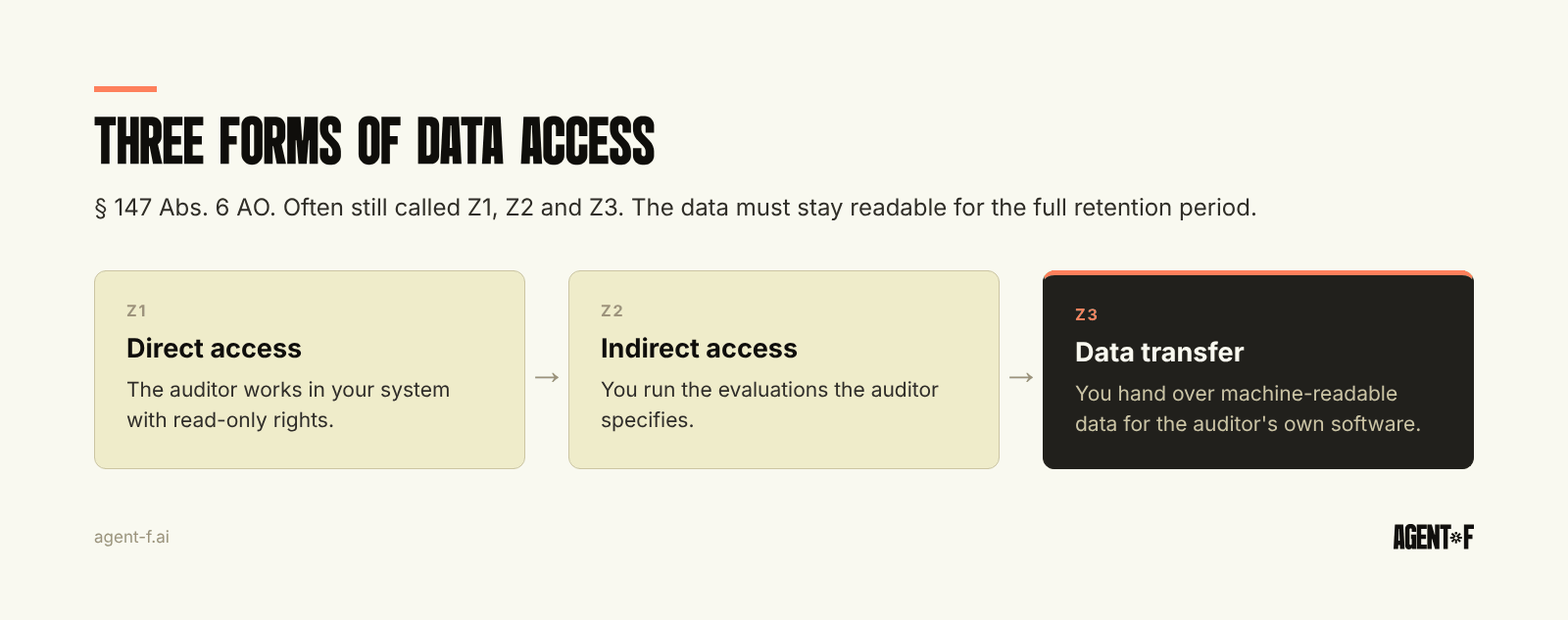
In a formal audit, § 147 Abs. 6 AO gives the tax authority three forms of access to data kept in a computer system. They are still often called the GDPdU access types, after the former administrative rules, and described as Z1, Z2 and Z3.
- Direct access (Z1). The auditor works in your system with read-only rights and runs their own queries.
- Indirect access (Z2). The auditor tells you which evaluations to run, and you or your tax advisor run them in your system.
- Data transfer (Z3). You hand over the data in a machine-readable format, which the auditor analyses with their own software.
If the data sits with a third party, such as your tax advisor's systems, that third party must provide the same access. The costs are yours.
The data must be available for the whole retention period. Under § 147 Abs. 3 AO, books, financial statements and the records behind them are kept for ten years, accounting vouchers such as invoices for eight years, and business correspondence and other tax-relevant documents for six years. A system change does not shorten this: old data must still be readable and evaluable. The archiving side is covered in archiving invoices under GoBD.
Auditors also expect a clear trail. From an amount in the VAT return, they want to reach the booking, the invoice, the payment and, for goods, the delivery. Under the GoBD (German digital bookkeeping rules), the process behind this trail should be described in a process documentation (Verfahrensdokumentation). Many SMEs do not have one, and it is one of the first documents an auditor asks for.
What happens if you cannot deliver quickly?
Delays in an audit have become more expensive. Since recent changes to the AO, the auditor can issue a qualified request for cooperation (§ 200a AO) once six months have passed after the audit order was announced. If you do not comply within one month, a delay penalty (Mitwirkungsverzögerungsgeld) of 75 euros for each full day applies, for up to 150 days. Larger companies can face an additional surcharge.
The bigger risk is quieter. If records are incomplete or cannot be evaluated, the tax office may estimate the tax base. Estimates are rarely in the taxpayer's favour, and disputing them takes far longer than producing the data would have.
The practical lesson is that audit readiness is the state your books are in after every monthly close: invoices attached to bookings, VAT reconciled to the return, and data exportable without manual work.
How does Agent F help you stay audit-ready?
In Agent F, every booking is linked to its source: the invoice, including the original e-invoice XML, the payment, the purchase order and the goods receipt where they exist. An inspector's question about a specific input VAT amount leads from the VAT return to the booking and the document in a few clicks, not through folders and email.
Invoices are checked against the § 14 UStG requirements on receipt, before approval and payment. AI suggestions for accounts, VAT treatment and matching carry a confidence score and are approved by a person, and every step, including changes, is kept in the immutable audit trail. Data is hosted in Germany, and the books go to your tax advisor as a DATEV export, as described in the DATEV export. Because everything sits in one ledger, the data an auditor asks for does not have to be assembled from several tools first.
To get ready now, name the people who receive an inspector and agree the steps with your tax advisor. Pick three large input VAT amounts from last quarter and time how long it takes to show the invoice, booking and payment for each. Check whether you could export last year's ledger in a machine-readable format today, and whether a process documentation exists. If any of these takes more than a few minutes, start there.
Learn how Agent F works, or see it on your own books at agent-f.ai/demo.
This article is for general information only and does not constitute tax or legal advice. Parts of it were generated with AI. Please consult your tax advisor or legal counsel before acting on it, and feel free to reach out at team@agent-f.com with any questions or for support.