Updated
Payroll accounting: how payroll reaches your general ledger

Payroll accounting is the step that turns a payroll run into bookings: gross salaries and employer social security as expenses, and net pay, wage tax and social security contributions as liabilities until they are paid. In Germany, payroll is usually run by the tax advisor or a payroll provider, so finance receives a payroll journal each month and has to book it to the right accounts, cost centres and period.
The payroll run itself is rarely the problem. The problem is the hand-off: a PDF or a booking file arrives late, lands as one lump sum on one cost centre, and bonuses appear in the month they are paid instead of the month they were earned. That is where the management numbers go wrong.
What does payroll accounting actually book?
Every payroll run produces the same structure, whatever the software. On the expense side there are two blocks:
- Gross wages and salaries, including bonuses, overtime and taxable benefits.
- Employer social security: the employer's share of pension, unemployment, health and long-term care insurance, plus statutory accident insurance and the levies for sick pay and maternity cover.
On the liability side, the same total is split by who is owed the money:
- Net pay owed to employees until the salary transfer goes out.
- Wage tax, solidarity surcharge and church tax owed to the tax office.
- Social security contributions, employee and employer share together, owed to the health insurance funds.
- Other deductions, such as company pension contributions or garnishments, owed to third parties.
When the payments leave the bank, the liabilities are cleared. If one of these accounts does not return to zero after a month, something was booked twice, paid twice or never paid. Keeping these clearing accounts separate makes that check a one-minute task.
Which deadlines shape the payroll month?
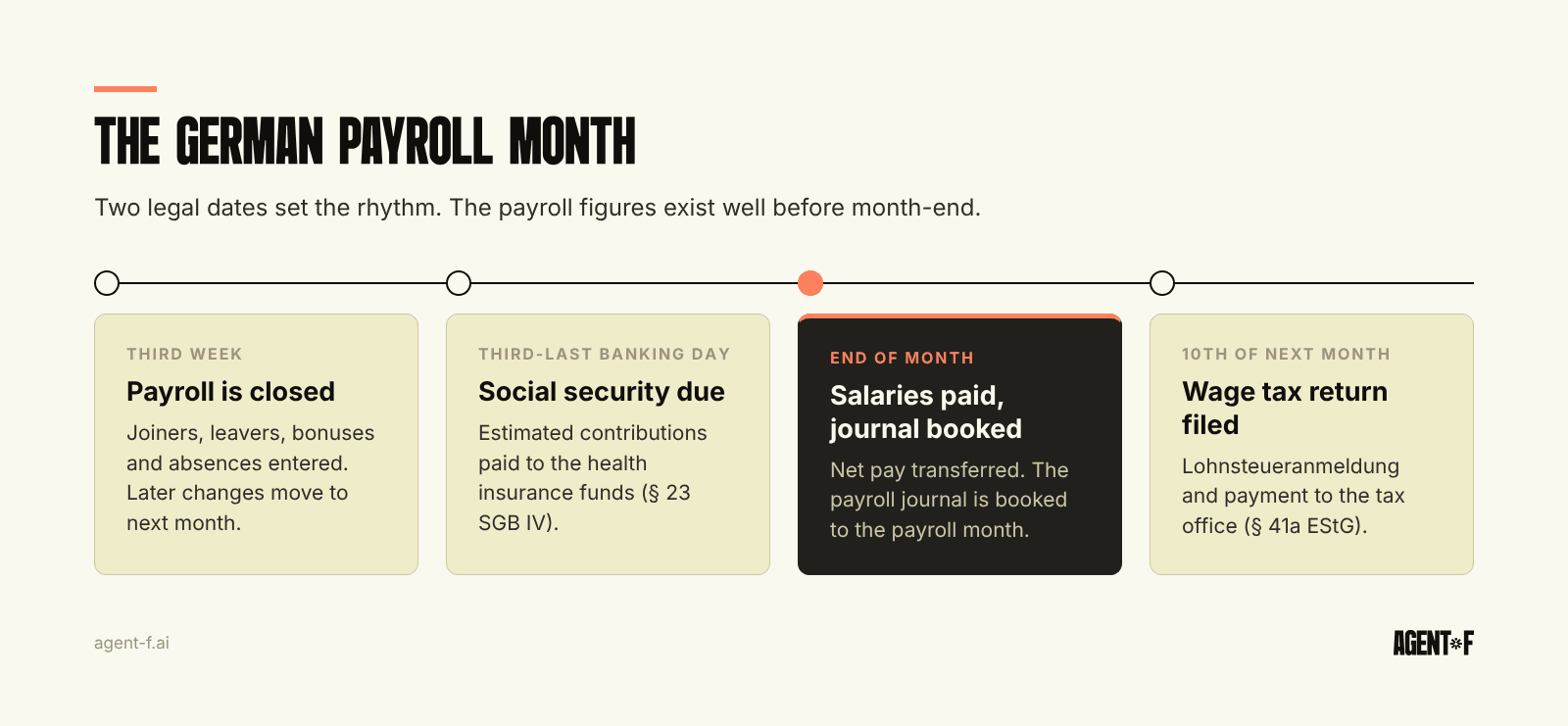
German payroll runs to two fixed dates, and both come from law rather than from the payroll provider.
Social security is due on the third-last banking day of the month in which the work is done, at the estimated amount (§ 23 SGB IV). Any difference is settled on the same day of the following month. The contribution statement has to reach the funds a few working days before that date, which is why payroll for a month is usually closed in its third week. Late joiners, leavers and bonuses that come in after that point are corrected the following month.
The wage tax return (Lohnsteueranmeldung) is due by the tenth day after the end of the filing period (§ 41a EStG). Monthly filing is the rule. Quarterly filing applies if the previous year's wage tax was more than 1,080 euros and not more than 5,000 euros, and annual filing at or below 1,080 euros.
For finance, this means the payroll figures exist well before month-end. There is no reason for payroll to be the last item on the month-end close checklist, other than the journal arriving in a form nobody can book quickly.
How does the payroll journal get into the ledger?
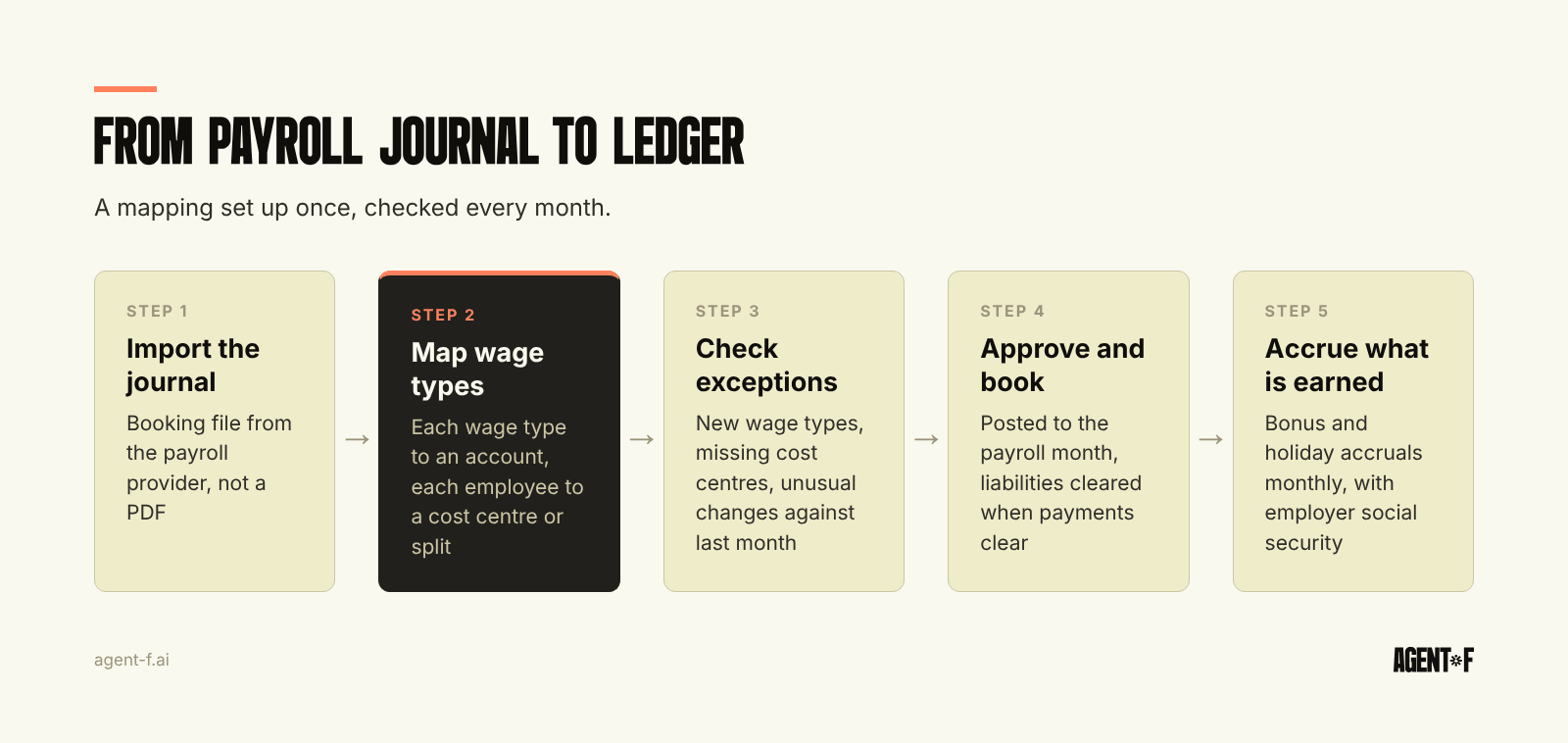
If your tax advisor (Steuerberater) runs payroll in DATEV, the payroll programme produces the payroll journal (Lohnjournal) and a booking file. When the tax advisor also does your bookkeeping, those bookings go straight into their DATEV accounting, and you see them in the next BWA (the monthly management report from your tax advisor). When you keep the books yourself, you receive the journal and have to book it.
That is where three things usually go wrong:
- One line instead of many. The journal is booked as a single total to "salaries", with no split by department or project. Every cost-centre report then needs a manual allocation.
- Wage types mapped by memory. Payroll works with wage types (Lohnarten): base salary, bonus, company car, pension contribution, sick pay. Each needs a fixed account and a rule for the cost centre. When the mapping lives in one person's head, it changes every time that person is on holiday.
- The wrong period. Payroll for October that arrives on 5 November is booked in November.
The fix is a mapping, set up once and checked monthly: each wage type to an account, each employee to a cost centre or a split across several, and the posting date fixed to the payroll month. Who does what between you and your tax advisor is covered in working with your tax advisor.
How should bonuses and other payroll accruals be booked?
Bonuses are the classic distortion. A sales team earns a bonus over the year, and payroll pays it in March of the next year. If nothing is booked before March, the previous year's profit is too high and March looks like a disaster.
Under the German Commercial Code (HGB), a bonus that the company owes but whose exact amount is not yet fixed is an uncertain liability, and § 249 HGB requires a provision (Rückstellung) for it at year-end. For monthly management reporting, the same logic should run every month: book one twelfth of the expected annual bonus, or the amount earned to date, and adjust when targets are measured. Include the employer's social security on top, since it is due when the bonus is paid.
The same applies to other payroll costs that build up quietly: holiday not yet taken at year-end, overtime balances, and agreed salary increases paid retroactively. The general approach to accruals at month-end applies here too. With these accruals in place, personnel costs in your budget vs actual report show what the team really costs, month by month.
What changes every January?
Payroll has more annual changes than most finance processes. Contribution ceilings (Beitragsbemessungsgrenzen) rise each year, health insurance funds change their additional contribution rates, and the minimum wage and the mini-job limit tied to it move as well. Your payroll provider handles the calculation. Finance should check the effects: higher employer costs for well-paid staff, a new average contribution rate in the budget, and a January payroll journal that looks different from December's for reasons that have nothing to do with headcount.
A short January review of the payroll journal against December, by wage type, catches mapping gaps before they reach the reports.
How does Agent F bring payroll into the ledger?
In Agent F, payroll is connected to the general ledger on the same data model as budgets, cost centres and workforce planning. Each month the payroll journal, for example from your tax advisor's DATEV payroll, is imported. Agent F maps each wage type to the account and each employee to the cost centre from your previous months and your HR data, with a confidence score per line. New wage types, new employees without a cost centre and amounts that differ sharply from the prior month are flagged for review.
A person checks and approves the batch, and the bookings are posted to the payroll month. Net pay, wage tax and social security liabilities are cleared automatically when the payments appear in the bank feed. At month-end, Agent F suggests the bonus and holiday accruals from the data already in the system, again as suggestions that someone approves. Everything is recorded in the audit trail, and the bookings flow into the DATEV export for your tax advisor.
To start, ask your payroll provider for the journal as a booking file rather than a PDF, write down the mapping of your ten most common wage types, agree a fixed date by which the journal reaches finance, and book the expected annual bonus monthly from January. If personnel costs are your largest expense, these four changes do more for your management numbers than any new report.
Learn how Agent F works, or see it on your own payroll data at agent-f.ai/demo.
This article is for general information only and does not constitute tax or legal advice. Parts of it were generated with AI. Please consult your tax advisor or legal counsel before acting on it, and feel free to reach out at team@agent-f.com with any questions or for support.