Updated
Purchase order approval: checking plan vs actual before you order
Purchase order approval is the step where a person with budget responsibility confirms an order before it goes to the supplier. It only works as a budget control if the approver sees the remaining budget at that moment: plan, minus costs already booked, minus orders placed but not yet invoiced. Without those open orders, the budget looks healthier than it is until the invoices arrive.
Most approval designs focus on who signs and up to what amount. The more useful question is what the approver sees when they sign. Open orders, called commitments or Bestellobligo in German controlling, are the missing number. They matter for the budget, for the liquidity plan and, at year-end, for the annual accounts.
Why does the budget report look fine until the invoices arrive?
Budget reports are built from the ledger, and the ledger only knows what has been booked. An order creates an obligation on the day it is placed, but it reaches the books weeks or months later, when the invoice arrives. In between, the money is spent in every sense except the accounting one.
For direct materials with long lead times, the gap can last most of a year. For indirect spend, it hides in annual contracts: an agency retainer signed in January, a trade fair booked for next spring, a software licence paid annually in advance. The BWA (the monthly management report from your tax advisor) shows none of these until they are invoiced.
The result is a familiar conversation. Management asks a department to cut spending for the second half of the year, and the department head explains that most of it is already contracted. The budget was committed where nobody could see it. This is the gap our article on budget vs actual reporting describes from the reporting side.
What should the approver see at the moment of ordering?
One number, calculated for the cost centre and period the order belongs to:
Available budget = plan − booked actuals − open commitments
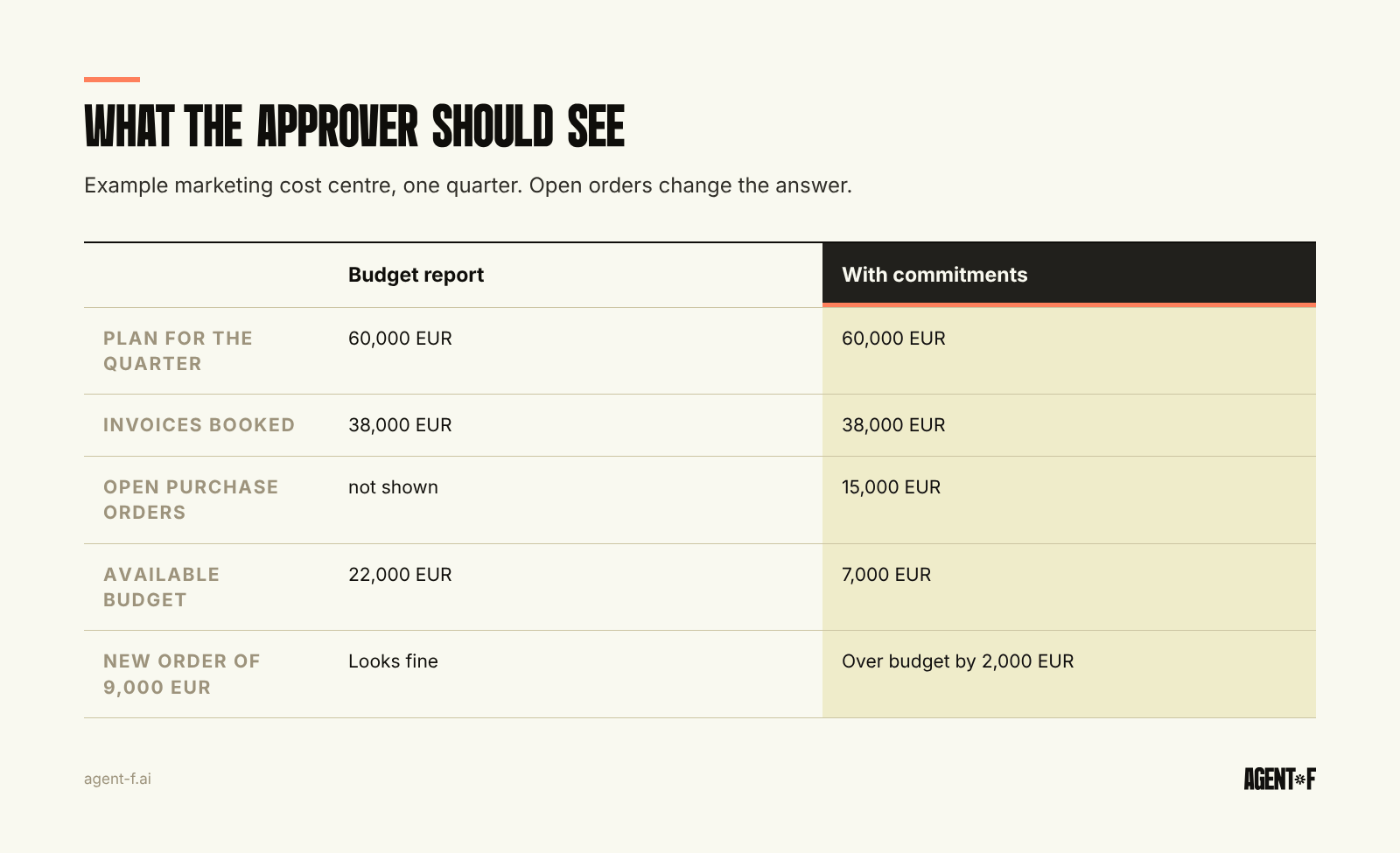
Take a marketing cost centre with a quarterly plan of 60,000 euros. Invoices booked so far come to 38,000 euros. Three approved orders that have not been invoiced add up to 15,000 euros. The budget report shows 22,000 euros left. The real figure is 7,000. An approver looking at a new order of 9,000 euros needs to see the second number, not the first.
Three details make the number reliable:
- The right period. An annual contract invoiced monthly should consume each month's budget, not the full year in the month of signing.
- The right dimension. If the order is coded to a cost centre and project, the check runs on both. A cost centre structure that matches your reporting is the precondition, covered in cost centre accounting.
- Net amounts. For a company entitled to deduct input VAT, the budget is consumed by the net amount, so the check should be too.
How should purchase order approval rules be set up?
A single limit for everyone either slows down small purchases or waves through large ones. A rule set that works in a 50-person company usually has four parts.
- Value thresholds. Small routine orders within budget need the requester's own budget owner, or no approval at all. Larger orders add the head of department, and the largest add the managing director (Geschäftsführer).
- Budget status. An order that fits the remaining budget follows the normal route. An order that exceeds it goes to whoever can move budget, with the overrun shown, rather than being blocked without explanation.
- Category. IT hardware, software subscriptions and external consultants often need a second look from a specialist, regardless of amount, because they create recurring costs or data risks.
- Changes. An order whose amount rises after approval goes back through approval. Otherwise the limit can be bypassed by approving a small order and raising it later.
Watch for split orders as well. Three orders of 4,900 euros to the same supplier in a week, under a 5,000 euro limit, are one decision. A good process flags them. The wider flow from request to payment, and the checks before an order goes out, are in procure to pay.
What happens to a commitment after the order is placed?
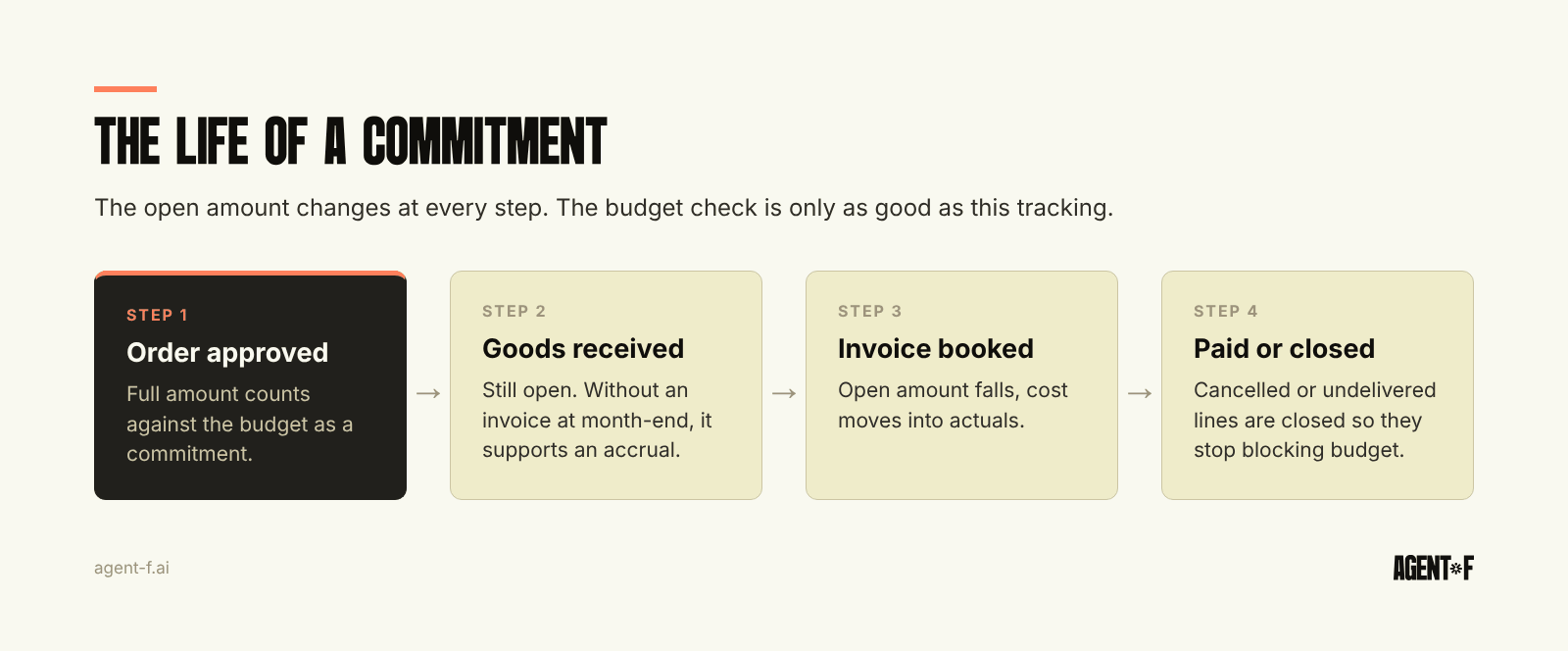
A commitment is not a fixed number. It changes with every step, and the budget check is only as good as that tracking.
When goods or services are received, the commitment stays but becomes a confirmed obligation. When the invoice is booked, the open amount falls by the invoiced amount and the cost moves into actuals. Partial deliveries and partial invoices reduce it step by step. A cancelled order or a line that will never be delivered should be closed, otherwise it keeps blocking budget. Price differences between order and invoice need a decision: accept, dispute or re-approve.
Month-end adds one more case. If goods arrived or a service was performed but the invoice has not, the cost belongs to this month under the accrual principle of the German Commercial Code (HGB). The open order with a goods receipt is the evidence for that accrual, which is why procurement data makes accruals at month-end easier to book. Orders older than a few months with no receipt and no invoice deserve a quarterly clean-up with their owners.
Why do open purchase orders belong in the liquidity plan and at year-end?
Every approved order is a future payment. With the supplier's payment terms and the expected delivery date, it can be placed in the right week of the liquidity plan long before the invoice exists. That turns the cash forecast from a projection of past patterns into a list of known obligations. We describe the full method in our guide to the 13-week cash flow forecast.
Commitments also appear in the annual accounts. Under § 285 Nr. 3a HGB, companies must state in the notes (Anhang) the total of other financial obligations that are not on the balance sheet, where it matters for assessing the financial position. Small GmbHs are not exempt from this disclosure. Large open orders, long-term contracts and rental obligations are typical parts of it. If commitments are tracked during the year, the figure your tax advisor (Steuerberater) asks for at year-end is a report, not a search through email.
How does Agent F help with purchase order approval?
In Agent F, purchase requests, orders, goods receipts, invoices and the budget sit on one data model. Procurement runs from quotation to purchase order to goods receipt, and budget vs actual per cost centre is built from the same live data, not from last month's export. The approver looks at the same numbers as the finance team.
Approval chains are part of procurement. You define who approves which orders, and every approval is logged in the immutable audit trail with the order. Keep the rule simple at first: one approver for ordinary orders, a second for anything that would take a cost centre past its plan.
Before payment, the three-way match checks order, delivery and invoice. Anomaly detection in the AI layer works on the same data, and like every AI action in Agent F it produces a suggestion with a confidence score for a person to review, never a silent change. The bookings then reach your tax advisor (Steuerberater) through the DATEV export.
To start, pick your three largest cost centres and list every order placed but not yet invoiced. Compare the total with what the budget report shows as remaining. Then agree a rule that orders above a set value must exist in the system before the supplier receives them. If the difference surprises your department heads, the approval step is the place to fix it.
Learn how Agent F works, or see it on your own purchase orders at agent-f.ai/demo.
This article is for general information only and does not constitute tax or legal advice. Parts of it were generated with AI. Please consult your tax advisor or legal counsel before acting on it, and feel free to reach out at team@agent-f.com with any questions or for support.