Updated
Continuous close: what has to be true before a zero-day close is realistic

A continuous close spreads the work of the month-end across the month: bank matching, invoice booking, accruals and depreciation run daily or weekly, so that the close itself becomes a review rather than a production run. A true zero-day close is rare. In Germany, a close of one or two days is realistic once documents arrive on time and the ledger, not a spreadsheet, does the routine work.
The idea comes mostly from large companies with in-house accounting teams. German SMEs work differently: the tax advisor often keeps or reviews the books, and the advance VAT return sets a hard rhythm. That does not make a continuous close impossible. It changes which parts can move into the month and which will always belong to the end of it.
What does a continuous close actually mean?
In a traditional close, the month ends and the work starts. Statements are downloaded, invoices are chased, payments are matched, accruals are calculated in a spreadsheet and the tax advisor receives everything a week later. The numbers for October arrive in late November.
A continuous close turns this around. Most transactions are booked and matched within days of happening. Recurring entries such as depreciation and prepayments are calculated by the system. Accruals for missing invoices are proposed as the month goes on. When the month ends, the remaining work is a short list of open items, a review and the lock.
The phrase "zero-day close" describes the ideal: books final on the first day of the next month. Few companies get there, and it is not the right target for most. The useful goal is that the month-end stops being a crunch.
Which parts of the close can move into the month?
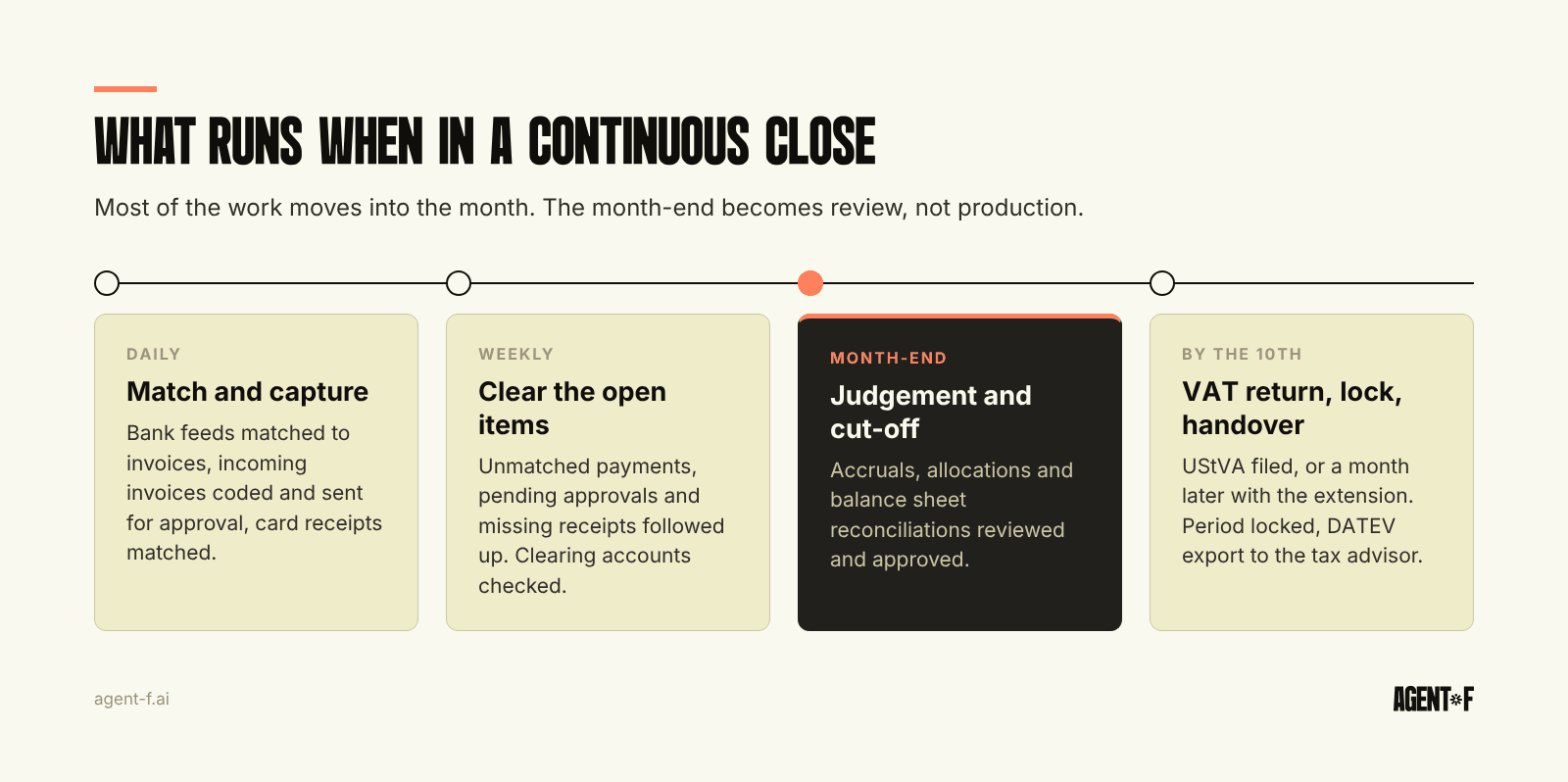
Not every task is equally movable. A practical split for a German company looks like this:
Daily
- Bank transactions arrive through a feed and are matched to invoices and payments.
- Incoming invoices are captured, coded and sent for approval.
- Card payments are matched to receipts.
Weekly
- Open items are reviewed: unmatched payments, invoices waiting for approval, missing receipts.
- Clearing accounts are checked so they do not grow during the month.
At month-end
- Accruals for goods and services received but not invoiced. See our guide on accruals at month-end.
- Depreciation and prepayment releases, if not already posted by schedule.
- Allocations between cost centres and entities.
- Reconciliation of balance sheet accounts that only make sense at a cut-off, covered in balance sheet reconciliation.
- Review, VAT figures, lock and handover to the tax advisor.
The month-end list is shorter, but it never disappears. Some judgements only make sense once the period is over.
Why does a German close still depend on the tax advisor?
In many German SMEs, the tax advisor (Steuerberater) either books the month or reviews it before filing. Either way, their cut-off defines when the month is really closed. The advance VAT return (UStVA) is due on the tenth day after the period, or a month later with a permanent extension (Dauerfristverlängerung). Many advisors lock the period once the return is filed.
The German digital bookkeeping rules, the GoBD, also set a rhythm. Non-cash transactions should be recorded within ten days, and cash transactions daily. Booking a month's non-cash transactions periodically is acceptable if it happens by the end of the following month and the documents are secured in the meantime. In other words, the law already expects most of the work to happen during the month. Handing over a monthly shoebox on the fifth is a habit, and habits can change.
The tax advisor stays involved; what changes is what they receive. If they get raw documents, the close takes as long as their queue. If they get matched, coded bookings with documents attached and a short list of questions, they review instead of research. Our guide to the month-end close process with a tax advisor describes that split.
What has to be true before it works?
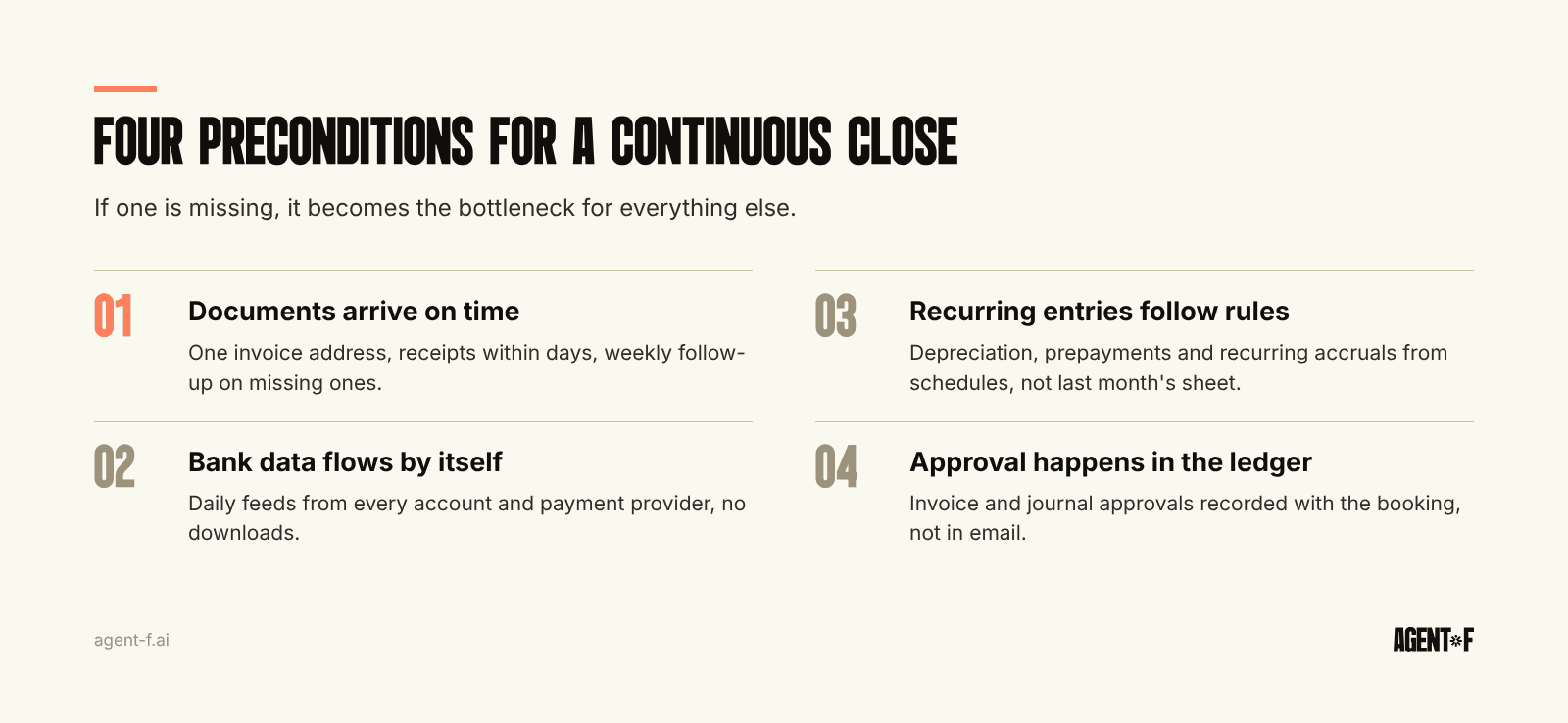
Four conditions decide whether a continuous close is realistic or a slide in a presentation:
- Documents arrive on time. Suppliers send invoices to one address, employees submit receipts within days, and someone follows up on the missing ones weekly, not at month-end.
- Bank data flows by itself. Daily statement feeds from every account, including payment providers. Without them, matching waits for a download.
- Recurring entries follow rules. Depreciation, prepayments and recurring accruals are calculated from schedules in the system, not copied from last month's spreadsheet.
- Approval happens in the ledger. Invoice approvals and journal entry reviews are recorded where the booking is, so the month-end does not start with collecting sign-offs from email.
If one of these is missing, it becomes the bottleneck, and the rest of the automation waits for it. Most companies find the first condition is the hardest, because it depends on people outside finance.
There is also a common trap. Teams automate the visible step, usually bank matching, while the books underneath stay untidy: clearing accounts that have not been explained for months, suppliers recorded twice, cost centres that changed meaning last year. Daily matching on that basis produces daily exceptions, and the team concludes that a continuous close does not work for them. Clean the starting balances once, agree which accounts must be explained every week, and only then increase the frequency.
What changes for the finance team?
The rhythm changes more than the workload. Instead of a quiet three weeks and a stressful one, the team spends a little time every day on exceptions. The work shifts from producing entries to checking them: is this match right, does this accrual make sense, why is this account higher than last month.
That shift has a side effect that matters for management. If the books are current during the month, reporting does not have to wait for the close. A cost overrun in the second week shows up in the second week. Budget owners see their actuals while they can still act. The close stops being the moment the company learns what happened.
The change also needs some discipline from outside finance. Budget owners must approve within days, not at the end of the month, and project leads must flag services received before the invoice arrives. A continuous close is as much a process agreement as a technology.
How does Agent F support a continuous close?
In Agent F, matching, accrual suggestions, depreciation and prepayment schedules run on the general ledger as data arrives, each suggestion with a confidence score for a person to approve. The month-end becomes approval, not production: review the open items, confirm the accruals, prepare the UStVA figures, lock the period and send the DATEV export to the tax advisor. Companies typically move from a 5 to 10 day close to 1 to 2 days. If you are comparing systems, our article on financial close software lists the tests to run.
A sensible first step does not need new software. Pick one task from the month-end list, usually bank matching, and move it to a daily or weekly routine for two months. Measure how many items are still open on the last day. Then do the same with invoice approvals. A month-end close checklist helps you see which tasks remain at the end and why.
Learn how Agent F works, or see it on your own month-end at agent-f.ai/demo.
This article is for general information only and does not constitute tax or legal advice. Parts of it were generated with AI. Please consult your tax advisor or legal counsel before acting on it, and feel free to reach out at team@agent-f.com with any questions or for support.